Atomic Structure — Flashcards
ICSE · Class 8 · Chemistry
36 flashcards for Atomic Structure (ICSE Class 8 Chemistry) to test yourself on key terms and facts. Sample: "What is an atom?"
Interactive on Super Tutor
Studying Atomic Structure? Get the full interactive chapter.
Quizzes, flashcards, AI doubt-solver and a step-by-step study plan — built for flashcards and more.
Free trial, no card needed.
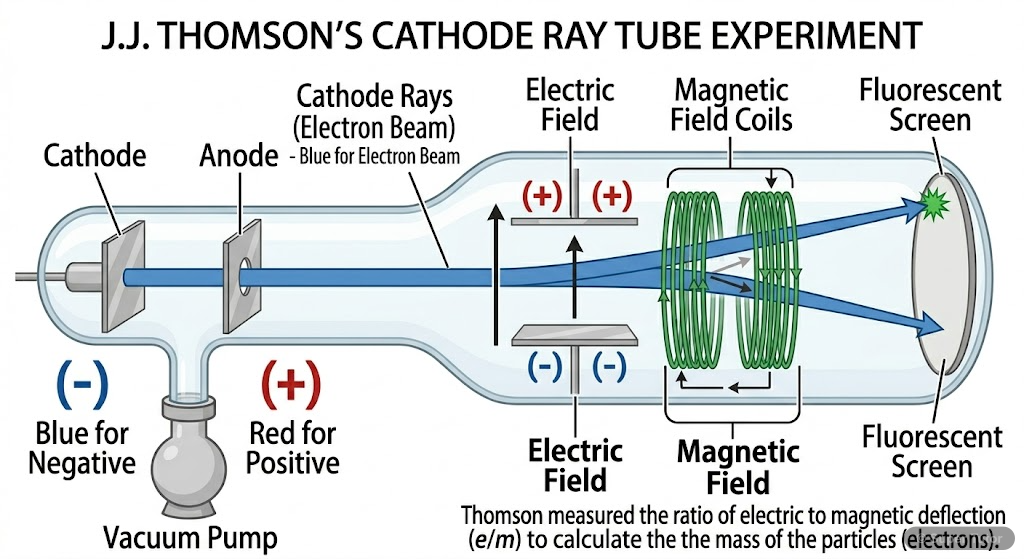
Learn better with visuals Super Tutor pairs illustrations like this with notes and quizzes for Atomic Structure.
What is an atom?
Answer
An atom is the smallest particle of matter that exhibits all the properties of an element. It is the building block of all types of matter and takes part in chemical reactions.
Who proposed that matter consisted of indestructible particles called paramanus?
Answer
Maharishi Kanada proposed that matter consisted of indestructible particles called paramanus, which combine to form anu, now called molecules.
What did Democritus call the paramanu?
Answer
Democritus called the paramanu an atom. The word atom comes from the Greek word atomos, meaning indivisible.
What did John Dalton say about the atom?
Answer
John Dalton described the atom as the smallest particle that exhibits all the properties of a particular element. Later research showed that many parts of Dalton's atomic theory were incorrect, but at…
Why are atoms now known to be divisible?
Answer
Atoms are divisible because they contain smaller particles called electrons, protons, and neutrons. These are called sub-atomic or fundamental particles.
What are the three main sub-atomic particles in an atom?
Answer
The three main sub-atomic particles are electrons, protons, and neutrons.
What is the charge and mass of an electron?
Answer
An electron carries one unit negative charge equal to 1.602×10⁻19 coulombs. Its mass is 9.108×10⁻31 kg, which is about 1/1837 of the mass of a hydrogen atom.
How was the electron discovered?
Answer
Electrons were discovered in 1897 by J.J. Thomson while studying cathode rays. Cathode rays consist of negatively charged particles called electrons.
+28 more flashcards
Practise AllFrequently Asked Questions
What are the important topics in Atomic Structure for ICSE Class 8 Chemistry?
How many flashcards are available for Atomic Structure?
How should I revise Atomic Structure for Class 8 exams?
Sources & Official References
Content is aligned to the official syllabus. Refer to the board website for the latest curriculum.
More resources for Atomic Structure
Practice Quiz
Test yourself with a quick quiz
Important Questions
Exam-style questions with answers
Revision Notes
Key points for last-minute revision
Chapter Summary
Understand the chapter at a glance
Concept Maps
See how topics connect
Study Plan
Step-by-step plan for this chapter
Syllabus
What topics to cover
For serious students
Get the full Atomic Structure chapter — start free.
Quizzes, flashcards, an AI doubt solver and a study plan for ICSE Class 8 Chemistry. Free to start, no card needed.