Atomic Structure — Practice Quiz
ICSE · Class 8 · Chemistry
Try a 4-question quiz on Atomic Structure for ICSE Class 8 Chemistry: tap an answer to check it and see why. 45 questions in the full chapter test.
Interactive on Super Tutor
Studying Atomic Structure? Get the full interactive chapter.
Quizzes, flashcards, AI doubt-solver and a step-by-step study plan — built for practice quiz and more.
Free trial, no card needed.
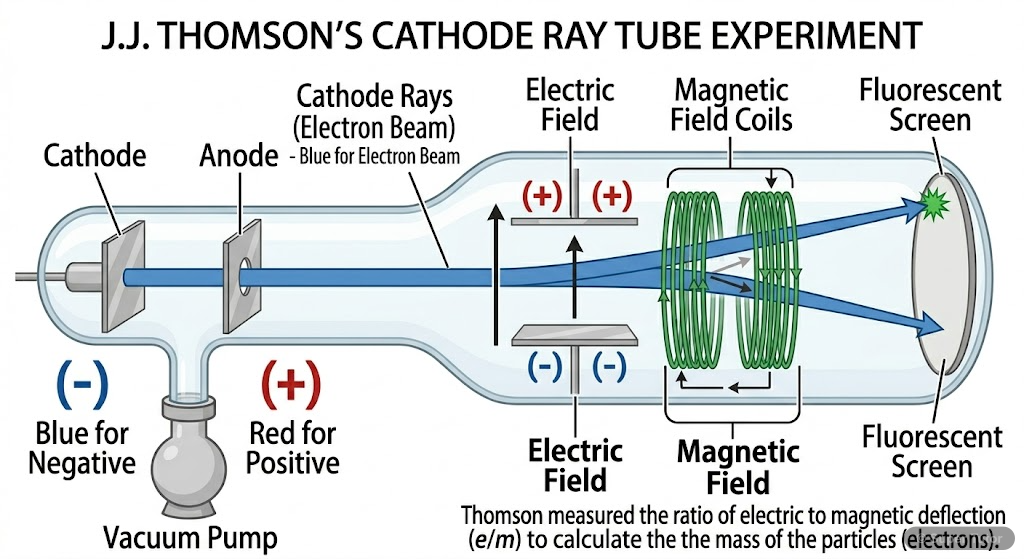
Learn better with visuals Super Tutor pairs illustrations like this with notes and quizzes for Atomic Structure.
Quick Quiz: Atomic Structure
0/4Tap an answer to check it instantly. No sign-up needed for these 4.
An element X has atomic number 15 and mass number 31. Which of the following statements about element X is CORRECT?
Rutherford's gold foil experiment showed that most alpha particles passed straight through. What does this conclusively prove about the structure of an atom?
The element Potassium (K) has atomic number 19. Why does it have the electronic configuration 2, 8, 8, 1 and NOT 2, 8, 9?
Two isotopes of chlorine are ³⁵Cl and ³⁷Cl. Which of the following differences between them is CORRECT?
Sample Questions
Which of the following correctly explains WHY Thomson's Plum Pudding Model was rejected?
Show answer
It could not account for the observation that most alpha particles passed through the gold foil undeflected, which disproved a uniformly positive sphere
Step 1: Thomson's model said the atom is a uniformly positive sphere with electrons embedded in it like plums in a pudding. Step 2: If this were true, alpha particles (positively charged) would be slowed down or deflected uniformly as they hit the spread-out positive charge. Step 3: But Rutherford's experiment showed most alpha particles passed STRAIGHT THROUGH — impossible if the positive charge were spread throughout. Step 4: Also, a very few bounced back completely — showing the positive charge is concentrated in a tiny, dense nucleus, NOT spread out. Step 5: Option A is wrong because Thoms
An atom has 2 electrons in the K shell, 8 in the L shell, and 7 in the M shell. What is its atomic number, valency, and the type of ion it would form?
Show answer
Atomic number 17, valency 1, forms an anion by gaining 1 electron
Step 1: Atomic number = total electrons = 2 + 8 + 7 = 17. This is Chlorine (Cl). Step 2: The valence shell (M shell) has 7 electrons. To reach the stable octet (8 electrons), it needs to GAIN 1 electron. Step 3: Valency = number of electrons needed to complete the octet = 8 – 7 = 1. Step 4: When chlorine gains 1 electron, it becomes Cl⁻ — a negatively charged ion called an anion. Step 5: Option A is wrong because gaining electrons forms anions, not cations. Option C is wrong — atomic number is 17, not 18. Option D is wrong — valency is 1 (electrons needed), not 7 (electrons already present).
Element A has atomic number 12. Which of the following is the CORRECT symbolic representation showing its atomic number and mass number, and its electronic configuration?
Show answer
²⁴₁₂Mg with electronic configuration 2, 8, 2
Step 1: Atomic number 12 corresponds to Magnesium (Mg) with mass number 24. Step 2: In symbolic representation, mass number is written as SUPERSCRIPT (top) and atomic number as SUBSCRIPT (bottom) → ²⁴₁₂Mg. Step 3: Electronic configuration — Total electrons = 12. K shell = 2, L shell = 8, remaining = 12–10 = 2 in M shell. Configuration: 2, 8, 2. Step 4: Option A is wrong — electronic configuration 2, 8, 4 would mean 14 electrons, which is Silicon, not Magnesium. Option C is wrong — the positions of mass number and atomic number are swapped. Option D is wrong — L shell can only hold a maximum of
Bohr's atomic model successfully explained atomic stability. Which of the following is the KEY reason that electrons do NOT fall into the nucleus according to Bohr?
Show answer
Electrons revolve in fixed orbits (energy levels) where they neither gain nor lose energy, so the outward force of revolution balances the inward pull of the nucleus
Step 1: The problem with Rutherford's model was that a moving charged particle (electron) should continuously lose energy and spiral into the nucleus. Step 2: Bohr proposed that electrons occupy specific fixed energy levels (shells) called orbits — in these orbits, they do NOT radiate or lose energy. Step 3: As long as no external force acts on them, electrons maintain their position — the centrifugal force (outward) due to revolving exactly balances the electrostatic attraction (inward) by the nucleus. Step 4: This explains atomic stability — electrons stay in their shells. Option C is incorr
+41 more questions on Atomic Structure (ICSE Class 8 Chemistry)
Practise AllFrequently Asked Questions
What are the important topics in Atomic Structure for ICSE Class 8 Chemistry?
How many practice questions are there for Atomic Structure?
Sources & Official References
Content is aligned to the official syllabus. Refer to the board website for the latest curriculum.
More resources for Atomic Structure
Important Questions
Exam-style questions with answers
Revision Notes
Key points for last-minute revision
Chapter Summary
Understand the chapter at a glance
Concept Maps
See how topics connect
Study Plan
Step-by-step plan for this chapter
Flashcards
Quick-fire cards for active recall
Syllabus
What topics to cover
For serious students
Get the full Atomic Structure chapter — start free.
Quizzes, flashcards, an AI doubt solver and a study plan for ICSE Class 8 Chemistry. Free to start, no card needed.