The United Nations
ICSE · Class 8 · History & Civics
Most important questions from The United Nations for ICSE Class 8 History & Civics board exam 2026. MCQs, short answer, and long answer questions with marks.
Interactive on Super Tutor
Studying The United Nations? Get the full interactive chapter.
Quizzes, flashcards, AI doubt-solver and a step-by-step study plan — built for important questions and more.
1,000+ Class 8 students started this chapter today
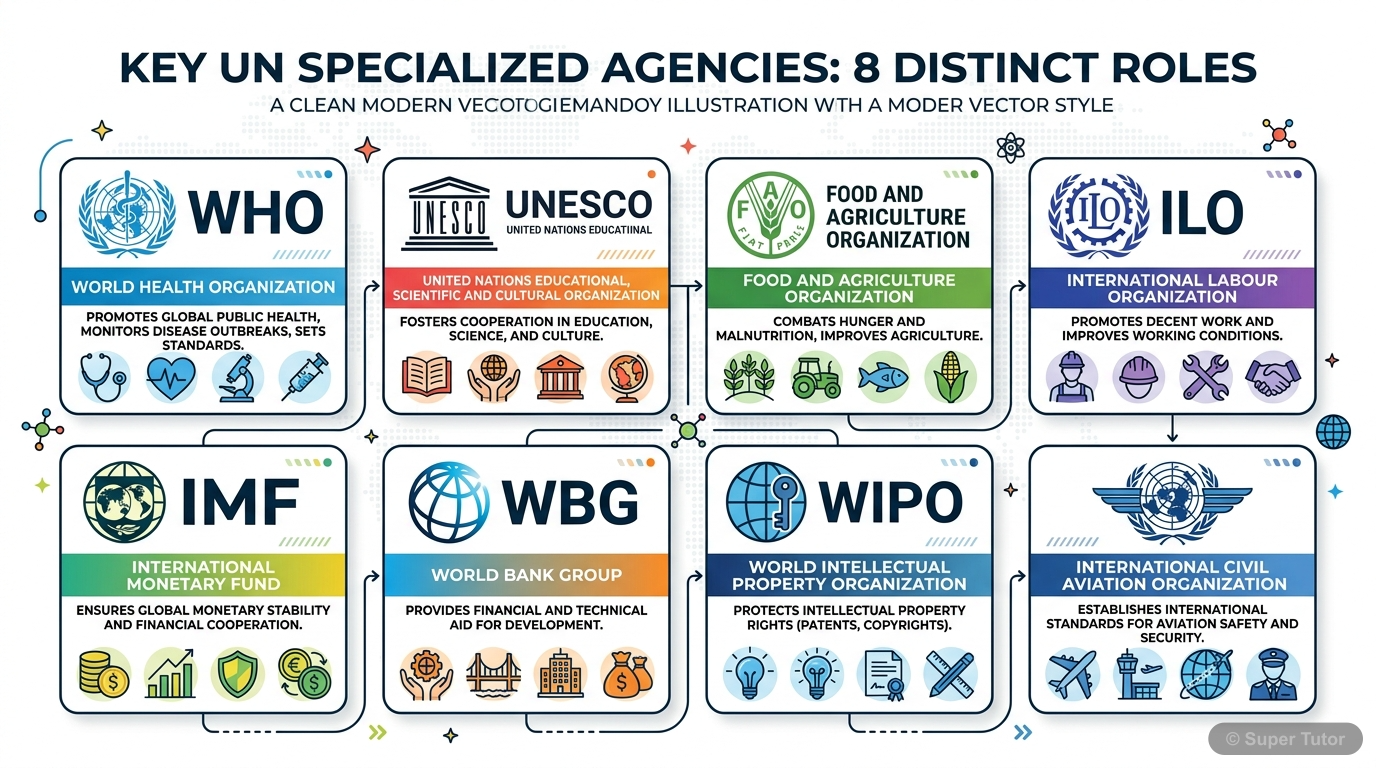
Learn better with visuals Super Tutor has hundreds of illustrations like this across every chapter — all free to try.
Get startedSample Questions
The General Assembly of the United Nations is compared to which national institution?
Show answer
The Parliament
Step 1: The General Assembly is described as the Parliament of the UNO in the textbook. Step 2: Just like a Parliament represents all citizens of a country, the General Assembly represents all member-states of the UN. Step 3: Every member-state can send up to five delegates to the General Assembly, and each state gets one vote — similar to how each representative in a Parliament gets one vote. Step 4: A Supreme Court is a judicial body, a Cabinet is the executive council, and the PM's Office handles executive functions — none of these match the role of the General Assembly. Step 5: The Parliam
How many permanent members does the UN Security Council have, and which of the following is one of them?
Show answer
5 permanent members; France is one of them
Step 1: The Security Council has 15 members in total. Step 2: Out of these, 5 are PERMANENT members: USA, UK, France, China, and Russia. Step 3: The remaining 10 members are elected by the General Assembly for a term of two years. Step 4: India, Germany, and Japan are NOT permanent members, though India and others have often sought a permanent seat. Step 5: France IS one of the five permanent members, making Option B the correct answer. Remember the five permanent members as the major Allied powers after World War II.
What is the VETO power enjoyed by the permanent members of the Security Council?
Show answer
The power to block any final decision of the Security Council by not agreeing to it
Step 1: The word 'veto' comes from Latin meaning 'I forbid.' Step 2: According to the UN Charter, the Security Council cannot take any FINAL decision unless all five permanent members agree. Step 3: This means if even ONE permanent member disagrees, the entire resolution is blocked — this is the veto power. Step 4: Expelling a member, appointing the Secretary-General, and deploying military forces are different functions and are not what the veto power refers to. Step 5: The veto power is one of the most controversial aspects of the UN because it gives disproportionate power to just five count
Where is the International Court of Justice (ICJ) located?
Show answer
The Hague, Netherlands
Step 1: The UN has its organs and agencies spread across different cities in the world. Step 2: The ICJ is the principal judicial (legal) organ of the UN. Step 3: It is located at The Hague, in the Netherlands (also called Holland). Step 4: New York is the location of the UN Headquarters, the General Assembly, and the Secretariat. Geneva is the location of WHO and ILO. Rome is where FAO is headquartered. Step 5: It is important to remember the different headquarters: UN HQ → New York, ICJ → The Hague, WHO/ILO → Geneva, FAO → Rome, IMF → Washington.
+40 more questions available
Practice AllFrequently Asked Questions
What are the important topics in The United Nations for ICSE Class 8 History & Civics?
How to score full marks in The United Nations — ICSE Class 8 History & Civics?
How many important questions are there in The United Nations?
Sources & Official References
Content is aligned to the official syllabus. Refer to the board website for the latest curriculum.
More resources for The United Nations
Practice Quiz
Test yourself with a quick quiz
Revision Notes
Key points for last-minute revision
Formula Sheet
All formulas in one place
Chapter Summary
Understand the chapter at a glance
Concept Maps
See how topics connect visually
Study Plan
Step-by-step plan to ace this chapter
Flashcards
Quick-fire cards for active recall
Syllabus
What topics to cover
NCERT Solutions
Every textbook question solved step by step
For serious students
Get the full The United Nations chapter — for free.
Quizzes, flashcards, AI doubt-solver and a step-by-step study plan for ICSE Class 8 History & Civics.