The United Nations — Syllabus
ICSE · Class 8 · History & Civics
What The United Nations covers in ICSE Class 8 History & Civics: 4 topics, for the 2026-27 session. Part of the ICSE Class 8 History & Civics syllabus.
Interactive on Super Tutor
Studying The United Nations? Get the full interactive chapter.
Quizzes, flashcards, AI doubt-solver and a step-by-step study plan — built for syllabus and more.
Free trial, no card needed.
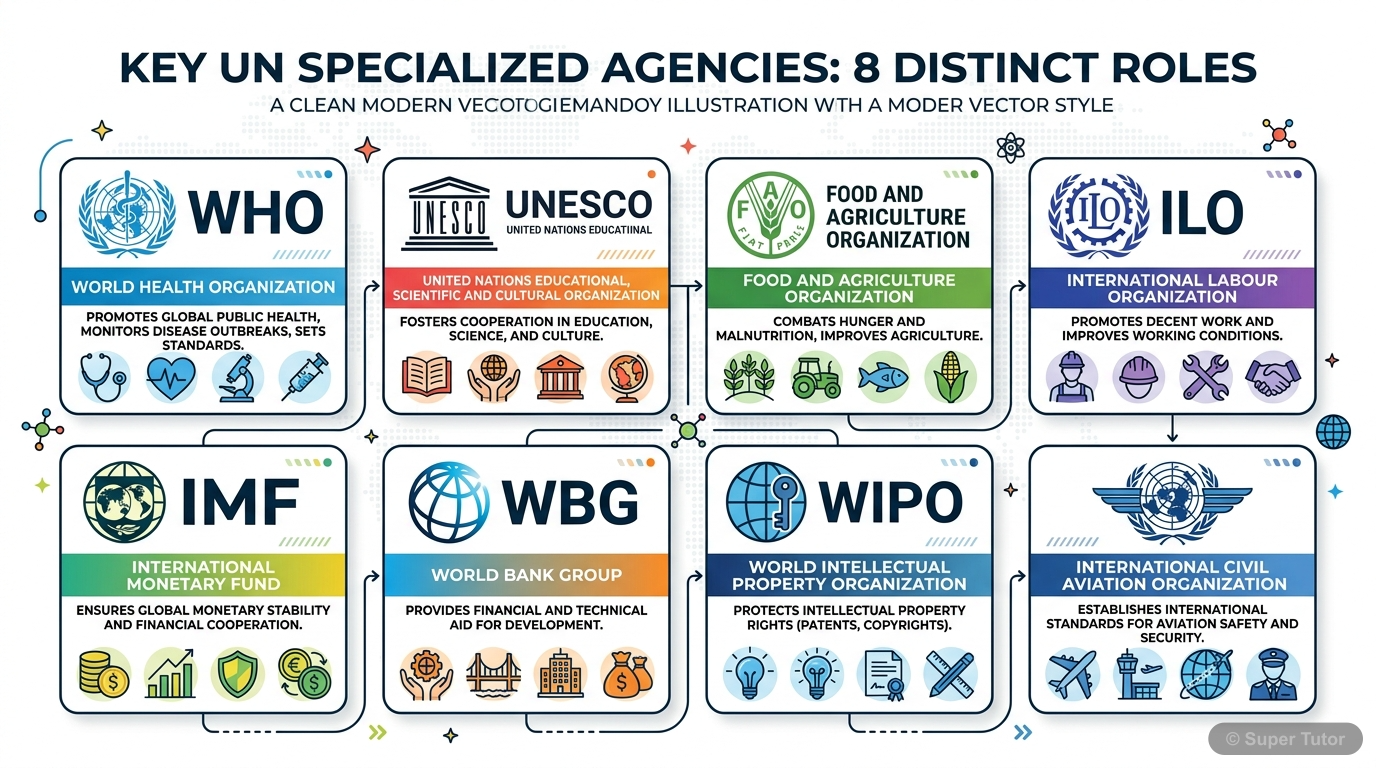
An illustration from Super Tutor's The United Nations chapter — alongside flashcards, concept maps and practice questions.
Topics in The United Nations
Origin of the United Nations
- The United Nations was created because the world wanted a strong organisation to prevent another world war.
- The League of Nations was formed after the First World War, but it failed to stop the Second World War.
- In 1941, Franklin D Roosevelt underlined the need for an international organisation to ensure peace.
Aims and Principles of the United Nations
- The first aim of the United Nations is to save succeeding generations from the scourge of war.
- The UN aims to reaffirm faith in fundamental human rights, dignity, worth of the human person, and equal rights of men and women and of all nations.
- The UN aims to maintain international peace and security.
Facts about the United Nations
- The United Nations came into existence on October 24, 1945.
- The UN originally had 51 member countries and now has 193 members.
- India is one of the original 51 members of the UN.
Principal Organs of the United Nations
- The UN has six principal organs: General Assembly, Security Council, Economic and Social Council, Trusteeship Council, International Court of Justice, and Secretariat.
- The General Assembly can be taken as the Parliament of UNO.
- The Security Council is mainly responsible for maintaining international peace and security.
Key Concepts
Central concept: United Nations as a global organization for peace, cooperation, and international security
Work through every topic in The United Nations with notes and quizzes
Start This ChapterFrequently Asked Questions
What are the important topics in The United Nations for ICSE Class 8 History & Civics?
How should I revise The United Nations for Class 8 exams?
Sources & Official References
Content is aligned to the official syllabus. Refer to the board website for the latest curriculum.
More resources for The United Nations
Practice Quiz
Test yourself with a quick quiz
Important Questions
Exam-style questions with answers
Revision Notes
Key points for last-minute revision
Chapter Summary
Understand the chapter at a glance
Concept Maps
See how topics connect
Study Plan
Step-by-step plan for this chapter
Flashcards
Quick-fire cards for active recall
For serious students
Get the full The United Nations chapter — start free.
Quizzes, flashcards, an AI doubt solver and a study plan for ICSE Class 8 History & Civics. Free to start, no card needed.