The Union Executive — Practice Quiz
ICSE · Class 8 · History & Civics
Try a 4-question quiz on The Union Executive for ICSE Class 8 History & Civics: tap an answer to check it and see why.
Interactive on Super Tutor
Studying The Union Executive? Get the full interactive chapter.
Quizzes, flashcards, AI doubt-solver and a step-by-step study plan — built for practice quiz and more.
Free trial, no card needed.
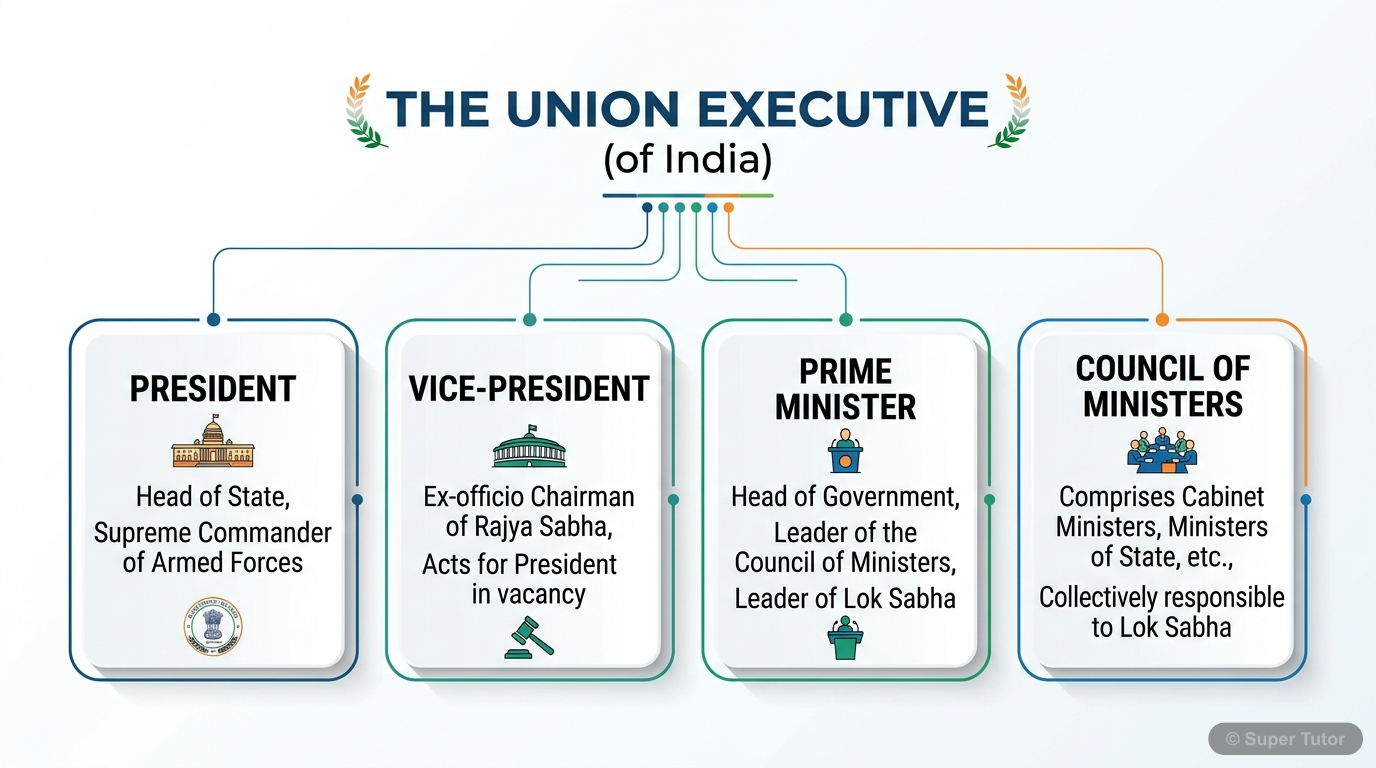
Learn better with visuals Super Tutor pairs illustrations like this with notes and quizzes for The Union Executive.
Quick Quiz: The Union Executive
0/4Tap an answer to check it instantly. No sign-up needed for these 4.
Who is considered the nominal head of the executive of the Indian Union under a Parliamentary form of government?
What is the minimum age required for a person to be eligible to become the President of India?
Who elects the President of India?
Which of the following is an Executive Power of the President of India?
Sample Questions
The President of India can issue 'Ordinances' when:
Show answer
The Parliament is not in session
Step 1: An Ordinance is a law-like order issued by the President in urgent situations. Step 2: Since Parliament is not always in session throughout the year, there may be urgent situations requiring immediate law-making. Step 3: In such cases, the President has the legislative power to issue Ordinances (orders). Step 4: An Ordinance has the same force as a law passed by Parliament, but it must be approved by Parliament when it reassembles. Step 5: The Supreme Court, Prime Minister's travel, or emergency declaration are not the triggering conditions for issuing an Ordinance.
Under which power does the President of India have the authority to pardon a person sentenced to death?
Show answer
Judicial Power
Step 1: The power to pardon, remit, or suspend a sentence of punishment is related to the justice system. Step 2: Such powers, which involve overriding or modifying court decisions, come under Judicial Powers of the President. Step 3: The President can pardon a death sentence passed by any court, or suspend/remit a sentence given by a court martial. Step 4: Executive powers deal with appointments and administration; Legislative powers deal with Parliament; Emergency powers deal with national crises. Step 5: Since pardoning a death sentence is connected to the justice/judiciary system, it is a
Who is the ex-officio Chairman of the Rajya Sabha?
Show answer
The Vice-President of India
Step 1: 'Ex-officio' means a position held automatically because of another position or office one holds. Step 2: The Vice-President of India becomes the Chairman of the Rajya Sabha automatically by virtue of being the Vice-President. Step 3: As Chairman, the Vice-President presides over the sessions of the Rajya Sabha and regulates debates and proceedings. Step 4: The Speaker of Lok Sabha presides over the Lok Sabha, not the Rajya Sabha. Step 5: Therefore, the Vice-President is the correct answer as the ex-officio Chairman of the Rajya Sabha.
How many members does the President nominate to the Rajya Sabha?
Show answer
12 members
Step 1: The Rajya Sabha (Council of States) has members elected by State Legislative Assemblies and some nominated members. Step 2: Under the Legislative Powers of the President, he has the power to nominate members to the Rajya Sabha. Step 3: The President nominates 12 members to the Rajya Sabha. Step 4: These 12 members are usually distinguished persons in the fields of literature, science, art, and social service. Step 5: The numbers 6, 10, and 15 are all incorrect; the precise constitutional number is 12.
+38 more questions on The Union Executive (ICSE Class 8 History & Civics)
Practise AllFrequently Asked Questions
What are the important topics in The Union Executive for ICSE Class 8 History & Civics?
How many practice questions are there for The Union Executive?
Sources & Official References
Content is aligned to the official syllabus. Refer to the board website for the latest curriculum.
More resources for The Union Executive
Important Questions
Exam-style questions with answers
Revision Notes
Key points for last-minute revision
Chapter Summary
Understand the chapter at a glance
Concept Maps
See how topics connect
Study Plan
Step-by-step plan for this chapter
Flashcards
Quick-fire cards for active recall
Syllabus
What topics to cover
For serious students
Get the full The Union Executive chapter — start free.
Quizzes, flashcards, an AI doubt solver and a study plan for ICSE Class 8 History & Civics. Free to start, no card needed.