The Judiciary — Practice Quiz
ICSE · Class 8 · History & Civics
Try a 4-question quiz on The Judiciary for ICSE Class 8 History & Civics: tap an answer to check it and see why. 41 questions in the full chapter test.
Interactive on Super Tutor
Studying The Judiciary? Get the full interactive chapter.
Quizzes, flashcards, AI doubt-solver and a step-by-step study plan — built for practice quiz and more.
Free trial, no card needed.
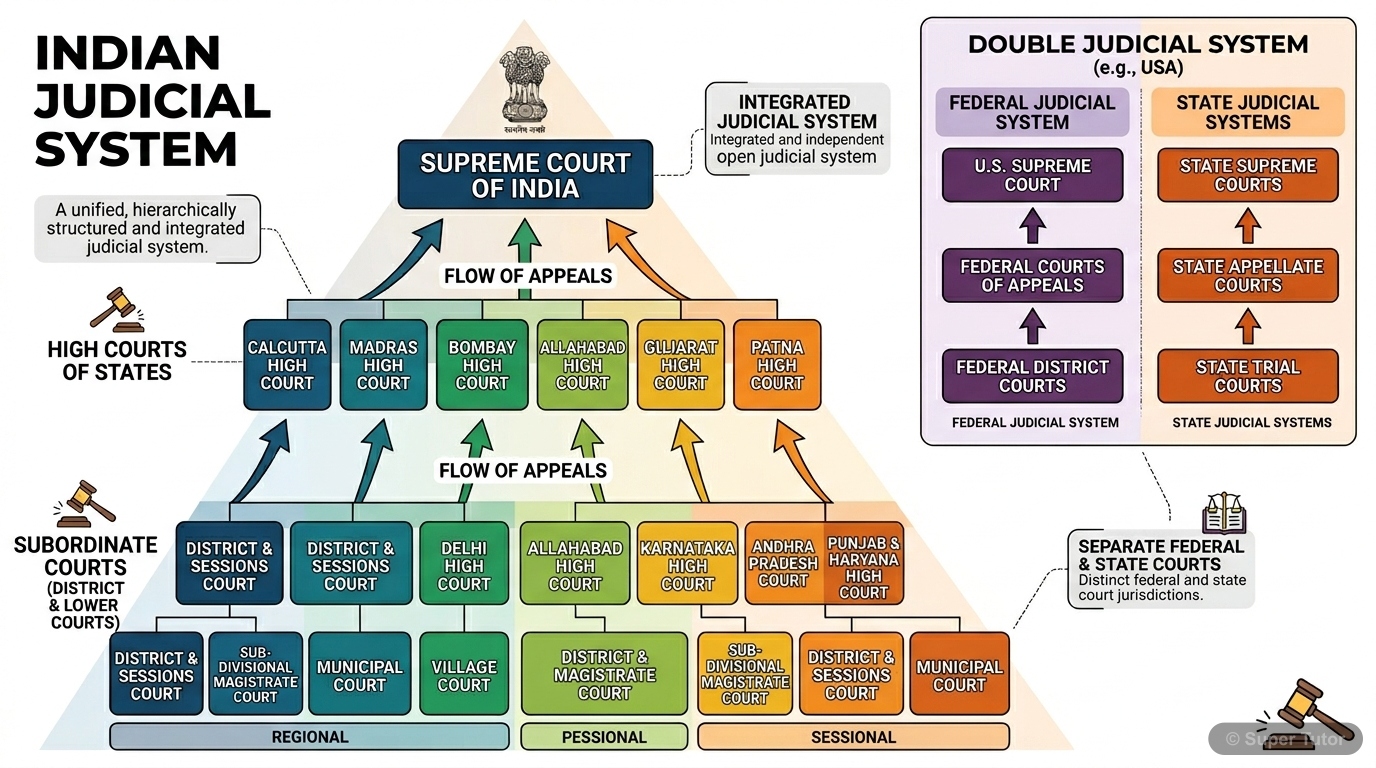
Learn better with visuals Super Tutor pairs illustrations like this with notes and quizzes for The Judiciary.
Quick Quiz: The Judiciary
0/4Tap an answer to check it instantly. No sign-up needed for these 4.
Which court is at the apex (top) of the Indian judicial system?
The Supreme Court of India currently consists of the Chief Justice and how many other judges?
Who appoints the Chief Justice of the Supreme Court of India?
At what age do the judges of the Supreme Court retire?
Sample Questions
What is the process called by which a Supreme Court judge can be removed from office?
Show answer
Impeachment
Step 1: Supreme Court judges have strong protection to ensure their independence. Step 2: They can only be removed by the President, but only on grounds of 'proved misbehaviour' or 'incapacity'. Step 3: This removal requires a special majority in both Houses of Parliament. Step 4: The process of removing a judge in this manner is called Impeachment. Step 5: Dissolution refers to ending Parliament, suspension and dismissal are informal terms not used constitutionally for judges. So Impeachment is the correct answer.
Which jurisdiction allows the Supreme Court to hear a case for the very first time, without going through lower courts?
Show answer
Original Jurisdiction
Step 1: The Supreme Court has two main types of judicial powers — original and appellate. Step 2: 'Original Jurisdiction' means the authority to hear a case for the first time. Step 3: Cases involving interpretation of the Constitution, disputes between Centre and States, and violations of Fundamental Rights can be directly filed in the Supreme Court under Original Jurisdiction. Step 4: Appellate Jurisdiction is when the Supreme Court hears a case that has already gone through lower courts. Advisory Jurisdiction is when the President seeks the court's opinion. So Original Jurisdiction is corre
The writ of Habeas Corpus is used to protect which right of a citizen?
Show answer
Personal Freedom
Step 1: 'Habeas Corpus' is a Latin term meaning 'to have the body of'. Step 2: By issuing this writ, the court can get the body (person) of any individual released if he or she has been unlawfully captured. Step 3: This makes it a great safeguard for the personal freedom of a citizen. Step 4: It has nothing to do with property, education, or voting rights. Step 5: Remember Habeas Corpus = protection of personal liberty and freedom from unlawful detention.
What does the Latin term 'Mandamus' literally mean?
Show answer
We command
Step 1: Each writ has a specific Latin meaning that helps us understand its purpose. Step 2: 'Mandamus' literally means 'we command'. Step 3: It is a command issued by a higher court to a lower court or government authority that has refused to perform its duty. Step 4: 'To be certified' is Certiorari, 'to forbid' is Prohibition, and 'by what authority' is Quo Warranto. Step 5: So 'We command' is the correct meaning of Mandamus.
+37 more questions on The Judiciary (ICSE Class 8 History & Civics)
Practise AllFrequently Asked Questions
What are the important topics in The Judiciary for ICSE Class 8 History & Civics?
How many practice questions are there for The Judiciary?
Sources & Official References
Content is aligned to the official syllabus. Refer to the board website for the latest curriculum.
More resources for The Judiciary
Important Questions
Exam-style questions with answers
Revision Notes
Key points for last-minute revision
Chapter Summary
Understand the chapter at a glance
Concept Maps
See how topics connect
Study Plan
Step-by-step plan for this chapter
Flashcards
Quick-fire cards for active recall
Syllabus
What topics to cover
For serious students
Get the full The Judiciary chapter — start free.
Quizzes, flashcards, an AI doubt solver and a study plan for ICSE Class 8 History & Civics. Free to start, no card needed.