Cell - The Unit of Life — Practice Quiz
ICSE · Class 9 · Biology
Try a 4-question quiz on Cell - The Unit of Life for ICSE Class 9 Biology: tap an answer to check it and see why. 42 questions in the full chapter test.
Interactive on Super Tutor
Studying Cell - The Unit of Life? Get the full interactive chapter.
Quizzes, flashcards, AI doubt-solver and a step-by-step study plan — built for practice quiz and more.
Free trial, no card needed.
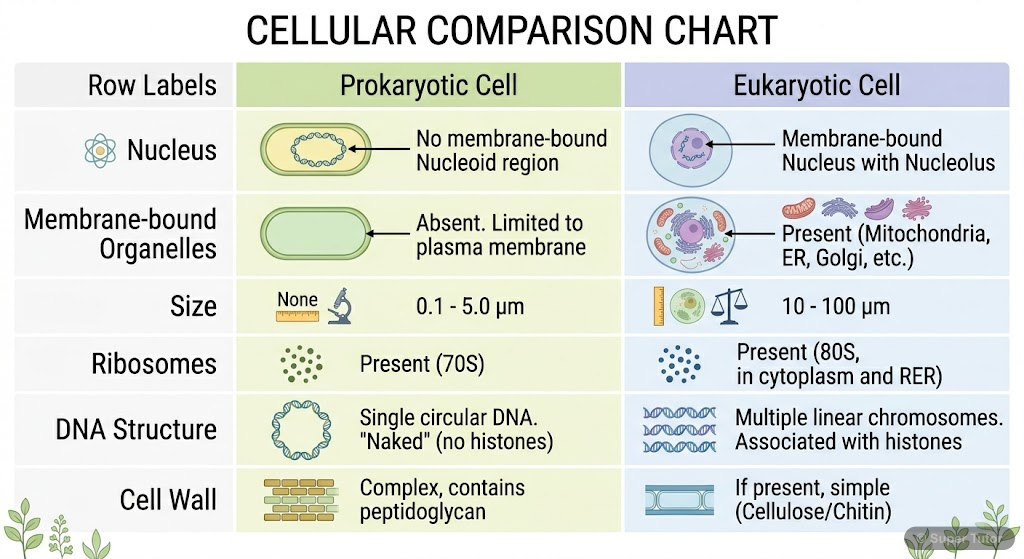
One of 12 illustrations for Cell - The Unit of Life in Super Tutor — alongside flashcards, concept maps and practice questions.
Quick Quiz: Cell - The Unit of Life
0/4Tap an answer to check it instantly. No sign-up needed for these 4.
Who first observed cells in a thin slice of cork?
Which organelle is known as the 'powerhouse of the cell'?
What is the main component of the cell wall in plants?
Which type of plastids are responsible for the red color in tomatoes?
Sample Questions
Which of the following are parts of the cell theory?
Show answer
Cell is the smallest unit of structure of all living things, Cell is the unit of function of all living things, All cells arise from pre-existing cells
The cell theory has three main points: cells are the basic structural unit, functional unit, and all cells come from existing cells. Not all cells have chloroplasts, and cells cannot be created from non-living matter.
The cell membrane is selectively permeable.
Show answer
True
The cell membrane is selectively permeable, meaning it allows only certain substances to pass through while preventing others from entering or leaving the cell.
The green pigment in chloroplasts is called ________.
Show answer
Chlorophyll
Chloroplasts are green because they contain the pigment chlorophyll. The chapter states that chloroplasts are green coloured plastids and that chlorophyll is their green pigment. Other pigments like carotene and xanthophyll are associated with other colours, while anthocyanins are not plastid pigments.
Match the organelles with their functions:
Show answer
Ribosome - Protein synthesis
Each organelle has specific functions: ribosomes make proteins, lysosomes digest waste, Golgi apparatus packages and secretes materials, and nucleus controls cell activities.
+38 more questions on Cell - The Unit of Life (ICSE Class 9 Biology)
Practise AllFrequently Asked Questions
What are the important topics in Cell - The Unit of Life for ICSE Class 9 Biology?
How many practice questions are there for Cell - The Unit of Life?
Sources & Official References
Content is aligned to the official syllabus. Refer to the board website for the latest curriculum.
More resources for Cell - The Unit of Life
Important Questions
Exam-style questions with answers
Revision Notes
Key points for last-minute revision
Formula Sheet
The chapter's formulas in one place
Chapter Summary
Understand the chapter at a glance
Concept Maps
See how topics connect
Study Plan
Step-by-step plan for this chapter
Flashcards
Quick-fire cards for active recall
Syllabus
What topics to cover
For serious students
Get the full Cell - The Unit of Life chapter — start free.
Quizzes, flashcards, an AI doubt solver and a study plan for ICSE Class 9 Biology. Free to start, no card needed.