Cell - The Unit of Life — Flashcards
ICSE · Class 9 · Biology
38 flashcards for Cell - The Unit of Life (ICSE Class 9 Biology) to test yourself on key terms and facts. Sample: "What is a cell?"
Interactive on Super Tutor
Studying Cell - The Unit of Life? Get the full interactive chapter.
Quizzes, flashcards, AI doubt-solver and a step-by-step study plan — built for flashcards and more.
Free trial, no card needed.
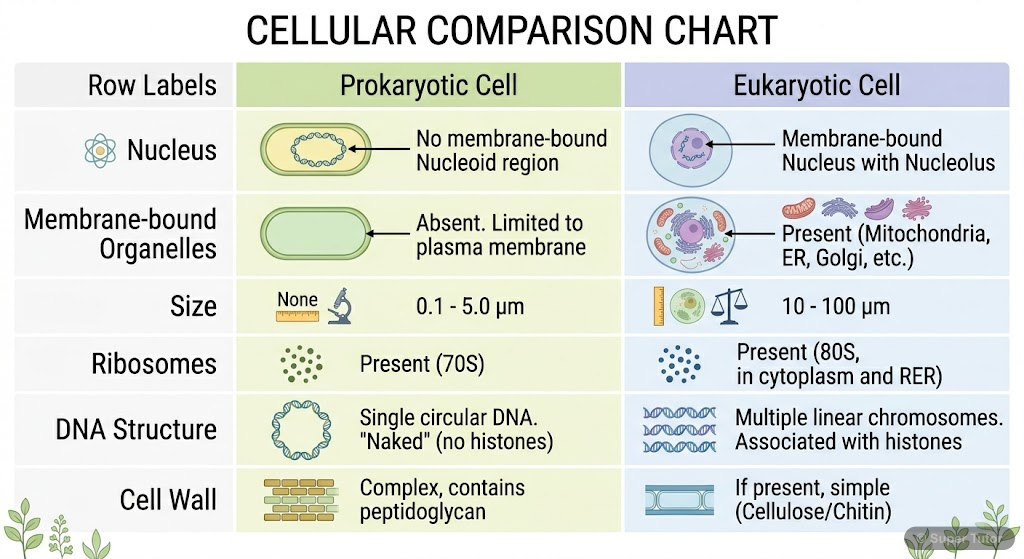
One of 12 illustrations for Cell - The Unit of Life in Super Tutor — alongside flashcards, concept maps and practice questions.
What is a cell?
Answer
A cell is the fundamental structural and functional unit of all living beings. It is the smallest part of an organism capable of independent existence and performing the essential functions of life.
Why were microscopes important for the study of cells?
Answer
Cells are microscopic and cannot be seen with the naked eye. Microscopes made it possible to observe cells and discover their structure.
What is a simple microscope?
Answer
A simple microscope is a microscope with a single biconvex lens. Antony van Leeuwenhoek used this type of microscope.
What is a compound microscope?
Answer
A compound microscope uses two lenses for greater magnification. Robert Hooke developed this type of microscope.
Who first observed cork cells and how were they named?
Answer
Robert Hooke examined a thin slice of cork and saw tiny box-like compartments. He called them cells because they reminded him of the rooms of monks in a monastery.
What did Robert Hooke actually see in cork?
Answer
He saw dead cells. He observed only the empty boxes or walls, not living cell contents.
State the three main points of Cell Theory.
Answer
1. The cell is the smallest unit of structure of all living things. 2. The cell is the unit of function of all living things. 3. All cells arise from pre-existing cells.
Which scientists proposed Cell Theory, and who added to it later?
Answer
Schleiden and Schwann proposed Cell Theory in 1839. Rudolf Virchow later added that all cells arise from pre-existing cells.
+30 more flashcards
Practise AllFrequently Asked Questions
What are the important topics in Cell - The Unit of Life for ICSE Class 9 Biology?
How many flashcards are available for Cell - The Unit of Life?
How should I revise Cell - The Unit of Life for Class 9 exams?
Sources & Official References
Content is aligned to the official syllabus. Refer to the board website for the latest curriculum.
More resources for Cell - The Unit of Life
Practice Quiz
Test yourself with a quick quiz
Important Questions
Exam-style questions with answers
Revision Notes
Key points for last-minute revision
Formula Sheet
The chapter's formulas in one place
Chapter Summary
Understand the chapter at a glance
Concept Maps
See how topics connect
Study Plan
Step-by-step plan for this chapter
Syllabus
What topics to cover
For serious students
Get the full Cell - The Unit of Life chapter — start free.
Quizzes, flashcards, an AI doubt solver and a study plan for ICSE Class 9 Biology. Free to start, no card needed.