Cell - The Unit of Life — Chapter Summary
ICSE · Class 9 · Biology
Summary of Cell - The Unit of Life for ICSE Class 9 Biology. Part of the ICSE Class 9 Biology syllabus. The cell is the fundamental structural.
Interactive on Super Tutor
Studying Cell - The Unit of Life? Get the full interactive chapter.
Quizzes, flashcards, AI doubt-solver and a step-by-step study plan — built for chapter summary and more.
Free trial, no card needed.
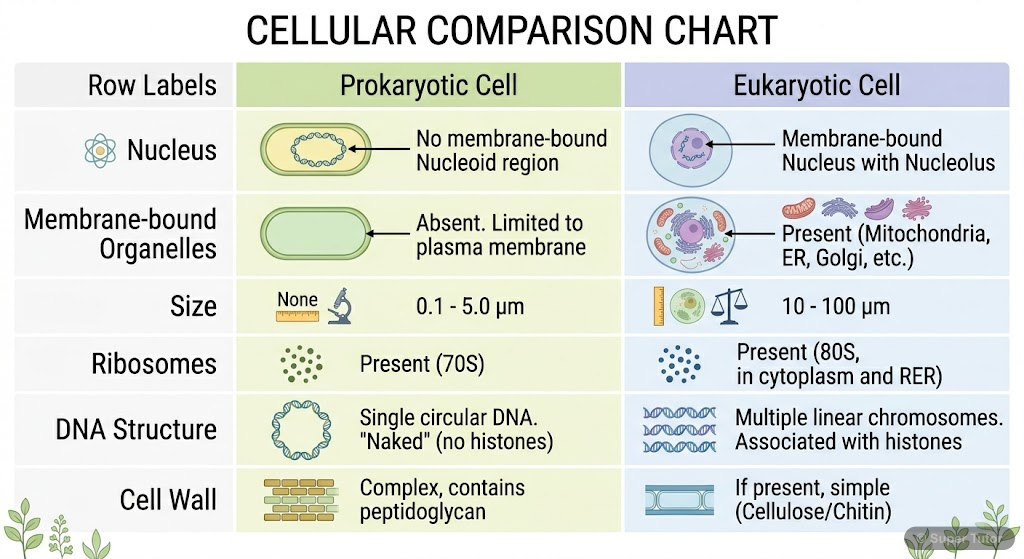
One of 12 illustrations for Cell - The Unit of Life in Super Tutor — alongside flashcards, concept maps and practice questions.
Overview
The cell is the fundamental structural and functional unit of all living beings. It is the smallest part of the body of an organism capable of independent existence and performing the essential functions of life. All living things are made of cells, and every activity of life depends on cellular act
Key Concepts
A cell is the smallest part
A cell is the smallest part of the body of an organism capable of independent existence and performing essential functions of life. It is the basic st
Antony van Leeuwenhoek constructed the first
Antony van Leeuwenhoek constructed the first simple microscope with a single biconvex lens and observed microscopic objects. Robert Hooke developed th
The cell theory states three major
The cell theory states three major points: the cell is the smallest structural unit of living things, the cell is the unit of function of living thing
Prokaryotic cells do not have
Prokaryotic cells do not have a nuclear membrane, and their chromatin material lies freely in the cytoplasm. Eukaryotic cells have a well-defined nucl
The cell membrane is living
The cell membrane is living and selectively permeable, so it allows only certain substances to pass through. The cell wall is found only in plant cell
Learning Objectives
- Define a cell and explain why it is called the unit of life
- Describe the invention of the microscope and the discovery of cells
- Explain the main ideas of cell theory
- Compare prokaryotic and eukaryotic cells
- Compare plant cells and animal cells
Frequently Asked Questions
What are the important topics in Cell - The Unit of Life for ICSE Class 9 Biology?
How should I revise Cell - The Unit of Life for Class 9 exams?
Sources & Official References
Content is aligned to the official syllabus. Refer to the board website for the latest curriculum.
More resources for Cell - The Unit of Life
Practice Quiz
Test yourself with a quick quiz
Important Questions
Exam-style questions with answers
Revision Notes
Key points for last-minute revision
Formula Sheet
The chapter's formulas in one place
Concept Maps
See how topics connect
Study Plan
Step-by-step plan for this chapter
Flashcards
Quick-fire cards for active recall
Syllabus
What topics to cover
For serious students
Get the full Cell - The Unit of Life chapter — start free.
Quizzes, flashcards, an AI doubt solver and a study plan for ICSE Class 9 Biology. Free to start, no card needed.