Skeleton Movement and Locomotion — Practice Quiz
ICSE · Class 9 · Biology
Try a 4-question quiz on Skeleton Movement and Locomotion for ICSE Class 9 Biology: tap an answer to check it and see why.
Interactive on Super Tutor
Studying Skeleton Movement and Locomotion? Get the full interactive chapter.
Quizzes, flashcards, AI doubt-solver and a step-by-step study plan — built for practice quiz and more.
Free trial, no card needed.
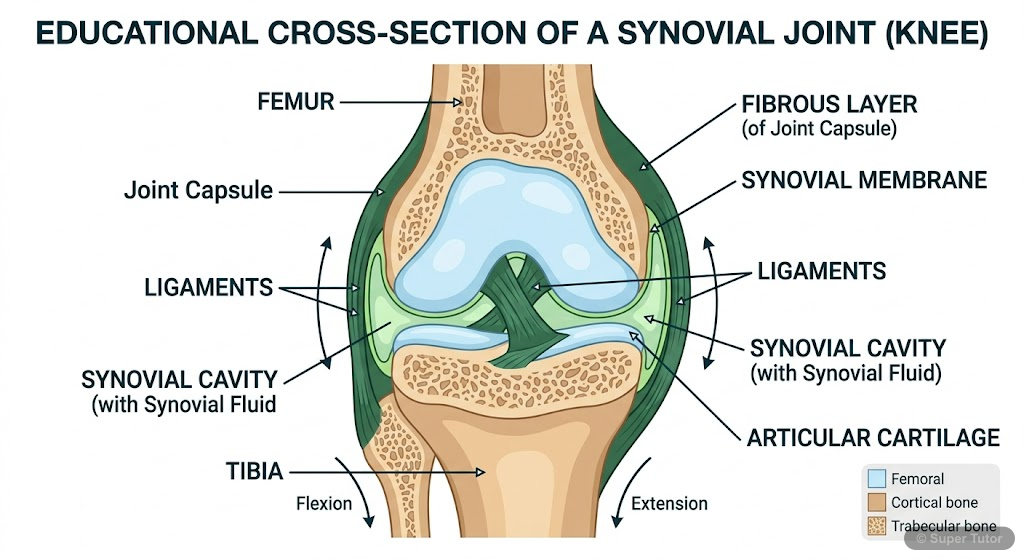
Learn better with visuals Super Tutor pairs illustrations like this with notes and quizzes for Skeleton Movement and Locomotion.
Quick Quiz: Skeleton Movement and Locomotion
0/4Tap an answer to check it instantly. No sign-up needed for these 4.
Which of the following is the longest bone in the human body?
How many bones are present in the human skull including the ear bones?
The joint between the skull bones is an example of which type of joint?
How many pairs of ribs are there in the human body?
Sample Questions
Which of the following are functions of the human skeleton? (Select all correct answers)
Show answer
Provides support and shape to the body, Protects internal organs, Forms blood cells, Stores calcium and phosphorus
The skeleton has six main functions: support and shape, protection, movement, leverage, blood cell formation, and storage of calcium and phosphorus. It does not produce digestive enzymes.
Which components make up the human skeleton? (Select all correct answers)
Show answer
Bones, Cartilages, Ligaments
The skeleton consists of bones (hard framework), cartilages (supporting structures), and ligaments (bind bones together). Muscles and tendons are part of the muscular system.
The elbow joint is an example of which type of joint?
Show answer
Hinge joint
The elbow joint is a hinge joint that allows movement in only one plane, like a door hinge. It allows bending and straightening of the arm.
Which of the following bones are part of the appendicular skeleton? (Select all correct answers)
Show answer
Femur, Humerus, Scapula
The appendicular skeleton includes bones of limbs and girdles. Femur (leg), humerus (arm), and scapula (shoulder girdle) belong to this. Ribs and skull are part of axial skeleton.
+37 more questions on Skeleton Movement and Locomotion (ICSE Class 9 Biology)
Practise AllFrequently Asked Questions
What are the important topics in Skeleton Movement and Locomotion for ICSE Class 9 Biology?
How many practice questions are there for Skeleton Movement and Locomotion?
Sources & Official References
Content is aligned to the official syllabus. Refer to the board website for the latest curriculum.
More resources for Skeleton Movement and Locomotion
Important Questions
Exam-style questions with answers
Revision Notes
Key points for last-minute revision
Chapter Summary
Understand the chapter at a glance
Concept Maps
See how topics connect
Study Plan
Step-by-step plan for this chapter
Flashcards
Quick-fire cards for active recall
Syllabus
What topics to cover
For serious students
Get the full Skeleton Movement and Locomotion chapter — start free.
Quizzes, flashcards, an AI doubt solver and a study plan for ICSE Class 9 Biology. Free to start, no card needed.