Adverbs: Position and Order — Concept Maps
ICSE · Class 9 · English Language - Archer
4 concept maps of Adverbs: Position and Order for ICSE Class 9 English Language - Archer, each also written out as a text outline.
Interactive on Super Tutor
Studying Adverbs: Position and Order? Get the full interactive chapter.
Quizzes, flashcards, AI doubt-solver and a step-by-step study plan — built for concept maps and more.
Free trial, no card needed.
Learn better with visuals Super Tutor pairs illustrations like this with notes and quizzes for Adverbs: Position and Order.
Complete Adverbs Position and Order Concept Map
The map in words
- Adverbs Position and Order
- Types of Adverbs
- Manner
- How questions
- After intransitive verbs
- After object of transitive
- Place
- Where questions
- Beginning or end
- After verbs
- Time
- When questions
- Beginning possible
- End of sentence
- Frequency
- How often
- Before main verb
- After auxiliary
- Degree
- How much extent
- Before main verb
- Modifies adjectives
- Probability
- Certainty level
- Before main verb
- Shows likelihood
- Manner
- Position Rules
- Flexible Placement
- Beginning emphasis
- Middle standard
- End common
- Special Cases
- Negative adverbs
- Auxiliary inversion
- Question formation
- Frequency Adverbs
- Before main verb
- After auxiliary
- After modal verbs
- Flexible Placement
- Order Rules
- Standard Order
- Manner first
- Place second
- Frequency third
- Time last
- Multiple Adverbs
- Maximum three
- Natural flow
- Avoid overcrowding
- Emphasis Exception
- Time first for emphasis
- Beginning placement
- Frequency before time
- Standard Order
- Types of Adverbs
Types and Positions of Adverbs
The map in words
- Adverbs
- Types
- Manner
- How something happens
- After verbs or objects
- Time
- When something happens
- Beginning or end
- Place
- Where something happens
- After verbs or objects
- Frequency
- How often
- Before main verbs
- Degree
- To what extent
- Before main verbs
- Probability
- How certain
- Before main verbs
- Manner
- Position Rules
- After Verbs
- Manner adverbs
- Time adverbs
- Place adverbs
- Before Main Verbs
- Frequency adverbs
- Degree adverbs
- Probability adverbs
- Beginning Emphasis
- Time adverbs
- Negative adverbs with inversion
- After Verbs
- Order Pattern
- Manner first
- Place second
- Frequency third
- Time last
- Types
Adverb Position Decision Tree
The map in words
- Identify Adverb Type
- Frequency Adverb?
- Yes: Beginning of Sentence?
- Yes: Negative Adverb?
- Yes: Use Inversion: Aux + Subject + Verb
- Correct
- No: Normal Order + Comma
- Yes: Use Inversion: Aux + Subject + Verb
- No: Place Before Main Verb
- Yes: Negative Adverb?
- No: Manner Adverb?
- Yes: Transitive Verb?
- Yes: Place After Object
- No: Place After Verb
- No: Time/Place Adverb
- Can Go Beginning, Middle, or End
- Yes: Transitive Verb?
- Yes: Beginning of Sentence?
- Frequency Adverb?
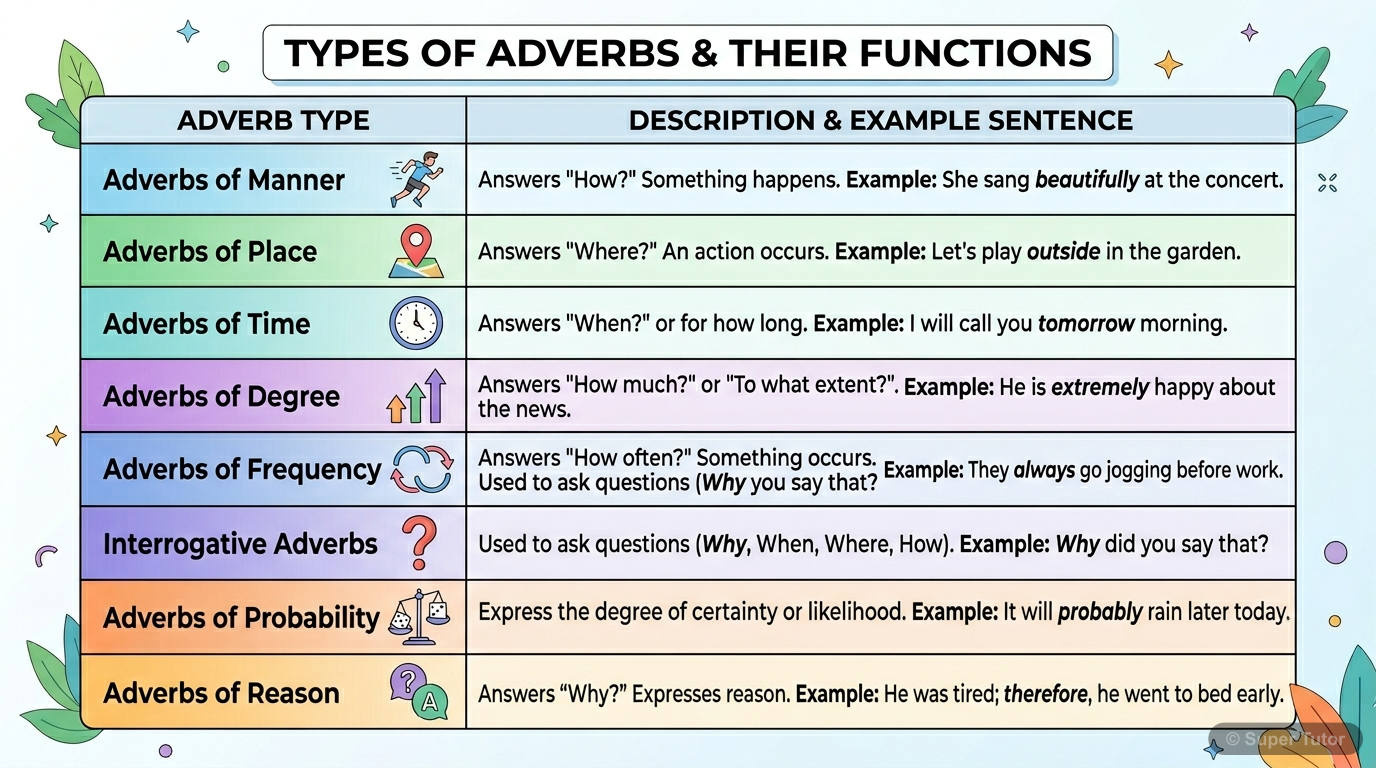
Adverbs modify verbs, adjectives, or other adverbs, and their position in a sentence affects clarity, emphasis, and correctness.
The map in words
- Adverbs modify verbs, adjectives, or other adverbs, and their position in a sentence affects clarity, emphasis, and correctness.
- Adverbs of manner
- Adverbs of place
- Adverbs of time
- Adverbs of degree
- Adverbs of frequency
- Interrogative adverbs
- Adverbs of probability
- Adverbs of reason
Explore these maps interactively
Explore DiagramsFrequently Asked Questions
What are the important topics in Adverbs: Position and Order for ICSE Class 9 English Language - Archer?
What do the concept maps for Adverbs: Position and Order show?
How should I revise Adverbs: Position and Order for Class 9 exams?
Sources & Official References
Content is aligned to the official syllabus. Refer to the board website for the latest curriculum.
More resources for Adverbs: Position and Order
Practice Quiz
Test yourself with a quick quiz
Important Questions
Exam-style questions with answers
Revision Notes
Key points for last-minute revision
Formula Sheet
The chapter's formulas in one place
Chapter Summary
Understand the chapter at a glance
Study Plan
Step-by-step plan for this chapter
Flashcards
Quick-fire cards for active recall
Syllabus
What topics to cover
For serious students
Get the full Adverbs: Position and Order chapter — start free.
Quizzes, flashcards, an AI doubt solver and a study plan for ICSE Class 9 English Language - Archer. Free to start, no card needed.