Adverbs: Position and Order — Chapter Summary
ICSE · Class 9 · English Language - Archer
Summary of Adverbs: Position and Order for ICSE Class 9 English Language - Archer. Part of the ICSE Class 9 English Language - Archer syllabus.
Interactive on Super Tutor
Studying Adverbs: Position and Order? Get the full interactive chapter.
Quizzes, flashcards, AI doubt-solver and a step-by-step study plan — built for chapter summary and more.
Free trial, no card needed.
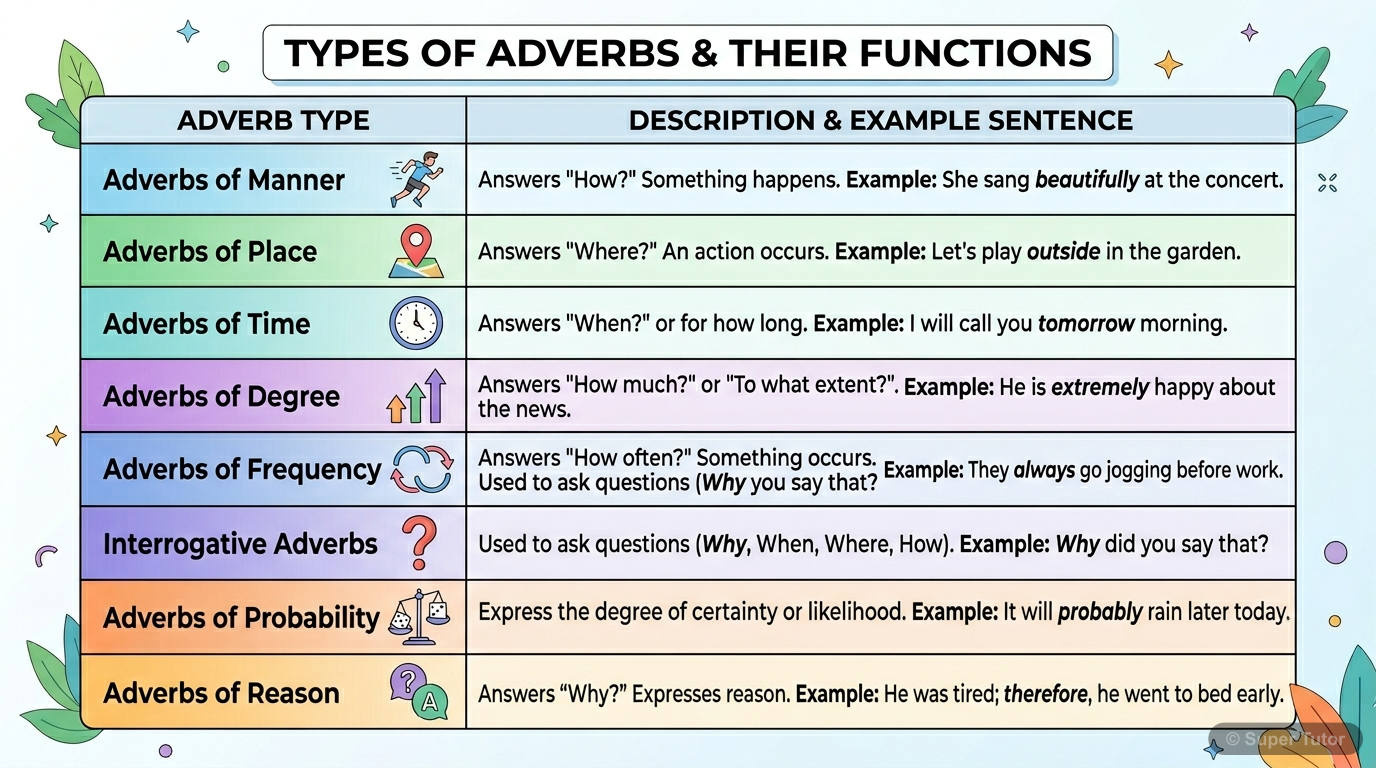
Learn better with visuals Super Tutor pairs illustrations like this with notes and quizzes for Adverbs: Position and Order.
Overview
Adverbs are words that modify a verb, an adjective, or an adverb. They help show how an action happens, where it happens, when it happens, how often it happens, or to what degree it happens. Adverbs can appear at the beginning, middle, or end of a sentence. Their position changes the emphasis and, i
Key Concepts
Adverbs modify a verb
Adverbs modify a verb, an adjective, or an adverb. For example, quickly modifies the verb fled, very modifies the adjective delicious, and quite modif
Adverbs can be of manner
Adverbs can be of manner, place, time, degree, frequency, probability, reason, and interrogative type. Manner answers How?, place answers Where?, time
Adverbs may be placed at
Adverbs may be placed at the beginning, middle, or end of a sentence. The position depends on the kind of adverb and the emphasis needed.
Adverbs of manner
Adverbs of manner, time, and place can come after intransitive verbs or after the object of a transitive verb. Some adverbs of time and place can also
Adverbs of frequency
Adverbs of frequency, probability, and degree are usually placed before the main verb. Adverbs of frequency are also placed after an auxiliary verb or
Learning Objectives
- Identify different kinds of adverbs and their functions
- Understand how adverbs modify verbs, adjectives, and other adverbs
- Learn the usual position of adverbs in a sentence
- Use adverbs of manner, place, time, frequency, degree, probability, reason, and interrogative adverbs correctly
- Apply the correct order when more than one adverb appears in a sentence
Frequently Asked Questions
What are the important topics in Adverbs: Position and Order for ICSE Class 9 English Language - Archer?
How should I revise Adverbs: Position and Order for Class 9 exams?
Sources & Official References
Content is aligned to the official syllabus. Refer to the board website for the latest curriculum.
More resources for Adverbs: Position and Order
Practice Quiz
Test yourself with a quick quiz
Important Questions
Exam-style questions with answers
Revision Notes
Key points for last-minute revision
Formula Sheet
The chapter's formulas in one place
Concept Maps
See how topics connect
Study Plan
Step-by-step plan for this chapter
Flashcards
Quick-fire cards for active recall
Syllabus
What topics to cover
For serious students
Get the full Adverbs: Position and Order chapter — start free.
Quizzes, flashcards, an AI doubt solver and a study plan for ICSE Class 9 English Language - Archer. Free to start, no card needed.