Compound Interest (Without Using Formula) — Syllabus
ICSE · Class 9 · Mathematics
What Compound Interest (Without Using Formula) covers in ICSE Class 9 Mathematics: 3 topics, for the 2026-27 session.
Interactive on Super Tutor
Studying Compound Interest (Without Using Formula)? Get the full interactive chapter.
Quizzes, flashcards, AI doubt-solver and a step-by-step study plan — built for syllabus and more.
Free trial, no card needed.
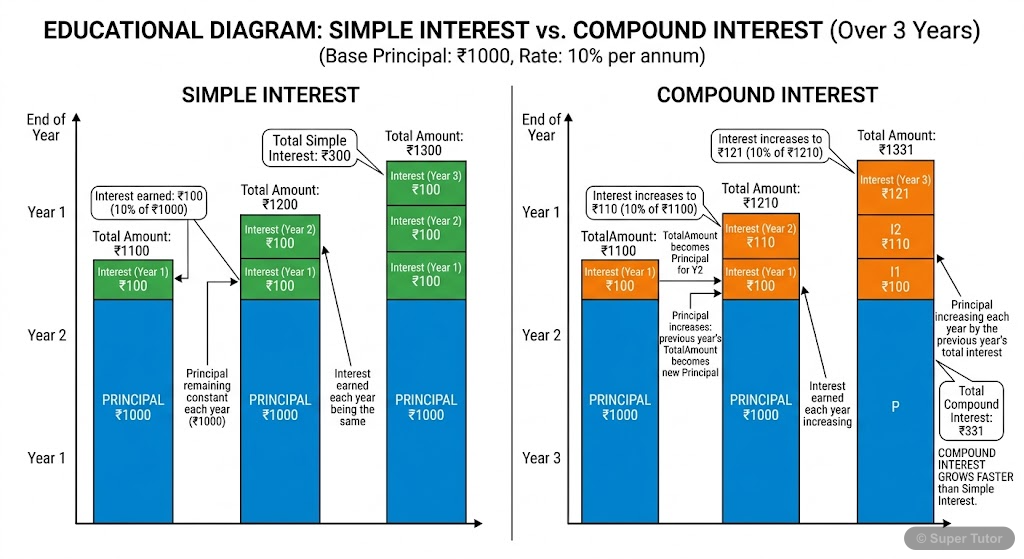
One of 6 illustrations for Compound Interest (Without Using Formula) in Super Tutor — alongside flashcards, concept maps and practice questions.
Topics in Compound Interest (Without Using Formula)
Core ideas and definitions
- Principal is the money borrowed from a bank or lender.
- Interest is the extra money paid for using the lender's money.
- Amount is the total money paid to the lender at the end of the specified period.
Worked patterns that repeat in exams
- Yearly compounding follows a repeating pattern: calculate interest on the current principal, add it to get the amount, then use that amount as the next principal.
- Half-yearly compounding follows the same pattern, but each period is half a year.
- When rates change every year, solve each year separately with the given rate.
Key examples to remember
- In yearly compounding, if principal is ₹1,000 at 10% for 3 years, the amounts become ₹1,100, ₹1,210, and ₹1,331.
- For ₹8,000 at 5% for 2 years, the first year's interest is ₹400 and the second year's interest is ₹420, so the final amount is ₹8,820 and C.I. is ₹820.
- For ₹10,000 at 8% compounded half-yearly for 1 year, the amount becomes ₹10,816 and C.I. is ₹816.
Key Concepts
Central concept: Compound interest is interest added to the principal after each conversion period, so the amount becomes the new principal for the next period.
Work through every topic in Compound Interest (Without Using Formula) with notes and quizzes
Start This ChapterFrequently Asked Questions
What are the important topics in Compound Interest (Without Using Formula) for ICSE Class 9 Mathematics?
How should I revise Compound Interest (Without Using Formula) for Class 9 exams?
Sources & Official References
Content is aligned to the official syllabus. Refer to the board website for the latest curriculum.
More resources for Compound Interest (Without Using Formula)
Practice Quiz
Test yourself with a quick quiz
Important Questions
Exam-style questions with answers
Revision Notes
Key points for last-minute revision
Formula Sheet
The chapter's formulas in one place
Chapter Summary
Understand the chapter at a glance
Concept Maps
See how topics connect
Study Plan
Step-by-step plan for this chapter
Flashcards
Quick-fire cards for active recall
For serious students
Get the full Compound Interest (Without Using Formula) chapter — start free.
Quizzes, flashcards, an AI doubt solver and a study plan for ICSE Class 9 Mathematics. Free to start, no card needed.