Compound Interest (Without Using Formula) — Practice Quiz
ICSE · Class 9 · Mathematics
Try a 4-question quiz on Compound Interest (Without Using Formula) for ICSE Class 9 Mathematics: tap an answer to check it and see why.
Interactive on Super Tutor
Studying Compound Interest (Without Using Formula)? Get the full interactive chapter.
Quizzes, flashcards, AI doubt-solver and a step-by-step study plan — built for practice quiz and more.
Free trial, no card needed.
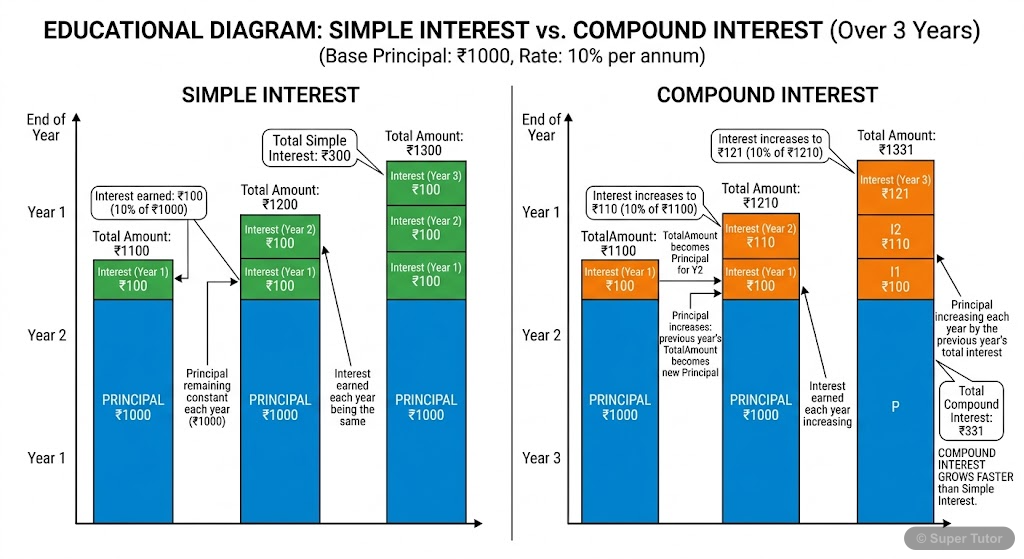
One of 6 illustrations for Compound Interest (Without Using Formula) in Super Tutor — alongside flashcards, concept maps and practice questions.
Quick Quiz: Compound Interest (Without Using Formula)
0/4Tap an answer to check it instantly. No sign-up needed for these 4.
What is the compound interest on ₹2,000 at 10% per annum for 2 years?
If ₹5,000 amounts to ₹5,500 in first year at compound interest, what will be the amount at the end of second year?
₹8,000 is invested at 5% compound interest. What is the difference between CI and SI for 2 years?
₹6,000 at 8% compound interest for 1.5 years. What is the total amount?
Sample Questions
Which of the following statements are correct about compound interest?
Show answer
CI for first year equals SI for first year, CI increases each year on same principal, CI is always greater than SI after first year
In CI, first year interest equals SI. Each year's interest is calculated on growing amount, so CI increases yearly and exceeds SI after year 1.
If compound interest on ₹10,000 for 2 years is ₹2,100, what is the rate per annum?
Show answer
10%
Let rate = r%. Year 1: CI = 10000r/100. Year 2: CI = (10000+10000r/100)×r/100. Total CI = 10000r/100 + (10000r + 100r²)/10000 = 2100. Solving: r = 10%
Which calculations are needed to find compound interest for 3 years?
Show answer
Interest for year 1 on original principal, Interest for year 2 on year 1 amount, Interest for year 3 on year 2 amount, Sum of all yearly interests
CI calculation requires computing interest each year on the growing principal (amount from previous year), then summing all yearly interests.
₹15,000 invested at different rates: 12% for year 1, 15% for year 2. What is the amount after 2 years?
Show answer
₹19,320
Year 1: Interest = (15000×12)/100 = ₹1,800, Amount = ₹16,800. Year 2: Interest = (16800×15)/100 = ₹2,520, Amount = 16800 + 2520 = ₹19,320
+30 more questions on Compound Interest (Without Using Formula) (ICSE Class 9 Mathematics)
Practise AllFrequently Asked Questions
What are the important topics in Compound Interest (Without Using Formula) for ICSE Class 9 Mathematics?
How many practice questions are there for Compound Interest (Without Using Formula)?
Sources & Official References
Content is aligned to the official syllabus. Refer to the board website for the latest curriculum.
More resources for Compound Interest (Without Using Formula)
Important Questions
Exam-style questions with answers
Revision Notes
Key points for last-minute revision
Formula Sheet
The chapter's formulas in one place
Chapter Summary
Understand the chapter at a glance
Concept Maps
See how topics connect
Study Plan
Step-by-step plan for this chapter
Flashcards
Quick-fire cards for active recall
Syllabus
What topics to cover
For serious students
Get the full Compound Interest (Without Using Formula) chapter — start free.
Quizzes, flashcards, an AI doubt solver and a study plan for ICSE Class 9 Mathematics. Free to start, no card needed.