Compound Interest (Without Using Formula) — Chapter Summary
ICSE · Class 9 · Mathematics
Summary of Compound Interest (Without Using Formula) for ICSE Class 9 Mathematics. Part of the ICSE Class 9 Mathematics syllabus.
Interactive on Super Tutor
Studying Compound Interest (Without Using Formula)? Get the full interactive chapter.
Quizzes, flashcards, AI doubt-solver and a step-by-step study plan — built for chapter summary and more.
Free trial, no card needed.
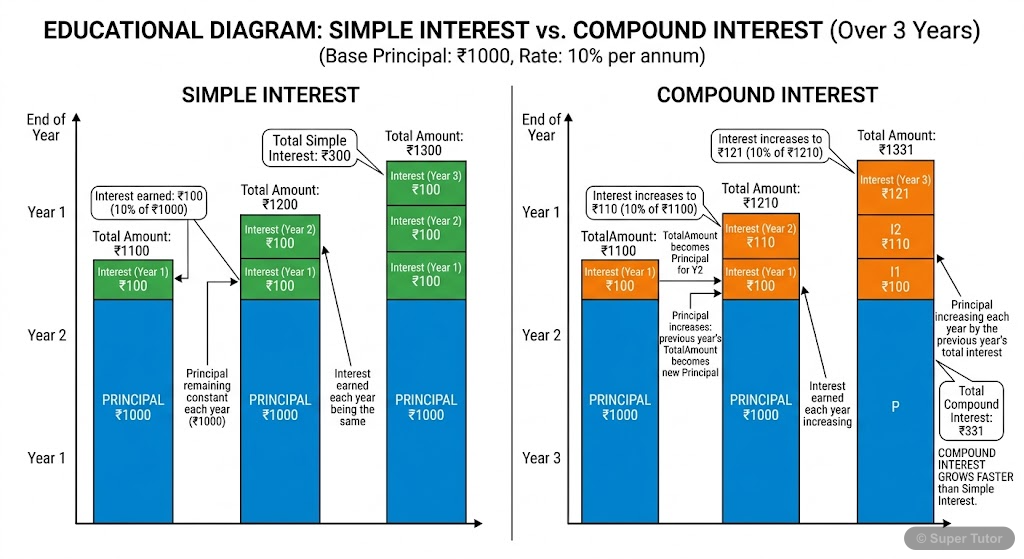
One of 6 illustrations for Compound Interest (Without Using Formula) in Super Tutor — alongside flashcards, concept maps and practice questions.
Overview
Compound interest is interest calculated on a growing principal. The interest of each period is added to the amount, and that new amount becomes the principal for the next period. Because of this, the interest keeps increasing from one period to the next. Simple interest is different because it is a
Key Concepts
The money borrowed is called
The money borrowed is called the principal. The extra money paid for using the lender's money is called interest. The total money paid to the lender a
Interest is simple if it
Interest is simple if it is calculated on the original principal throughout the loan period. Its formula is I = (P × R × T)/100. When interest is ment
Money is said to be lent
Money is said to be lent at compound interest when the interest due at the end of a fixed period is added to the sum lent, and the new amount becomes
The period after which the principal
The period after which the principal changes is called the conversion period. It may be one year in yearly compounding or half a year in half-yearly c
Compound interest increases from period
Compound interest increases from period to period. The compound interest of the second year is always more than the compound interest of the first yea
Learning Objectives
- Understand principal, interest, and amount.
- Distinguish between simple interest and compound interest.
- Find compound interest by calculating period by period.
- Work with yearly, half-yearly, and fractional-time compounding.
- Handle cases where rates change from one year to another.
Frequently Asked Questions
What are the important topics in Compound Interest (Without Using Formula) for ICSE Class 9 Mathematics?
How should I revise Compound Interest (Without Using Formula) for Class 9 exams?
Sources & Official References
Content is aligned to the official syllabus. Refer to the board website for the latest curriculum.
More resources for Compound Interest (Without Using Formula)
Practice Quiz
Test yourself with a quick quiz
Important Questions
Exam-style questions with answers
Revision Notes
Key points for last-minute revision
Formula Sheet
The chapter's formulas in one place
Concept Maps
See how topics connect
Study Plan
Step-by-step plan for this chapter
Flashcards
Quick-fire cards for active recall
Syllabus
What topics to cover
For serious students
Get the full Compound Interest (Without Using Formula) chapter — start free.
Quizzes, flashcards, an AI doubt solver and a study plan for ICSE Class 9 Mathematics. Free to start, no card needed.