Sound — NCERT Solutions
Jharkhand Board · Class 9 · Science
NCERT Solutions for Sound, Jharkhand Board Class 9 Science: 17 textbook questions solved step by step. Covers Exercises.
Interactive on Super Tutor
Studying Sound? Get the full interactive chapter.
Quizzes, flashcards, AI doubt-solver and a step-by-step study plan — built for NCERT solutions and more.
Free trial, no card needed.
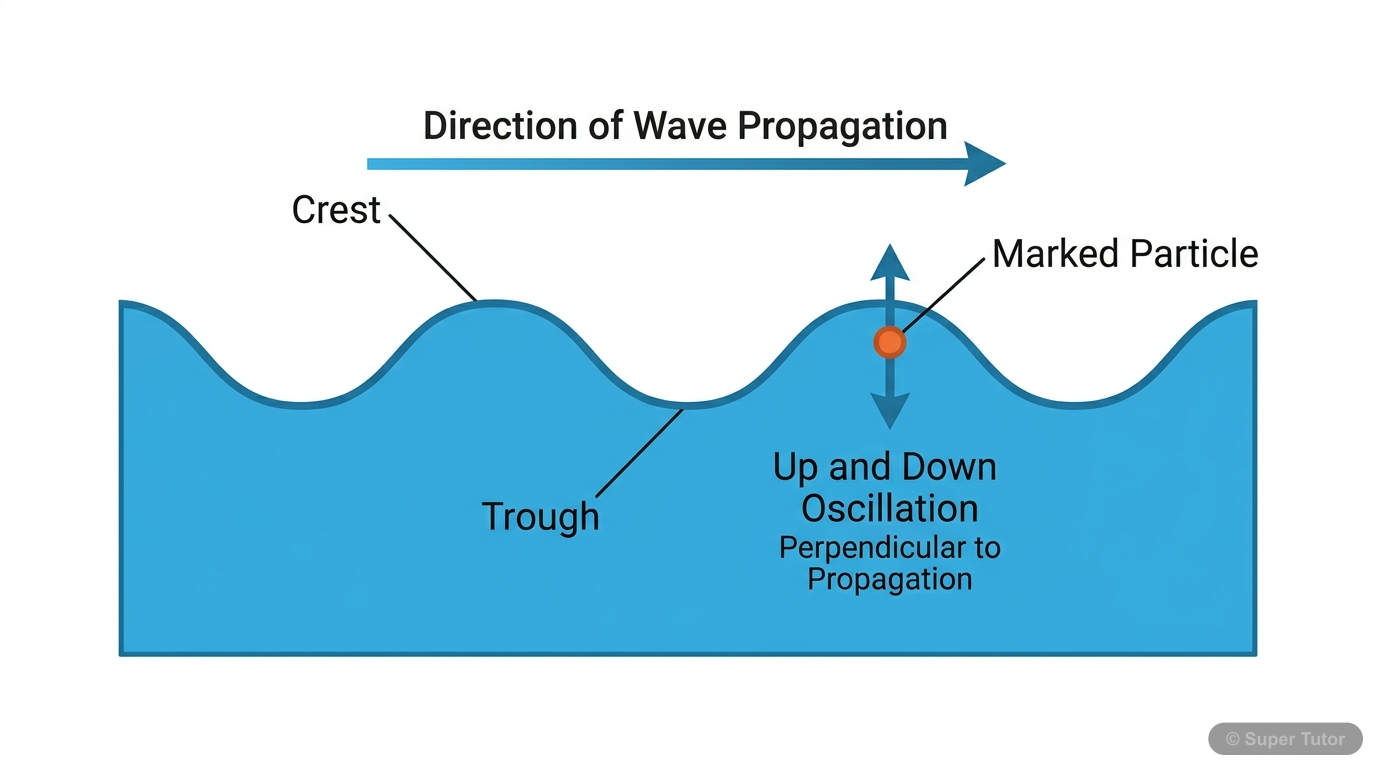
One of 2 illustrations for Sound in Super Tutor — alongside flashcards, concept maps and practice questions.
The first 9 solutions are open to read. The other 8 are free with a Super Tutor account.
Exercises
1What is sound and how is it produced?Show solution
Sound:
Sound is a form of energy that produces the sensation of hearing in our ears. It is a mechanical wave that requires a material medium (solid, liquid, or gas) for its propagation.
How sound is produced:
Sound is produced by the vibration of objects. When an object vibrates, it causes the particles of the surrounding medium to vibrate. These vibrations travel through the medium in the form of a wave, which we perceive as sound.
Example: When we pluck a stretched rubber band, it vibrates and produces sound. When a drum is beaten, its membrane vibrates and produces sound. The vibrating object acts as the source of sound.
2Describe with the help of a diagram, how compressions and rarefactions are produced in air near a source of sound.Show solution
Production of Compressions and Rarefactions:
Consider a vibrating tuning fork as the source of sound.
- When the prong of the tuning fork moves outward (forward), it pushes the air particles in front of it. These particles get crowded together, forming a region of high pressure called compression (C).
- When the prong moves inward (backward), it creates a region where air particles are spread apart, forming a region of low pressure called rarefaction (R).
- As the tuning fork continues to vibrate, a series of compressions and rarefactions are produced alternately in the air.
Diagram (description):
Where = Compression (region of high pressure, particles close together) and = Rarefaction (region of low pressure, particles spread apart).
These compressions and rarefactions propagate through the air as a longitudinal sound wave.
3Why is sound wave called a longitudinal wave?Show solution
Sound wave is called a longitudinal wave because the particles of the medium vibrate in the same direction as the direction of propagation of the wave.
Explanation:
When a sound wave travels through air, the air particles are displaced back and forth along the direction in which the wave is moving. This creates alternating regions of compressions (high pressure) and rarefactions (low pressure) along the direction of wave propagation.
Since the direction of particle vibration is parallel (along the same line) to the direction of wave propagation, sound waves are classified as longitudinal waves.
This is in contrast to transverse waves (like light waves), where particle vibration is perpendicular to the direction of wave propagation.
4Which characteristic of the sound helps you to identify your friend by his voice while sitting with others in a dark room?Show solution
The characteristic of sound that helps us identify a friend by his voice in a dark room is quality (or timbre) of sound.
Explanation:
Even if two sounds have the same pitch (frequency) and the same loudness (amplitude), they can differ in quality. Quality of sound depends on the waveform of the sound, which is determined by the number and relative intensities of the overtones (harmonics) present in the sound.
Every person has a unique vocal structure, so the sound produced by each person has a unique waveform (quality/timbre). This unique quality allows us to distinguish one person's voice from another even in darkness.
5Flash and thunder are produced simultaneously. But thunder is heard a few seconds after the flash is seen, why?Show solution
Given/Known:
- Flash (light) and thunder (sound) are produced simultaneously during lightning.
- Speed of light
- Speed of sound in air
Reason:
The speed of light is enormously greater than the speed of sound. Light travels at , while sound travels at only about in air.
Therefore, light from the flash reaches our eyes almost instantaneously, while sound (thunder) takes a much longer time to travel the same distance. This is why we see the flash first and hear the thunder a few seconds later.
Conclusion: The time gap between seeing the flash and hearing the thunder is due to the vast difference in the speeds of light and sound.
6A person has a hearing range from 20 Hz to 20 kHz. What are the typical wavelengths of sound waves in air corresponding to these two frequencies? Take the speed of sound in air as 344 m s⁻¹.Show solution
Given:
- Speed of sound in air,
- Frequency
- Frequency
Formula:
For :
For :
Result:
- Wavelength corresponding to 20 Hz
- Wavelength corresponding to 20 kHz (or )
7Two children are at opposite ends of an aluminium rod. One strikes the end of the rod with a stone. Find the ratio of times taken by the sound wave in air and in aluminium to reach the second child.Show solution
Given:
- Speed of sound in air, (standard value used in NCERT)
- Speed of sound in aluminium, (standard value from NCERT table)
- Let the length of the aluminium rod
Formula:
Time taken by sound through air:
Time taken by sound through aluminium:
Ratio:
This means sound takes about 18.5 times longer to travel through air than through aluminium for the same distance.
8The frequency of a source of sound is 100 Hz. How many times does it vibrate in a minute?Show solution
Given:
- Frequency of sound,
- Time
Concept:
Frequency is defined as the number of vibrations (oscillations) per second.
Calculation:
Answer: The source vibrates 6000 times in one minute.
9Does sound follow the same laws of reflection as light does? Explain.Show solution
Yes, sound follows the same laws of reflection as light does.
Laws of Reflection of Sound:
- First Law: The angle of incidence of the sound wave is equal to the angle of reflection.
- Second Law: The incident sound wave, the reflected sound wave, and the normal to the reflecting surface at the point of incidence — all lie in the same plane.
Explanation:
Just like light, when sound waves strike a hard surface (like a wall, cliff, or building), they bounce back. The direction of the reflected sound wave obeys the same geometrical rules as reflected light. This is why we hear echoes — the reflected sound follows the same laws as reflected light.
Practical evidence: The phenomenon of echo and the working of a megaphone, stethoscope, and soundboards all demonstrate that sound obeys the laws of reflection.
Free with a Super Tutor account
Free with a Super Tutor account
Free with a Super Tutor account
Free with a Super Tutor account
Free with a Super Tutor account
Free with a Super Tutor account
Free with a Super Tutor account
Free with a Super Tutor account
8 more solved questions in Sound
They are free with a Super Tutor account, along with practice quizzes and flashcards for this chapter. Free to start, no card needed.
Frequently Asked Questions
What are the important topics in Sound for Jharkhand Board Class 9 Science?
Are these NCERT Solutions for Sound free?
How should I revise Sound for Class 9 exams?
Sources & Official References
Content is aligned to the official syllabus. Refer to the board website for the latest curriculum.
More resources for Sound
For serious students
Get the full Sound chapter — start free.
Quizzes, flashcards, an AI doubt solver and a study plan for Jharkhand Board Class 9 Science. Free to start, no card needed.