Chapter 10 of 12
NCERT Solutions

Work and Energy

Jharkhand Board · Class 9 · Science

NCERT Solutions for Work and Energy — Jharkhand Board Class 9 Science.

45 questions22 flashcards5 concepts

Interactive on Super Tutor

Studying Work and Energy? Get the full interactive chapter.

Quizzes, flashcards, AI doubt-solver and a step-by-step study plan — built for ncert solutions and more.

1,000+ Class 9 students started this chapter today

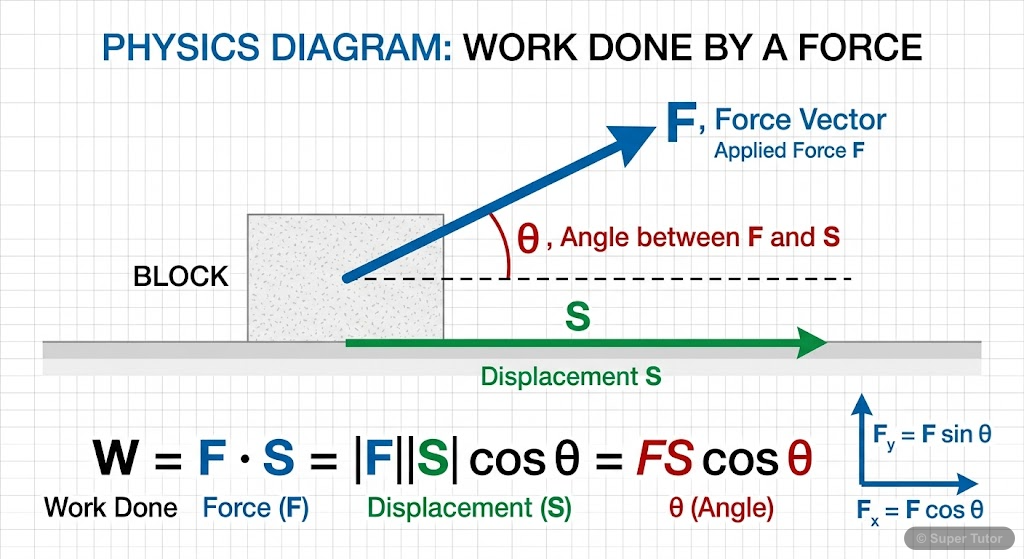
An illustration showing a block being pulled by a constant force F at an angle theta to the horizontal displacement S, with the formula W = F ⋅ S = FS cosθ.
Super Tutor

Learn better with visuals Super Tutor has hundreds of illustrations like this across every chapter — all free to try.

Get started
21 Questions Solved · 1 Section

Exercises

1Look at the activities listed below. Reason out whether or not work is done in the light of your understanding of the term 'work'.
- Suma is swimming in a pond.
- A donkey is carrying a load on its back.
- A wind-mill is lifting water from a well.
- A green plant is carrying out photosynthesis.
- An engine is pulling a train.
- Food grains are getting dried in the sun.
- A sailboat is moving due to wind energy.
Show solution
Concept: Work is done when a force acts on an object AND the object is displaced in the direction of (or having a component along) the applied force. W = F × d × cos θ.

1. Suma is swimming in a pond.
Suma applies force on water with her arms and legs, and her body moves forward (displacement occurs in the direction of applied force). Work is done.

2. A donkey is carrying a load on its back.
The donkey exerts an upward force (normal reaction) to support the load, but the displacement of the load is horizontal. The angle between force (vertical) and displacement (horizontal) is 90°, so W = F × d × cos 90° = 0. Work is NOT done by the donkey on the load (in the scientific sense).

3. A wind-mill is lifting water from a well.
The windmill applies force on water and the water is displaced upward (in the direction of force). Work is done.

4. A green plant is carrying out photosynthesis.
Photosynthesis is a biochemical process. There is no mechanical force causing displacement of an object. Work is NOT done (in the mechanical sense).

5. An engine is pulling a train.
The engine applies force on the train and the train moves in the direction of the force. Work is done.

6. Food grains are getting dried in the sun.
Drying is a physical/chemical process involving heat energy. No mechanical force causes displacement of the grains. Work is NOT done (in the mechanical sense).

7. A sailboat is moving due to wind energy.
Wind exerts force on the sail and the boat is displaced in the direction of the force. Work is done.
2An object thrown at a certain angle to the ground moves in a curved path and falls back to the ground. The initial and the final points of the path of the object lie on the same horizontal line. What is the work done by the force of gravity on the object?Show solution
Given:
- Object is thrown at an angle and returns to the same horizontal level.
- Initial point and final point are on the same horizontal line.

Concept: Work done by gravity = W=mghW = mgh, where hh is the vertical displacement (change in height).

Working:
Since the initial and final points lie on the same horizontal line, the net vertical displacement of the object is:
h=hfinalhinitial=0h = h_{\text{final}} - h_{\text{initial}} = 0

Therefore, work done by gravity:
W=mgh=mg×0=0W = mgh = mg \times 0 = 0

Answer: The work done by the force of gravity on the object is zero.
3A battery lights a bulb. Describe the energy changes involved in the process.Show solution
Energy transformations when a battery lights a bulb:

Step 1: The battery contains stored chemical energy.

Step 2: When the circuit is complete, chemical energy of the battery is converted into electrical energy (electric current flows through the circuit).

Step 3: When electric current passes through the filament of the bulb, electrical energy is converted into heat energy and light energy.

Summary of transformation:
Chemical EnergyElectrical EnergyHeat Energy + Light Energy\text{Chemical Energy} \rightarrow \text{Electrical Energy} \rightarrow \text{Heat Energy + Light Energy}
4Certain force acting on a 20 kg mass changes its velocity from 5 m/s to 2 m/s. Calculate the work done by the force.Show solution
Given:
- Mass, m=20m = 20 kg
- Initial velocity, u=5u = 5 m s1^{-1}
- Final velocity, v=2v = 2 m s1^{-1}

Concept: By the work-energy theorem, the work done by a force equals the change in kinetic energy of the object.
W=ΔKE=12mv212mu2W = \Delta KE = \frac{1}{2}mv^2 - \frac{1}{2}mu^2

Calculation:
W=12×20×(2)212×20×(5)2W = \frac{1}{2} \times 20 \times (2)^2 - \frac{1}{2} \times 20 \times (5)^2
W=12×20×412×20×25W = \frac{1}{2} \times 20 \times 4 - \frac{1}{2} \times 20 \times 25
W=40250W = 40 - 250
W=210 JW = -210 \text{ J}

Answer: The work done by the force is 210\mathbf{-210} J. The negative sign indicates that the force acts opposite to the direction of motion (it decelerates the object).
5A mass of 10 kg is at a point A on a table. It is moved to a point B. If the line joining A and B is horizontal, what is the work done on the object by the gravitational force? Explain your answer.Show solution
Given:
- Mass of object, m=10m = 10 kg
- The object is moved from point A to point B on a horizontal surface.
- The line AB is horizontal.

Concept: Work done by gravity = W=mghW = mgh, where hh is the vertical displacement.

Explanation:
Gravitational force acts vertically downward. When the object moves horizontally from A to B, there is no change in its height, i.e., the vertical displacement h=0h = 0.

The angle between the gravitational force (downward) and the displacement (horizontal) is 90°.
W=F×d×cos90°=mgh=mg×0=0W = F \times d \times \cos 90° = mgh = mg \times 0 = 0

Answer: The work done on the object by the gravitational force is zero, because the displacement is perpendicular to the direction of gravitational force (there is no vertical displacement).
6The potential energy of a freely falling object decreases progressively. Does this violate the law of conservation of energy? Why?Show solution
Answer: No, this does not violate the law of conservation of energy.

Explanation:
When an object falls freely from a height, its potential energy decreases. However, as it falls, its velocity increases, so its kinetic energy increases progressively.

According to the law of conservation of energy, energy can neither be created nor destroyed; it can only be transformed from one form to another.

During free fall:
- The potential energy (= mghmgh) decreases as height hh decreases.
- The kinetic energy (= 12mv2\frac{1}{2}mv^2) increases as velocity vv increases.
- The total mechanical energy (KE + PE) remains constant at every point.

KE+PE=constantKE + PE = \text{constant}

Thus, the decrease in potential energy is exactly equal to the increase in kinetic energy. The law of conservation of energy is fully obeyed.
7What are the various energy transformations that occur when you are riding a bicycle?Show solution
Energy transformations while riding a bicycle:

Step 1: The rider's body uses chemical energy (stored in food/muscles).

Step 2: The rider's muscles convert chemical energy into mechanical energy (muscular effort applied to the pedals).

Step 3: The mechanical energy of the pedals is transferred to the wheels through the chain, causing the bicycle to move — this is kinetic energy of the bicycle.

Step 4: Some energy is also lost as heat energy due to friction between the tyres and the road, and in the chain and bearings.

Summary:
Chemical EnergyMechanical (Muscular) EnergyKinetic Energy of Bicycle + Heat Energy (due to friction)\text{Chemical Energy} \rightarrow \text{Mechanical (Muscular) Energy} \rightarrow \text{Kinetic Energy of Bicycle + Heat Energy (due to friction)}
8Does the transfer of energy take place when you push a huge rock with all your might and fail to move it? Where is the energy you spend going?Show solution
Answer: In the scientific sense, no work is done on the rock because the rock does not move (displacement = 0). Therefore, no energy is transferred to the rock.

However, the person does spend energy. This energy is used by the muscles of the body. When we push the rock, our muscle fibres undergo repeated contraction and relaxation. The chemical energy stored in the body (from food) is used up and converted into heat energy, which causes the body to feel warm and tired.

Conclusion: The energy spent by the person is converted into heat energy within the body (muscles). No mechanical work is done on the rock since there is no displacement.
9A certain household has consumed 250 units of energy during a month. How much energy is this in joules?Show solution
Given:
- Energy consumed = 250 units

Concept: 1 unit of electrical energy = 1 kilowatt-hour (kWh)
1 kWh=1000 W×3600 s=3.6×10⁶ J1 \text{ kWh} = 1000 \text{ W} \times 3600 \text{ s} = 3.6 \times 10^6 \text{ J}

Calculation:
Energy=250 units=250 kWh\text{Energy} = 250 \text{ units} = 250 \text{ kWh}
=250×3.6×106 J= 250 \times 3.6 \times 10^6 \text{ J}
=9×10⁸ J= 9 \times 10^8 \text{ J}

Answer: The energy consumed is 9×10⁸\mathbf{9 \times 10^8} J.
10An object of mass 40 kg is raised to a height of 5 m above the ground. What is its potential energy? If the object is allowed to fall, find its kinetic energy when it is half-way down.Show solution
Given:
- Mass, m=40m = 40 kg
- Height, h=5h = 5 m
- g=10g = 10 m s2^{-2}

Part (i): Potential Energy at height 5 m
PE=mgh=40×10×5=2000 JPE = mgh = 40 \times 10 \times 5 = 2000 \text{ J}

Part (ii): Kinetic Energy at half-way down (i.e., at height = 2.5 m)

At half-way down, height = 52=2.5\frac{5}{2} = 2.5 m

Using the law of conservation of energy:
Total Energy=KE+PE=constant=2000 J\text{Total Energy} = KE + PE = \text{constant} = 2000 \text{ J}

Potential energy at half-way point:
PEhalf=mgh=40×10×2.5=1000 JPE_{\text{half}} = mgh' = 40 \times 10 \times 2.5 = 1000 \text{ J}

Therefore, kinetic energy at half-way point:
KE=Total EnergyPEhalf=20001000=1000 JKE = \text{Total Energy} - PE_{\text{half}} = 2000 - 1000 = 1000 \text{ J}

Answer:
- Potential energy at height 5 m = 2000 J
- Kinetic energy at half-way down = 1000 J
11What is the work done by the force of gravity on a satellite moving round the earth? Justify your answer.Show solution
Answer: The work done by the force of gravity on a satellite moving around the earth is zero.

Justification:
For a satellite in a circular orbit around the earth, the gravitational force acts towards the centre of the earth (centripetal direction), which is always perpendicular to the direction of motion (displacement) of the satellite at every point.

Since the angle θ\theta between the gravitational force and the displacement is always 90°:
W=F×d×cos90°=0W = F \times d \times \cos 90° = 0

Also, in a circular orbit, the satellite returns to the same point after one revolution, so the net displacement in the direction of gravity is zero.

Therefore, the work done by gravity on the satellite is zero.
12Can there be displacement of an object in the absence of any force acting on it? Think. Discuss this question with your friends and teacher.Show solution
Answer: Yes, there can be displacement of an object in the absence of any force acting on it.

Explanation:
According to Newton's first law of motion, an object in uniform motion continues to move with the same velocity in a straight line unless an external force acts on it.

If no net force acts on a moving object, it continues to move with constant velocity and thus gets displaced.

Example: An object moving in outer space (where there is no gravity or friction) will continue to move and get displaced without any force acting on it.

Conclusion: Displacement is possible without a force if the object is already in motion. In such a case, the work done by the net force is zero (since force = 0), but displacement is non-zero.
13A person holds a bundle of hay over his head for 30 minutes and gets tired. Has he done some work or not? Justify your answer.Show solution
Answer: In the scientific sense, the person has done no work on the bundle of hay.

Justification:
Work is done only when a force causes displacement in the object on which the force is applied.

Here:
- The person applies an upward force on the bundle of hay to hold it.
- The bundle of hay does not move — its displacement is zero.

W=F×d=F×0=0W = F \times d = F \times 0 = 0

Since displacement = 0, work done = 0.

Why does the person get tired?
The person gets tired because the muscles in the body continuously contract and relax to maintain the upward force. This uses up chemical energy stored in the body, which is converted into heat energy, causing fatigue. But this is not mechanical work done on the hay.
14An electric heater is rated 1500 W. How much energy does it use in 10 hours?Show solution
Given:
- Power of heater, P=1500P = 1500 W
- Time, t=10t = 10 hours =10×3600=36000= 10 \times 3600 = 36000 s

Concept: Energy = Power × Time
E=P×tE = P \times t

Calculation:
E=1500 W×36000 sE = 1500 \text{ W} \times 36000 \text{ s}
E=5.4×10⁷ JE = 5.4 \times 10^7 \text{ J}

In kilowatt-hours:
E=1.5 kW×10 h=15 kWh=15 unitsE = 1.5 \text{ kW} \times 10 \text{ h} = 15 \text{ kWh} = 15 \text{ units}

Answer: The electric heater uses 5.4×10⁷\mathbf{5.4 \times 10^7} J (or 15 kWh) of energy in 10 hours.
15Illustrate the law of conservation of energy by discussing the energy changes which occur when we draw a pendulum bob to one side and allow it to oscillate. Why does the bob eventually come to rest? What happens to its energy eventually? Is it a violation of the law of conservation of energy?Show solution
Law of Conservation of Energy and the Pendulum:

Setup: Consider a pendulum bob at its mean position O. It is drawn to one side to position A (highest point) and released.

Energy changes during oscillation:

- At position A (extreme position):
The bob is at maximum height. It is momentarily at rest.
- KE = 0 (velocity = 0)
- PE = maximum (= mghmgh)
- Total Energy = PE = mghmgh

- At position O (mean/lowest position):
The bob has maximum velocity.
- KE = maximum (= 12mv2\frac{1}{2}mv^2)
- PE = 0 (taking O as reference)
- Total Energy = KE = 12mv2\frac{1}{2}mv^2

- At any intermediate position:
- Total Energy = KE + PE = constant

At every point: KE+PE=mgh=constantKE + PE = mgh = \text{constant}

This illustrates the law of conservation of energy — energy is continuously transformed between kinetic and potential forms, but the total mechanical energy remains constant.

Why does the bob eventually come to rest?
In practice, the bob experiences air resistance and friction at the pivot. These forces cause the mechanical energy of the bob to be gradually converted into heat energy (and a little sound energy). As a result, the amplitude of oscillation decreases and the bob eventually comes to rest.

Is this a violation of the law of conservation of energy?
No, it is not a violation. The total energy (mechanical energy + heat energy + sound energy) remains constant. The mechanical energy is simply transformed into other forms of energy. The law of conservation of energy is fully obeyed.
16An object of mass, m is moving with a constant velocity, v. How much work should be done on the object in order to bring the object to rest?Show solution
Given:
- Mass of object = mm
- Initial velocity = vv
- Final velocity = 0 (object is brought to rest)

Concept: By the work-energy theorem:
W=ΔKE=KEfinalKEinitialW = \Delta KE = KE_{\text{final}} - KE_{\text{initial}}

Calculation:
W=12m(0)212mv2W = \frac{1}{2}m(0)^2 - \frac{1}{2}mv^2
W=012mv2W = 0 - \frac{1}{2}mv^2
W=12mv2\boxed{W = -\frac{1}{2}mv^2}

Answer: Work done on the object to bring it to rest is 12mv2\mathbf{-\frac{1}{2}mv^2}.

The negative sign indicates that the work is done against the direction of motion (a retarding force is applied). The magnitude of work required is 12mv2\frac{1}{2}mv^2.
17Calculate the work required to be done to stop a car of 1500 kg moving at a velocity of 60 km/h.Show solution
Given:
- Mass of car, m=1500m = 1500 kg
- Initial velocity, u=60u = 60 km/h =60×10003600=503= 60 \times \frac{1000}{3600} = \frac{50}{3} m/s
- Final velocity, v=0v = 0 (car is stopped)

Concept: Work done = Change in kinetic energy
W=12mv212mu2W = \frac{1}{2}mv^2 - \frac{1}{2}mu^2

Calculation:
u=503 m/su = \frac{50}{3} \text{ m/s}
W=12×1500×(0)212×1500×(503)2W = \frac{1}{2} \times 1500 \times (0)^2 - \frac{1}{2} \times 1500 \times \left(\frac{50}{3}\right)^2
W=012×1500×25009W = 0 - \frac{1}{2} \times 1500 \times \frac{2500}{9}
W=1500×250018W = -\frac{1500 \times 2500}{18}
W=375000018W = -\frac{3750000}{18}
W=208333.3 JW = -208333.3 \text{ J}
W2.08×105 JW \approx -2.08 \times 10^5 \text{ J}

Answer: The work required to stop the car is 2.08×10⁵\mathbf{-2.08 \times 10^5} J (approximately 208333-208333 J). The negative sign indicates the work is done against the motion of the car.
18In each of the following a force, F is acting on an object of mass, m. The direction of displacement is from west to east shown by the longer arrow. Observe the diagrams carefully and state whether the work done by the force is negative, positive or zero. (Three cases shown in diagram)Show solution
Note: The diagram shows three cases. Based on standard NCERT content, the three cases are:
- Case (i): Force F acts in the direction of displacement (from west to east).
- Case (ii): Force F acts perpendicular to the direction of displacement (vertically upward or downward).
- Case (iii): Force F acts opposite to the direction of displacement (from east to west).

Concept: W=F×d×cosθW = F \times d \times \cos\theta, where θ\theta is the angle between force and displacement.

---

Case (i): Force and displacement are in the same direction (θ=0°\theta = 0°)
W = Fd\cos 0° = Fd \times 1 = Fd > 0
Work done is POSITIVE.

---

Case (ii): Force is perpendicular to displacement (θ=90°\theta = 90°)
W=Fdcos90°=Fd×0=0W = Fd\cos 90° = Fd \times 0 = 0
Work done is ZERO.

---

Case (iii): Force and displacement are in opposite directions (θ=180°\theta = 180°)
W = Fd\cos 180° = Fd \times (-1) = -Fd < 0
Work done is NEGATIVE.
19Soni says that the acceleration in an object could be zero even when several forces are acting on it. Do you agree with her? Why?Show solution
Answer: Yes, I agree with Soni.

Explanation:
According to Newton's second law of motion:
Fnet=maF_{\text{net}} = ma

If the net (resultant) force acting on an object is zero, then the acceleration a=0a = 0, even if several individual forces are acting on the object.

This happens when all the forces acting on the object balance each other (i.e., they cancel out vectorially).

Example:
- A book lying on a table has two forces acting on it: gravity (downward) and normal reaction from the table (upward). These two forces are equal and opposite, so the net force is zero and acceleration is zero.
- A tug-of-war where both teams pull with equal force — the rope does not accelerate even though forces are acting.

Conclusion: When the vector sum of all forces acting on an object is zero, the acceleration is zero. So Soni is correct.
20Find the energy in joules consumed in 10 hours by four devices of power 500 W each.Show solution
Given:
- Power of each device, P=500P = 500 W
- Number of devices = 4
- Time, t=10t = 10 hours =10×3600=36000= 10 \times 3600 = 36000 s

Total power of four devices:
Ptotal=4×500=2000 WP_{\text{total}} = 4 \times 500 = 2000 \text{ W}

Energy consumed:
E=Ptotal×t=2000×36000E = P_{\text{total}} \times t = 2000 \times 36000
E=7.2×10⁷ JE = 7.2 \times 10^7 \text{ J}

Answer: The energy consumed by four devices in 10 hours is 7.2×10⁷\mathbf{7.2 \times 10^7} J.
21A freely falling object eventually stops on reaching the ground. What happens to its kinetic energy?Show solution
Answer: When a freely falling object hits the ground and stops, its kinetic energy is not destroyed. It is transformed into other forms of energy.

Explanation:
Just before hitting the ground, the object possesses maximum kinetic energy (all the potential energy has been converted to kinetic energy).

When the object strikes the ground and comes to rest:
- The kinetic energy is converted into heat energy (the object and ground become slightly warm).
- Some energy is converted into sound energy (we hear the sound of impact).
- If the object deforms or the ground deforms, some energy is stored as deformation/strain energy.

This is in accordance with the law of conservation of energy — the total energy is conserved; it is only transformed from kinetic energy into heat, sound, and deformation energy.

Conclusion: The kinetic energy of the freely falling object is converted into heat energy, sound energy, and deformation energy upon hitting the ground. No energy is destroyed.

Stuck on a step?

Ask Super Tutor AI to explain any solution on this page in a simpler way — free, 24x7.

Ask a Doubt Free

Frequently Asked Questions

What are the important topics in Work and Energy for Jharkhand Board Class 9 Science?
Work and Energy covers several key topics that are frequently asked in Jharkhand Board Class 9 board exams. Focus on the core concepts listed on this page and practise related questions to build confidence.
How to score full marks in Work and Energy — Jharkhand Board Class 9 Science?
Understand the core concepts first, then work through the 45 practice questions available for this chapter. Revise formulas and definitions regularly, and use flashcards for quick recall before the exam.
Where can I get free NCERT Solutions for Work and Energy Class 9 Science?
This page has free step-by-step NCERT Solutions for every exercise question in Work and Energy (Jharkhand Board Class 9 Science) — written the way examiners award marks: given, formula, working, answer.

Sources & Official References

Content is aligned to the official syllabus. Refer to the board website for the latest curriculum.

For serious students

Get the full Work and Energy chapter — for free.

Quizzes, flashcards, AI doubt-solver and a step-by-step study plan for Jharkhand Board Class 9 Science.