Microbes in Human Welfare — Revision Notes
Madhya Pradesh Board · Class 12 · Biology
Microbes in Human Welfare revision notes for Madhya Pradesh Board Class 12 Biology: 4 topics in quick points. Includes Microbes in Household Products.
Interactive on Super Tutor
Studying Microbes in Human Welfare? Get the full interactive chapter.
Quizzes, flashcards, AI doubt-solver and a step-by-step study plan — built for revision notes and more.
Free trial, no card needed.
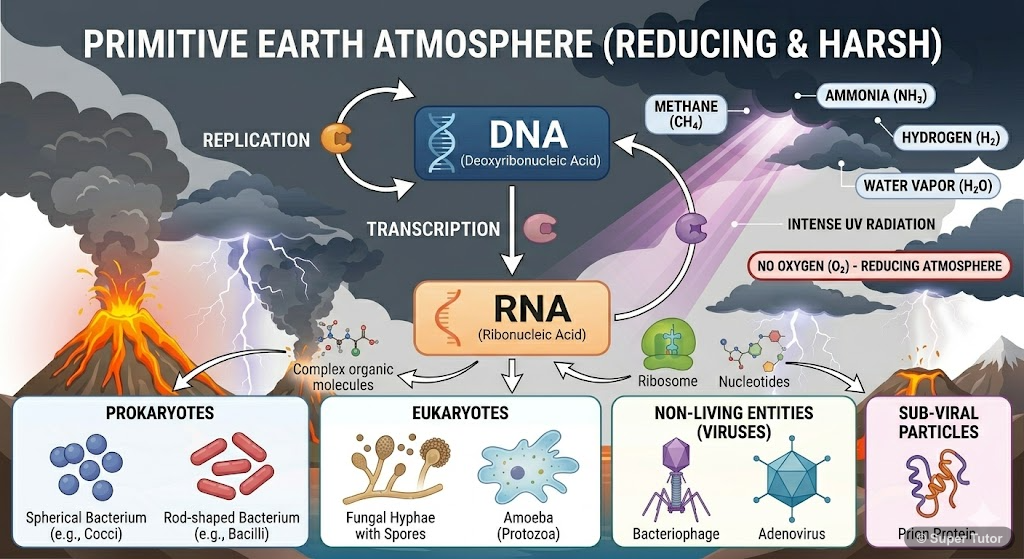
One of 13 illustrations for Microbes in Human Welfare in Super Tutor — alongside flashcards, concept maps and practice questions.
Key Topics to Revise
Microbes in Household Products
- Lactobacillus and other lactic acid bacteria (LAB) grow in milk and convert it into curd.
- LAB produce acids that coagulate and partially digest milk proteins during curd formation.
- A small amount of curd added to fresh milk as a starter contains millions of LAB and helps rapid curd formation at suitable temperature.
Microbes in Industrial Products
- Industrial-scale microbial production is done in large vessels called fermentors.
- Yeast, especially Saccharomyces cerevisiae, is used for commercial production of ethanol.
- Wine and beer are produced without distillation.
Microbes in Sewage Treatment
- Sewage is municipal waste-water containing large amounts of organic matter and pathogenic microbes.
- Sewage cannot be discharged directly into rivers and streams.
- Sewage treatment is carried out in two stages: primary treatment and secondary treatment.
Microbes in Production of Biogas
- Biogas is a mixture of gases containing predominantly methane, produced by microbial activity and used as fuel.
- Certain bacteria grow anaerobically on cellulosic material and produce methane, carbon dioxide, and hydrogen.
- These bacteria are called methanogens.
Get complete notes with diagrams and examples
Full NotesKey Concepts
Frequently Asked Questions
What are the important topics in Microbes in Human Welfare for Madhya Pradesh Board Class 12 Biology?
How should I revise Microbes in Human Welfare for the Madhya Pradesh Board Class 12 board exam?
Sources & Official References
Content is aligned to the official syllabus. Refer to the board website for the latest curriculum.
More resources for Microbes in Human Welfare
Practice Quiz
Test yourself with a quick quiz
Important Questions
Exam-style questions with answers
Chapter Summary
Understand the chapter at a glance
Concept Maps
See how topics connect
Study Plan
Step-by-step plan for this chapter
Flashcards
Quick-fire cards for active recall
Syllabus
What topics to cover
NCERT Solutions
Every textbook question solved step by step
For serious students
Get the full Microbes in Human Welfare chapter — start free.
Quizzes, flashcards, an AI doubt solver and a study plan for Madhya Pradesh Board Class 12 Biology. Free to start, no card needed.