Microbes in Human Welfare — NCERT Solutions
Madhya Pradesh Board · Class 12 · Biology
NCERT Solutions for Microbes in Human Welfare, Madhya Pradesh Board Class 12 Biology: 15 textbook questions solved step by step.
Interactive on Super Tutor
Studying Microbes in Human Welfare? Get the full interactive chapter.
Quizzes, flashcards, AI doubt-solver and a step-by-step study plan — built for NCERT solutions and more.
Free trial, no card needed.
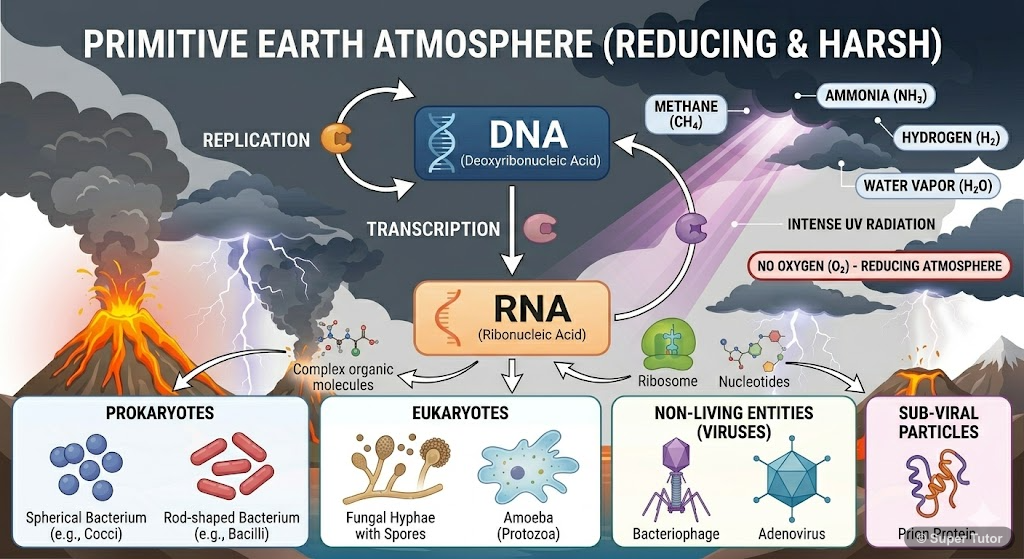
One of 13 illustrations for Microbes in Human Welfare in Super Tutor — alongside flashcards, concept maps and practice questions.
The first 8 solutions are open to read. The other 7 are free with a Super Tutor account.
EXERCISES — Microbes in Human Welfare
1Bacteria cannot be seen with the naked eyes, but these can be seen with the help of a microscope. If you have to carry a sample from your home to your biology laboratory to demonstrate the presence of microbes with the help of a microscope, which sample would you carry and why?Show solution
Sample to carry: Curd (or a piece of bread with mould, or a sample of buttermilk).
Best choice — Curd:
Given: We need a sample that is readily available at home and contains microbes that can be demonstrated under a microscope.
Reason:
- Curd is prepared by the action of Lactic Acid Bacteria (LAB), specifically Lactobacillus species.
- These bacteria are present in very large numbers in curd (millions per mL).
- A thin smear of curd on a glass slide, when stained and observed under a microscope, clearly shows the rod-shaped or spherical bacterial cells.
- Curd is easily available at home, is safe to handle, and the bacteria in it are non-pathogenic.
- Other suitable samples: a piece of mouldy bread (shows fungal hyphae of Rhizopus), or a sample of fermenting dough (shows yeast cells).
Conclusion: Curd is the most convenient and safe sample to carry from home to demonstrate the presence of microbes under a microscope.
2Give examples to prove that microbes release gases during metabolism.Show solution
Concept: Microbes carry out various metabolic processes (fermentation, respiration, decomposition) during which gases are released as by-products.
Examples:
- Carbon dioxide (CO₂) by Yeast:
- Saccharomyces cerevisiae (baker's yeast) ferments sugars anaerobically:
- The released causes dough to rise (leavening of bread) and produces froth in fermenting liquids (beer, wine).
- Methane (CH₄) by Methanogens:
- Methanogenic bacteria (e.g., Methanobacterium) decompose organic matter in anaerobic conditions and release methane (biogas):
- This is the basis of biogas production.
- Hydrogen sulphide (H₂S) by decomposers:
- Bacteria decomposing proteins and sulphur-containing compounds release , which gives a foul smell to sewage and rotten eggs.
- CO₂ by LAB:
- Lactic acid bacteria fermenting milk also release small amounts of .
Conclusion: The rising of bread dough, production of biogas, and frothing during fermentation are direct evidence that microbes release gases during metabolism.
3In which food would you find lactic acid bacteria? Mention some of their useful applications.Show solution
Foods containing Lactic Acid Bacteria (LAB):
- Curd — LAB (Lactobacillus) convert lactose in milk to lactic acid, causing coagulation and formation of curd.
- Cheese
- Buttermilk
- Fermented dough (for idli, dosa)
- Pickles
- Yoghurt
Useful Applications of LAB:
- Curd formation: LAB ferment milk to produce curd, which is nutritionally superior to milk as it is more digestible.
- Nutritional improvement: LAB increase the vitamin content of the product during fermentation.
- Checking harmful microbes: The lactic acid produced lowers the pH of the food, thereby checking the growth of disease-causing microbes. This acts as a natural preservative.
- Cheese production: LAB are used in the preparation of various types of cheese.
- Health benefits (Probiotics): LAB present in curd help in maintaining a healthy gut flora and improve digestion.
- Industrial production of lactic acid: Lactic acid produced by LAB is used in the food and pharmaceutical industries.
Conclusion: LAB are found in curd and other fermented dairy products and play an important role in food preservation, nutrition, and industry.
4Name some traditional Indian foods made of wheat, rice and Bengal gram (or their products) which involve use of microbes.Show solution
Concept: Many traditional Indian foods are prepared by fermentation, which involves the action of microbes (bacteria, yeast, or fungi).
| Raw Material | Traditional Food | Microbe Involved |
|---|---|---|
| Rice | Idli, Dosa | Bacteria (Leuconostoc, Lactobacillus) and yeast |
| Rice | Toddy (fermented rice drink) | Yeast |
| Wheat | Bread | Saccharomyces cerevisiae (yeast) |
| Wheat | Jalebi | Yeast (Saccharomyces) |
| Bengal gram | Dhokla, Khaman | Bacteria (LAB) and yeast |
| Bengal gram | Idli (urad dal + rice) | LAB and yeast |
Details:
- ***Idli* and Dosa:** Made from a batter of rice and black gram (urad dal) that is fermented overnight by lactic acid bacteria and yeast. Fermentation makes the batter rise and improves nutritional quality.
- ***Dhokla*:** Made from fermented batter of Bengal gram flour; microbes produce which makes it spongy.
- Bread: Wheat dough is fermented by Saccharomyces cerevisiae; produced makes the bread porous and soft.
- ***Jalebi*:** Wheat flour batter is fermented by yeast before frying.
Conclusion: Fermentation by microbes is an integral part of preparing many traditional Indian foods.
5In which way have microbes played a major role in controlling diseases caused by harmful bacteria?Show solution
Answer: Through the production of Antibiotics.
Definition: Antibiotics are chemical substances produced by some microbes that can kill or retard the growth of other (disease-causing) microbes.
How microbes help control bacterial diseases:
- Production of Antibiotics: Certain fungi and bacteria produce antibiotics that are used to treat infectious diseases.
- Penicillium notatum / P. chrysogenum → produces Penicillin (first antibiotic discovered by Alexander Fleming in 1928).
- Streptomyces (bacteria) → produces Streptomycin, Tetracycline, Erythromycin.
- Cephalosporium (fungus) → produces Cephalosporins.
- Mechanism: Antibiotics interfere with the cell wall synthesis, protein synthesis, or DNA replication of pathogenic bacteria, thereby killing them or stopping their growth.
- Diseases controlled:
- Penicillin controls — Diphtheria, whooping cough (pertussis), pneumonia, syphilis.
- Streptomycin controls — Tuberculosis.
- Tetracycline controls — Cholera, typhoid.
Conclusion: Microbes have played a revolutionary role in human welfare by producing antibiotics that have saved millions of lives by controlling deadly bacterial infections.
6Name any two species of fungus, which are used in the production of the antibiotics.Show solution
Two fungal species used in antibiotic production:
- Penicillium notatum (also Penicillium chrysogenum)
- Antibiotic produced: Penicillin
- Penicillin was the first antibiotic to be discovered (by Alexander Fleming, 1928) and is used against a wide range of gram-positive bacterial infections.
- Cephalosporium acremonium (now reclassified as Acremonium chrysogenum)
- Antibiotic produced: Cephalosporin
- Cephalosporins are broad-spectrum antibiotics effective against both gram-positive and gram-negative bacteria.
Conclusion: Penicillium and Cephalosporium are two important fungal genera that have contributed significantly to antibiotic production and human medicine.
7What is sewage? In which way can sewage be harmful to us?Show solution
Definition of Sewage:
Sewage is the municipal wastewater that contains large amounts of organic matter, pathogenic microbes, and other pollutants. It is the waste water generated from homes, hospitals, offices, and industries that is carried through a network of sewers (underground pipes).
Composition of Sewage:
- Human excreta and urine
- Waste water from kitchens and bathrooms
- Industrial effluents
- Pathogenic microorganisms (bacteria, viruses, protozoa, worms)
- Suspended solids and dissolved organic matter
How Sewage is Harmful to Us:
- Spread of Waterborne Diseases: Untreated sewage discharged into water bodies contaminates drinking water and causes diseases like:
- Typhoid (Salmonella typhi)
- Cholera (Vibrio cholerae)
- Dysentery (Entamoeba histolytica)
- Hepatitis A (virus)
- Polio (virus)
- Water Pollution: Sewage increases the BOD (Biochemical Oxygen Demand) of water bodies, depleting dissolved oxygen and killing aquatic life.
- Eutrophication: Nutrients (nitrates, phosphates) in sewage cause excessive algal growth (algal bloom), leading to oxygen depletion in water bodies.
- Soil Pollution: Untreated sewage used for irrigation contaminates soil and crops.
- Foul Odour and Aesthetic Pollution: Decomposing organic matter in sewage releases foul-smelling gases like and .
Conclusion: Sewage is a major source of water pollution and can cause serious public health hazards if not properly treated before disposal.
8What is the key difference between primary and secondary sewage treatment?Show solution
Key Difference:
| Feature | Primary Treatment | Secondary Treatment |
|---|---|---|
| Nature | Physical process | Biological process |
| Method | Filtration and sedimentation | Microbial decomposition (aerobic) |
| What is removed | Floating debris, suspended solids, grit | Dissolved organic matter, BOD |
| Product | Primary sludge + clarified water (effluent) | Secondary sludge + treated effluent |
| Microbes involved | None (physical) | Bacteria, fungi, protozoa (aerobic) |
| BOD reduction | Partial | Significant (BOD reduced to safe levels) |
Primary Treatment (Physical):
- Sewage is passed through bar screens to remove large floating objects.
- Then through a grit chamber to remove sand and gravel.
- Then into a sedimentation tank where suspended solids settle as primary sludge; the liquid (effluent) is passed for secondary treatment.
Secondary Treatment (Biological):
- The primary effluent is passed into large aeration tanks where it is constantly agitated and air is pumped in.
- Aerobic microbes form flocs (masses of bacteria held together by slime and fungal filaments).
- These microbes consume the dissolved organic matter, significantly reducing the BOD (Biochemical Oxygen Demand).
- The effluent then goes to a settling tank where the flocs settle as activated sludge.
- A part of the activated sludge is pumped back into the aeration tank as inoculum; the remaining is passed to anaerobic sludge digesters where methanogens decompose it, producing biogas.
Conclusion: The key difference is that primary treatment is a physical process removing suspended solids, while secondary treatment is a biological process using microbes to remove dissolved organic matter and reduce BOD.
Free with a Super Tutor account
Free with a Super Tutor account
Free with a Super Tutor account
Free with a Super Tutor account
(a) Single cell protein (SCP)
(b) Soil
Free with a Super Tutor account
Biogas, Citric acid, Penicillin and Curd
Free with a Super Tutor account
Free with a Super Tutor account
7 more solved questions in Microbes in Human Welfare
They are free with a Super Tutor account, along with practice quizzes and flashcards for this chapter. Free to start, no card needed.
Frequently Asked Questions
What are the important topics in Microbes in Human Welfare for Madhya Pradesh Board Class 12 Biology?
Are these NCERT Solutions for Microbes in Human Welfare free?
How should I revise Microbes in Human Welfare for the Madhya Pradesh Board Class 12 board exam?
Sources & Official References
Content is aligned to the official syllabus. Refer to the board website for the latest curriculum.
More resources for Microbes in Human Welfare
Practice Quiz
Test yourself with a quick quiz
Important Questions
Exam-style questions with answers
Revision Notes
Key points for last-minute revision
Chapter Summary
Understand the chapter at a glance
Concept Maps
See how topics connect
Study Plan
Step-by-step plan for this chapter
Flashcards
Quick-fire cards for active recall
Syllabus
What topics to cover
For serious students
Get the full Microbes in Human Welfare chapter — start free.
Quizzes, flashcards, an AI doubt solver and a study plan for Madhya Pradesh Board Class 12 Biology. Free to start, no card needed.