Theory of Consumer Behavior — Chapter Summary
Madhya Pradesh Board · Class 12 · Economics
Summary of Theory of Consumer Behavior for Madhya Pradesh Board Class 12 Economics. Part of the Madhya Pradesh Board Class 12 Economics syllabus.
Interactive on Super Tutor
Studying Theory of Consumer Behavior? Get the full interactive chapter.
Quizzes, flashcards, AI doubt-solver and a step-by-step study plan — built for chapter summary and more.
Free trial, no card needed.
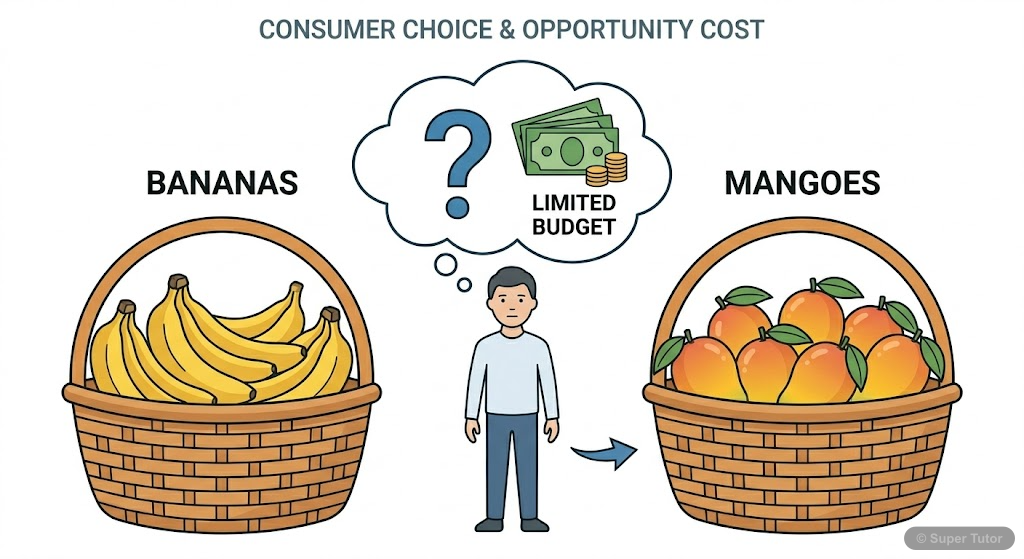
Learn better with visuals Super Tutor pairs illustrations like this with notes and quizzes for Theory of Consumer Behavior.
Overview
Consumer behaviour is shaped by preferences, income, and prices. The chapter explains how a consumer chooses among bundles of bananas and mangoes, how satisfaction is measured, how the budget limits choice, and how demand changes with price, income, and related goods. It presents two approaches to u
Key Concepts
Utility is the want
Utility is the want-satisfying capacity of a commodity. It is subjective, so the same good can give different satisfaction to different people or at d
This approach assumes that utility can
This approach assumes that utility can be measured in numbers. It uses total utility and marginal utility to study satisfaction.
Marginal utility is the change
Marginal utility is the change in total utility due to consumption of one additional unit. It is given by MU_n = TU_n - TU_{n-1}. When total utility s
Marginal utility from consuming each additional
Marginal utility from consuming each additional unit declines as consumption increases, while consumption of other commodities remains constant.
This approach does not measure utility
This approach does not measure utility in numbers. It only ranks bundles as giving more, less, or equal satisfaction.
Learning Objectives
- Understand utility, total utility, and marginal utility
- Distinguish between cardinal and ordinal utility analysis
- Explain indifference curves, indifference maps, and marginal rate of substitution
- Use the budget constraint, budget set, and budget line to describe consumer choice
- Explain how a consumer reaches optimum choice
Frequently Asked Questions
What are the important topics in Theory of Consumer Behavior for Madhya Pradesh Board Class 12 Economics?
How should I revise Theory of Consumer Behavior for the Madhya Pradesh Board Class 12 board exam?
Sources & Official References
Content is aligned to the official syllabus. Refer to the board website for the latest curriculum.
More resources for Theory of Consumer Behavior
Practice Quiz
Test yourself with a quick quiz
Important Questions
Exam-style questions with answers
Revision Notes
Key points for last-minute revision
Formula Sheet
The chapter's formulas in one place
Concept Maps
See how topics connect
Study Plan
Step-by-step plan for this chapter
Flashcards
Quick-fire cards for active recall
Syllabus
What topics to cover
NCERT Solutions
Every textbook question solved step by step
For serious students
Get the full Theory of Consumer Behavior chapter — start free.
Quizzes, flashcards, an AI doubt solver and a study plan for Madhya Pradesh Board Class 12 Economics. Free to start, no card needed.