Money and Banking — Chapter Summary
Madhya Pradesh Board · Class 12 · Economics
Summary of Money and Banking for Madhya Pradesh Board Class 12 Economics. Part of the Madhya Pradesh Board Class 12 Economics syllabus.
Interactive on Super Tutor
Studying Money and Banking? Get the full interactive chapter.
Quizzes, flashcards, AI doubt-solver and a step-by-step study plan — built for chapter summary and more.
Free trial, no card needed.
Learn better with visuals Super Tutor pairs illustrations like this with notes and quizzes for Money and Banking.
Overview
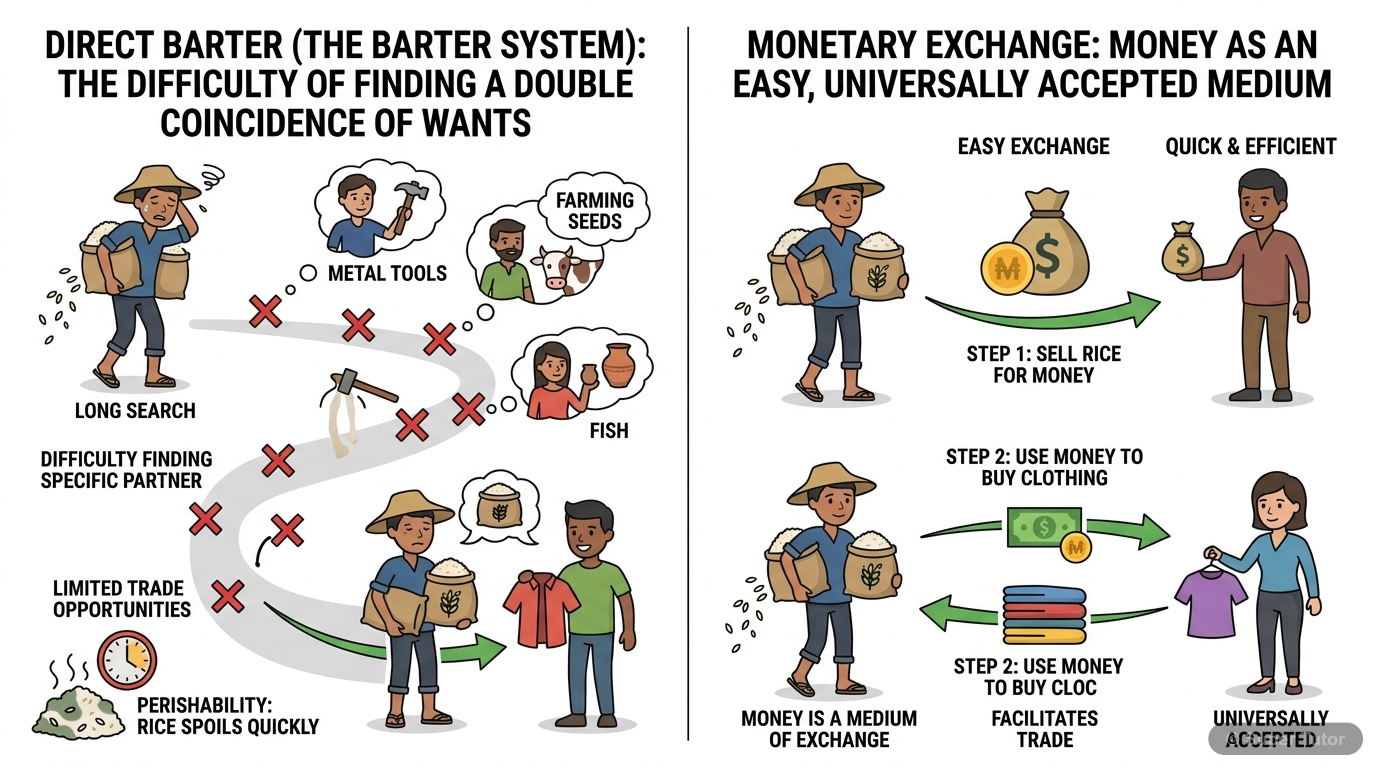
Money is the commonly accepted medium of exchange. It removes the difficulties of barter, where exchange depends on double coincidence of wants. Money also acts as a unit of account and a store of value. In a modern economy, money supply is created and managed through the central bank and commercial
Key Concepts
Money is the commonly accepted medium
Money is the commonly accepted medium of exchange. It is used to buy goods and services, measure value, and store wealth for future use.
Barter exchange means exchange without
Barter exchange means exchange without the mediation of money. It suffers from lack of double coincidence of wants.
Money acts as a medium
Money acts as a medium of exchange, unit of account, and store of value.
The RBI is India’s central bank
The RBI is India’s central bank, established in 1935. It issues currency notes, controls money supply, acts as banker to the government, custodian of
Commercial banks accept deposits from
Commercial banks accept deposits from the public and lend part of these funds to borrowers. They create credit by opening new deposits when loans are
Learning Objectives
- Understand the meaning and functions of money
- Explain the problems of barter and the role of money in solving them
- Describe the roles of the Reserve Bank of India and commercial banks in money creation
- Explain how banks create credit through deposits and loans
- Understand reserve requirements such as CRR and SLR
Frequently Asked Questions
What are the important topics in Money and Banking for Madhya Pradesh Board Class 12 Economics?
How should I revise Money and Banking for the Madhya Pradesh Board Class 12 board exam?
Sources & Official References
Content is aligned to the official syllabus. Refer to the board website for the latest curriculum.
More resources for Money and Banking
Practice Quiz
Test yourself with a quick quiz
Important Questions
Exam-style questions with answers
Revision Notes
Key points for last-minute revision
Formula Sheet
The chapter's formulas in one place
Concept Maps
See how topics connect
Study Plan
Step-by-step plan for this chapter
Flashcards
Quick-fire cards for active recall
Syllabus
What topics to cover
NCERT Solutions
Every textbook question solved step by step
For serious students
Get the full Money and Banking chapter — start free.
Quizzes, flashcards, an AI doubt solver and a study plan for Madhya Pradesh Board Class 12 Economics. Free to start, no card needed.