Kings, Farmers and Towns (Early States and Economies) (c.600 BCE-600 CE) — Practice Quiz
Madhya Pradesh Board · Class 12 · History
Try a 4-question quiz on Kings, Farmers and Towns (Early States and Economies) (c.600 BCE-600 CE) for Madhya Pradesh Board Class 12 History: tap an answer.
Interactive on Super Tutor
Studying Kings, Farmers and Towns (Early States and Economies) (c.600 BCE-600 CE)? Get the full interactive chapter.
Quizzes, flashcards, AI doubt-solver and a step-by-step study plan — built for practice quiz and more.
Free trial, no card needed.
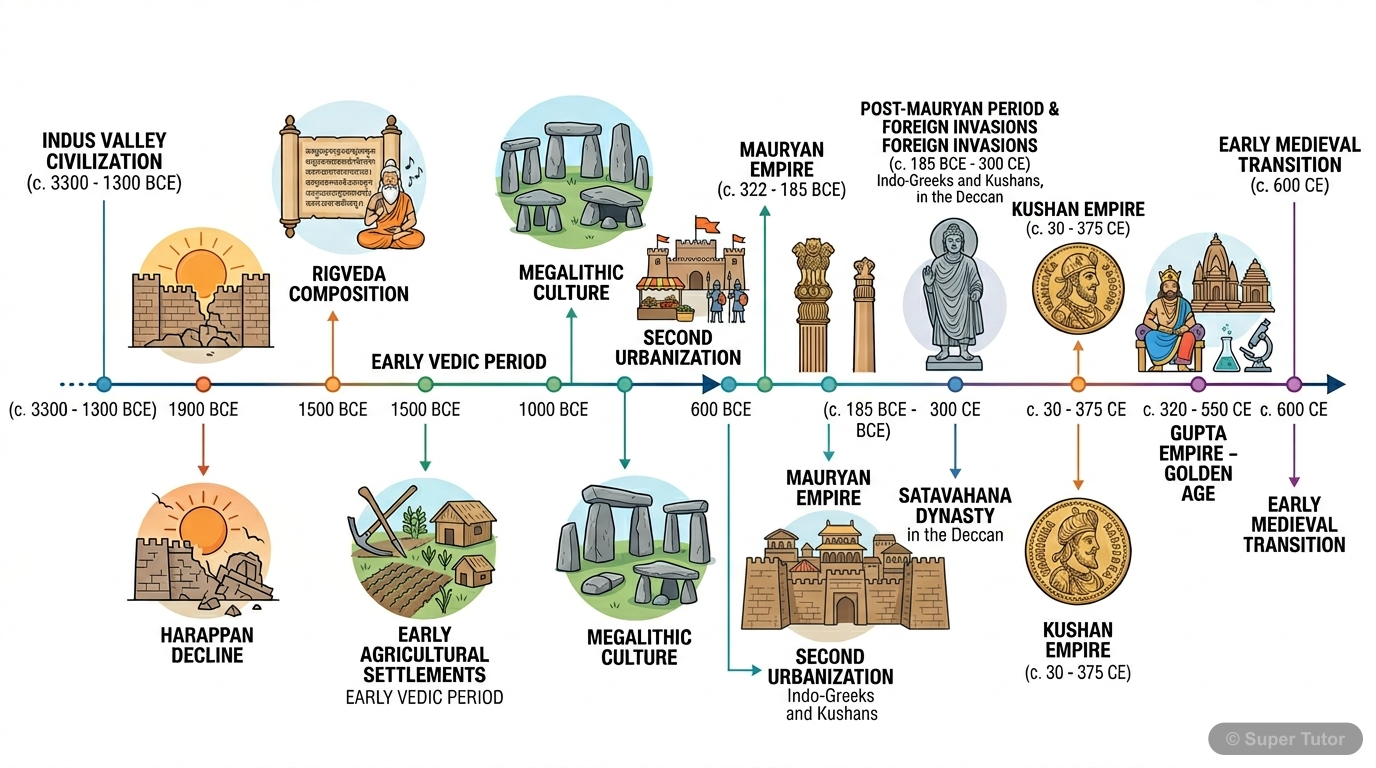
One of 18 illustrations for Kings, Farmers and Towns (Early States and Economies) (c.600 BCE-600 CE) in Super Tutor — alongside flashcards, concept maps and practice questions.
Quick Quiz: Kings, Farmers and Towns (Early States and Economies) (c.600 BCE-600 CE)
0/4Tap an answer to check it instantly. No sign-up needed for these 4.
Which of the following was NOT one of the major mahajanapadas mentioned in early Buddhist and Jaina texts?
What was the capital of Magadha before it was shifted to Pataliputra?
The Mauryan Empire was founded by which ruler around 321 BCE?
What does the term 'dhamma' refer to in Asokan inscriptions?
Sample Questions
Which of the following factors contributed to Magadha's rise to power? (Select all correct answers)
Show answer
Fertile agricultural land with productive farming, Access to iron mines in present-day Jharkhand, Presence of war elephants in nearby forests, Control over Ganga river trade routes
Magadha's power was built on multiple advantages: highly productive agriculture, access to iron resources for tools and weapons, elephants for military use, and control over river trade routes. There were no significant gold deposits in Magadha itself.
Which script was primarily used for most Asokan inscriptions?
Show answer
Brahmi
Most Asokan inscriptions were written in the Brahmi script. Kharosthi was used in the northwest, while Aramaic and Greek scripts were used in Afghanistan. Most modern Indian scripts are derived from Brahmi.
The five major political centers of the Mauryan Empire included which of the following? (Select all correct answers)
Show answer
Pataliputra, Taxila, Ujjayini, Tosali, Suvarnagiri
The five major political centers mentioned in Asokan inscriptions were: Pataliputra (capital), Taxila, Ujjayini, Tosali, and Suvarnagiri. These were strategically located for administrative control and trade.
What agricultural innovation led to increased paddy production in the Ganga valley?
Show answer
Transplantation technique
Transplantation was introduced in paddy cultivation, where seeds were first broadcast and grown, then saplings were transplanted to waterlogged fields. This ensured higher survival rates and better yields, though it required intensive labor.
+47 more questions on Kings, Farmers and Towns (Early States and Economies) (c.600 BCE-600 CE) (Madhya Pradesh Board Class 12 History)
Practise AllFrequently Asked Questions
What are the important topics in Kings, Farmers and Towns (Early States and Economies) (c.600 BCE-600 CE) for Madhya Pradesh Board Class 12 History?
How many practice questions are there for Kings, Farmers and Towns (Early States and Economies) (c.600 BCE-600 CE)?
Sources & Official References
Content is aligned to the official syllabus. Refer to the board website for the latest curriculum.
More resources for Kings, Farmers and Towns (Early States and Economies) (c.600 BCE-600 CE)
Important Questions
Exam-style questions with answers
Revision Notes
Key points for last-minute revision
Chapter Summary
Understand the chapter at a glance
Concept Maps
See how topics connect
Study Plan
Step-by-step plan for this chapter
Flashcards
Quick-fire cards for active recall
Syllabus
What topics to cover
NCERT Solutions
Every textbook question solved step by step
For serious students
Get the full Kings, Farmers and Towns (Early States and Economies) (c.600 BCE-600 CE) chapter — start free.
Quizzes, flashcards, an AI doubt solver and a study plan for Madhya Pradesh Board Class 12 History. Free to start, no card needed.