Kings, Farmers and Towns (Early States and Economies) (c.600 BCE-600 CE) — NCERT Solutions
Madhya Pradesh Board · Class 12 · History
NCERT Solutions for Kings, Farmers and Towns (Early States and Economies) (c.600 BCE-600 CE), Madhya Pradesh Board Class 12 History: 12 textbook questions.
Interactive on Super Tutor
Studying Kings, Farmers and Towns (Early States and Economies) (c.600 BCE-600 CE)? Get the full interactive chapter.
Quizzes, flashcards, AI doubt-solver and a step-by-step study plan — built for NCERT solutions and more.
Free trial, no card needed.
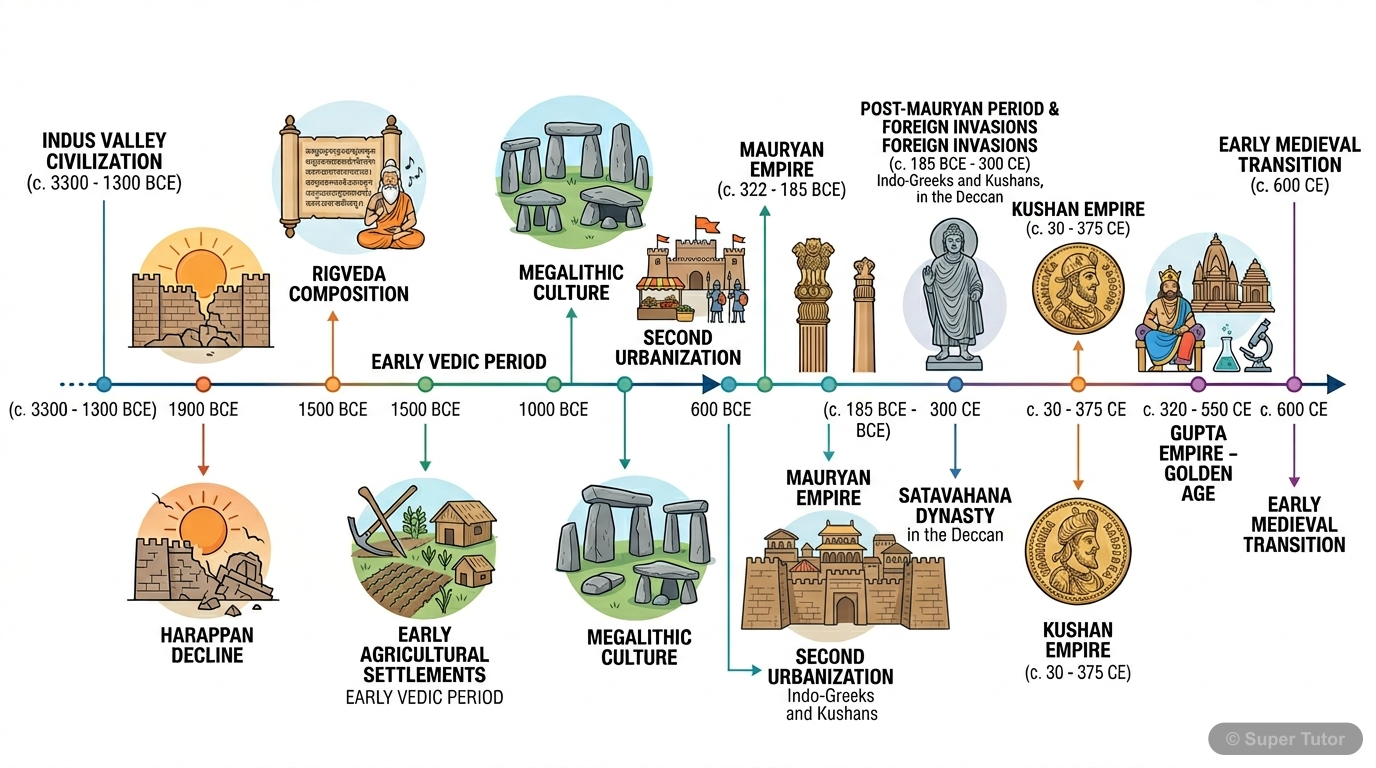
One of 18 illustrations for Kings, Farmers and Towns (Early States and Economies) (c.600 BCE-600 CE) in Super Tutor — alongside flashcards, concept maps and practice questions.
The first 6 solutions are open to read. The other 6 are free with a Super Tutor account.
Answer in 100-150 Words
1Discuss the evidence of craft production in Early Historic cities. In what ways is this different from the evidence from Harappan cities?Show solution
Given/Context: The question asks us to compare craft production evidence from Early Historic cities (c. 600 BCE–600 CE) with that from Harappan cities (c. 3rd millennium BCE).
Evidence of Craft Production in Early Historic Cities:
- Votive inscriptions (from c. 2nd century BCE) found in several cities mention the names and occupations of donors — weavers, scribes, carpenters, potters, goldsmiths, blacksmiths, washers, merchants, etc. This gives us direct textual evidence of craft specialisation.
- Guilds (shrenis) of craft producers and merchants are mentioned. These guilds procured raw materials, regulated production, and marketed finished goods.
- Iron tools were widely used by craftspersons to meet the demands of urban elites.
- Archaeological evidence of bead-making industries using precious and semi-precious stones has been found at sites like Kodumanal (Tamil Nadu).
- Punch-marked coins indicate monetised exchange involving craft goods.
Differences from Harappan Evidence:
| Aspect | Harappan Cities | Early Historic Cities |
|---|---|---|
| Evidence type | Primarily archaeological (seals, pottery, beads, weights) | Both archaeological AND textual (inscriptions, literary sources) |
| Literacy/Script | Script undeciphered; no readable texts | Scripts (Brahmi, Kharosthi) deciphered; inscriptions readable |
| Guilds | No evidence of guilds | Guilds (shrenis) clearly mentioned |
| Coins | No coins found | Punch-marked coins, gold coins in use |
| Donor records | None | Votive inscriptions name individual craftspersons |
Conclusion: While Harappan evidence is entirely material/archaeological, Early Historic evidence combines archaeology with written records, giving us a richer and more direct picture of craft production and the social identity of craftspersons.
2Describe the salient features of mahajanapadas.Show solution
Given/Context: Mahajanapadas were the major territorial states that emerged in the Indian subcontinent from c. 6th century BCE onwards.
Salient Features of Mahajanapadas:
- Number and Location: There were sixteen mahajanapadas in total. They were most densely clustered in the fertile plains of north India, particularly in the Ganga valley and surrounding regions.
- Capital Cities: Most mahajanapadas had a fortified capital city. For example, Magadha's capital was Rajagaha (Rajgir), later shifted to Pataliputra.
- Forms of Government: While many were ruled by kings (monarchies), some were governed by groups of men — these were known as oligarchies (e.g., the Vajjian confederacy, the Yaudheyas).
- Taxation: Rulers collected taxes and tribute from cultivators, traders and artisans. Raids on neighbouring states were also recognised as a legitimate means of acquiring wealth.
- Armies: Some states maintained standing armies and regular bureaucracies. Others depended on militia recruited from the peasantry.
- Dharmasutras: From the 6th century BCE, Brahmanas composed Dharmasutras laying down norms for rulers, who were ideally expected to be Kshatriyas.
- Rise of Magadha: Among the sixteen, Magadha became the most powerful by the 4th century BCE due to productive agriculture, access to iron mines, availability of elephants, and the Ganga river network for communication.
Conclusion: Mahajanapadas represented a significant political development — the transition from small chiefdoms to large territorial states with organised administration, armies, and revenue systems.
3How do historians reconstruct the lives of ordinary people?Show solution
Given/Context: Ordinary people rarely left written records of their thoughts and experiences. Historians therefore use indirect sources to reconstruct their lives.
Methods Used by Historians:
- Folk and Popular Literature: Stories in anthologies such as the Jatakas (written in Pali, c. mid-1st millennium CE) and the Panchatantra probably originated as popular oral tales. For example, the Gandatindu Jataka describes the plight of subjects — cultivators, herders, village boys — under a wicked king, revealing the oppressive nature of taxation and the option of fleeing to forests.
- Early Tamil Sangam Texts: These contain poems describing the lives of different categories of people in villages — large landowners (vellalar), ploughmen (uzhavar), and slaves (adimai).
- Inscriptions: Votive inscriptions from c. 2nd century BCE mention the names and occupations of donors — washers, weavers, carpenters, potters, etc. — giving us a glimpse of urban working people.
- Land Grant Records (Copper Plates): These mention rural populations including Brahmanas, peasants, and others who provided produce to the king, revealing the agrarian social structure.
- Literary Works: The Harshacharita by Banabhatta describes life in a forest-fringe settlement — small farmers, people carrying forest produce, village wives going to markets — providing a rare picture of ordinary rural life.
- Archaeological Evidence: Excavations reveal tools, pottery, coins, and other material remains that indicate the occupations and living conditions of common people.
Conclusion: By combining literary, epigraphical, and archaeological sources, historians piece together a picture of ordinary life, though this picture remains incomplete since the voices of the poor and marginalised are rarely directly recorded.
4Compare and contrast the list of things given to the Pandyan chief (Source 3) with those produced in the village of Danguna (Source 8). Do you notice any similarities or differences?Show solution
Given/Context: Source 3 is from the Silappadikaram describing gifts brought to the Pandya chief Senguttuvan. Source 8 is Prabhavati Gupta's inscription about the village of Danguna.
Gifts/Products from the Pandyan Chief's Forest Visit (Source 3):
- Forest products: ivory, fragrant wood, honey, sandalwood, red ochre, antimony, turmeric, cardamom, pepper
- Agricultural products: coconuts, mangoes, sugarcane, onions, flowers, areca nut, bananas
- Animal products: fans made of deer hair, medicinal plants, fruits
- Live animals: baby tigers, lions, elephants, monkeys, bear, deer, musk deer, fox, peacocks, musk cat, wild cocks, speaking parrots
Products/Resources from the Village of Danguna (Source 8):
- Agricultural produce (implied through taxes and dues)
- Grass, animal hides, charcoal (for touring royal officers)
- Fermenting liquors, salt (implied through exemptions)
- Flowers and milk
- Hidden treasures and deposits
- Major and minor taxes (implying grain, cash, or other produce)
Comparison:
| Aspect | Pandyan Chief (Source 3) | Village of Danguna (Source 8) |
|---|---|---|
| Nature of items | Primarily forest and wild products, exotic animals | Primarily agricultural produce and forest-edge resources |
| Context | Gifts voluntarily brought by forest-dwelling people | Dues/taxes owed to the lord of the village |
| Forest products | Prominent (ivory, honey, sandalwood, etc.) | Mentioned indirectly (charcoal, hides) |
| Agricultural items | Present (coconuts, mangoes, sugarcane) | Central (grain, flowers, milk) |
| Animals | Live exotic animals as gifts | Not mentioned |
| Relationship | Voluntary tribute to a chief | Obligatory dues to a new lord |
Similarities: Both lists include forest products and agricultural items, suggesting that the economy of both regions depended on a combination of forest resources and cultivation. Both also reflect the relationship between a powerful authority and subordinate communities who provided resources.
Differences: The Pandyan list is richer in forest and exotic products, reflecting a forest-based chiefdom economy. The Danguna list reflects a more settled agrarian economy with formalised tax obligations. The nature of the transfer also differs — gifts vs. taxes.
5List some of the problems faced by epigraphists.Show solution
Given/Context: Epigraphists are scholars who study inscriptions. Their work involves deciphering, translating, and interpreting ancient inscriptions.
Problems Faced by Epigraphists:
- Technical Limitations: Letters are sometimes very faintly engraved on stone or metal, making it difficult to read them accurately. Reconstructions in such cases remain uncertain.
- Physical Damage: Inscriptions may be damaged, broken, or have letters missing, making complete and accurate reading impossible.
- Linguistic Difficulties: It is not always easy to determine the exact meaning of words used in inscriptions, especially those specific to a particular place or time period.
- Undeciphered Scripts: Not all ancient scripts have been deciphered. For example, the Harappan script remains undeciphered to this day.
- Incomplete Publication: Although several thousand inscriptions have been discovered, not all have been deciphered, published, and translated, limiting the available body of knowledge.
- Survival Issues: Many inscriptions have not survived the ravages of time — due to weathering, deliberate destruction, or neglect. What is available today is probably only a fraction of what was originally inscribed.
- Interpretation Problems: Even after decipherment, interpreting the meaning and historical significance of inscriptions is challenging. Statements made by rulers in inscriptions may be exaggerated or politically motivated (e.g., Asoka's claim that no earlier ruler had arrangements for receiving reports).
- Literacy of the Audience: Historians must also consider whether the intended audience could actually read the inscriptions, since most people in ancient India were not literate.
- Language Variations: Inscriptions in different regions used different languages and scripts (Prakrit in Brahmi, Kharosthi in the northwest, Aramaic and Greek in Afghanistan), requiring expertise in multiple languages.
Conclusion: Despite these challenges, inscriptions remain among the most valuable primary sources for reconstructing early Indian history, and epigraphists continue to refine their readings through ongoing scholarly debate.
Write a Short Essay (About 500 Words)
6Discuss the main features of Mauryan administration. Which of these elements are evident in the Asokan inscriptions that you have studied?Show solution
Introduction:
The Mauryan Empire (c. 321–185 BCE), founded by Chandragupta Maurya, was one of the largest and most organised empires in early Indian history. Its administrative system was sophisticated and multi-layered, drawing on both centralised control and regional governance.
Main Features of Mauryan Administration:
1. Centralised Political Structure:
The empire had five major political centres: the capital Pataliputra and four provincial capitals — Taxila (northwest), Ujjayini (west), Tosali (east/Orissa), and Suvarnagiri (south). These centres were strategically located — Taxila and Ujjayini on important trade routes, and Suvarnagiri near Karnataka's gold mines.
2. Bureaucracy:
The Arthashastra (attributed to Kautilya/Chanakya) describes a detailed administrative and military organisation. Megasthenes, the Greek ambassador, mentions high officials who superintended rivers, measured land, inspected irrigation sluices, supervised huntsmen, collected taxes, and oversaw occupational groups like woodcutters, carpenters, blacksmiths, and miners.
3. Military Organisation:
Megasthenes mentions a committee with six subcommittees for coordinating military activity:
- Navy
- Transport and provisions
- Foot-soldiers
- Horses
- Chariots
- Elephants
According to Greek sources, the Mauryan army comprised 600,000 foot-soldiers, 30,000 cavalry, and 9,000 elephants (though some historians consider these figures exaggerated).
4. Communication and Control:
Communication along land and river routes was vital. The army ensured protection for those travelling across the empire. Asoka appointed special officers called dhamma mahamattas to spread the message of dhamma throughout the empire.
5. Propagation of Dhamma:
Asoka used dhamma as an instrument of administration and social cohesion. Dhamma included respect for elders, generosity towards Brahmanas and ascetics, kindness to slaves and servants, and respect for all religions. He inscribed these principles on rocks and pillars across the empire.
6. Reporting System:
Source 10 (Asokan inscription) reveals that Asoka introduced a system of pativedakas (reporters/informants) who could report to him at any time and anywhere — whether he was eating, in the inner apartment, in the garden, or being carried in a palanquin. This ensured that the king remained informed about the affairs of his subjects.
7. Regional Diversity:
Historians now recognise that administrative control was not uniform throughout the empire. The regions were too diverse — from the hilly terrain of Afghanistan to the coast of Orissa. Control was strongest near the capital and provincial centres.
Elements Evident in Asokan Inscriptions:
- Source 10 reveals the reporting system (pativedakas) and Asoka's concern for the welfare of his subjects.
- Source 11 (the Kalinga inscription) shows that Asoka conquered Kalinga, reflecting military power, but also reveals his remorse and subsequent commitment to dhamma — a shift in administrative philosophy from conquest to moral governance.
- The widespread distribution of inscriptions (from Pakistan's northwest frontier to Andhra Pradesh, Orissa, and Uttarakhand) itself demonstrates the empire's vast reach and Asoka's attempt to communicate uniformly with his subjects.
- The use of multiple languages and scripts (Prakrit/Brahmi, Kharosthi, Aramaic, Greek) in different regions shows sensitivity to regional diversity.
Conclusion:
The Mauryan administration was a remarkable achievement — combining military strength, bureaucratic organisation, communication networks, and ideological tools like dhamma. Asokan inscriptions are among the most direct and valuable sources for understanding how this administration functioned and what values it sought to promote.
Free with a Super Tutor account
Free with a Super Tutor account
Free with a Super Tutor account
Map Work
Free with a Super Tutor account
Project
Free with a Super Tutor account
Free with a Super Tutor account
6 more solved questions in Kings, Farmers and Towns (Early States and Economies) (c.600 BCE-600 CE)
They are free with a Super Tutor account, along with practice quizzes and flashcards for this chapter. Free to start, no card needed.
Frequently Asked Questions
What are the important topics in Kings, Farmers and Towns (Early States and Economies) (c.600 BCE-600 CE) for Madhya Pradesh Board Class 12 History?
Are these NCERT Solutions for Kings, Farmers and Towns (Early States and Economies) (c.600 BCE-600 CE) free?
How should I revise Kings, Farmers and Towns (Early States and Economies) (c.600 BCE-600 CE) for the Madhya Pradesh Board Class 12 board exam?
Sources & Official References
Content is aligned to the official syllabus. Refer to the board website for the latest curriculum.
More resources for Kings, Farmers and Towns (Early States and Economies) (c.600 BCE-600 CE)
Practice Quiz
Test yourself with a quick quiz
Important Questions
Exam-style questions with answers
Revision Notes
Key points for last-minute revision
Chapter Summary
Understand the chapter at a glance
Concept Maps
See how topics connect
Study Plan
Step-by-step plan for this chapter
Flashcards
Quick-fire cards for active recall
Syllabus
What topics to cover
For serious students
Get the full Kings, Farmers and Towns (Early States and Economies) (c.600 BCE-600 CE) chapter — start free.
Quizzes, flashcards, an AI doubt solver and a study plan for Madhya Pradesh Board Class 12 History. Free to start, no card needed.