Kings, Farmers and Towns (Early States and Economies) (c.600 BCE-600 CE) — Syllabus
Madhya Pradesh Board · Class 12 · History
What Kings, Farmers and Towns (Early States and Economies) (c.600 BCE-600 CE) covers in Madhya Pradesh Board Class 12 History: 4 topics, for the 2026-27.
Interactive on Super Tutor
Studying Kings, Farmers and Towns (Early States and Economies) (c.600 BCE-600 CE)? Get the full interactive chapter.
Quizzes, flashcards, AI doubt-solver and a step-by-step study plan — built for syllabus and more.
Free trial, no card needed.
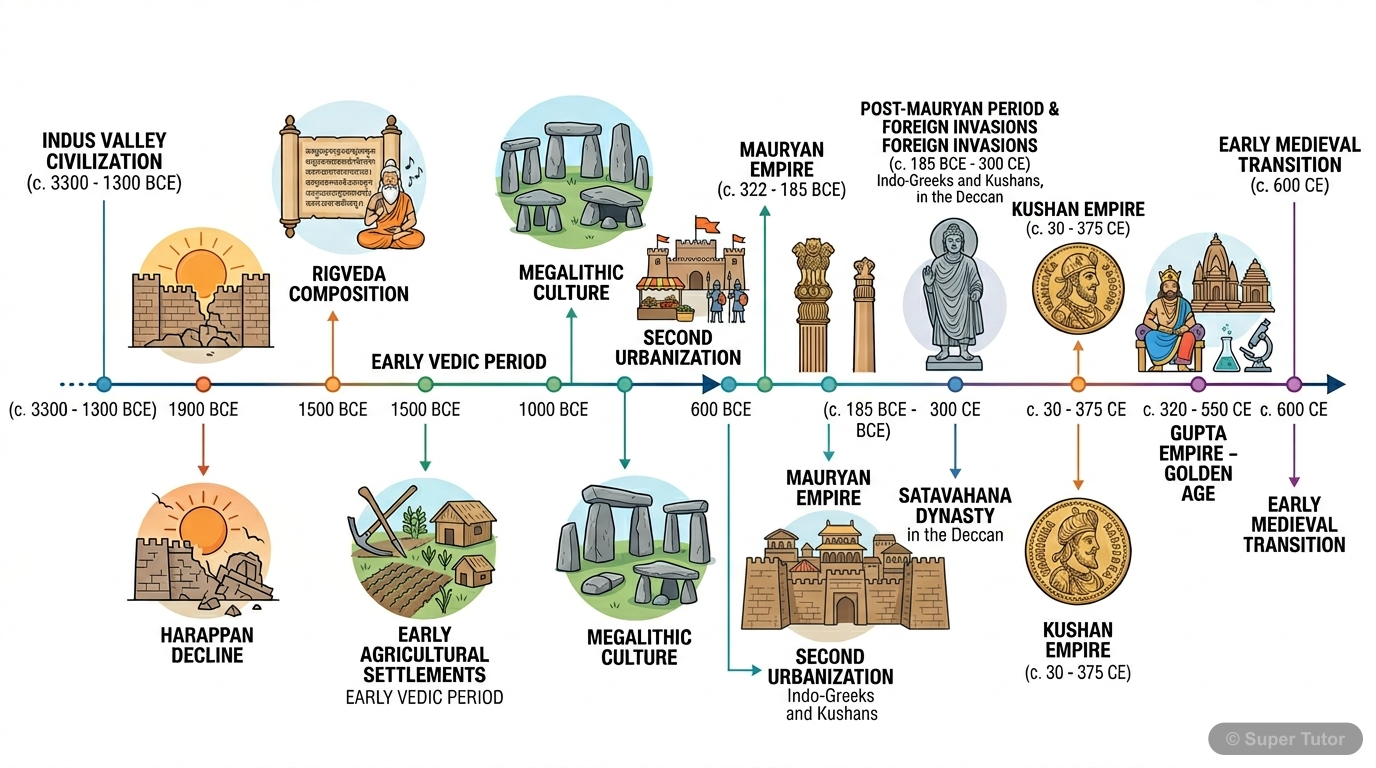
One of 18 illustrations for Kings, Farmers and Towns (Early States and Economies) (c.600 BCE-600 CE) in Super Tutor — alongside flashcards, concept maps and practice questions.
Topics in Kings, Farmers and Towns (Early States and Economies) (c.600 BCE-600 CE)
1. Sources for Early Indian History
- Historians use inscriptions, texts, coins, sculpture, and archaeology to study early states and economies.
- James Prinsep deciphered Asokan Brahmi in 1838, which opened up a new understanding of early inscriptions.
- The earliest inscriptions were in Prakrit, not Sanskrit.
2. Mahajanapadas and Early Political Forms
- The sixth century BCE was a major turning point in early Indian history.
- Sixteen mahajanapadas are mentioned in early Buddhist and Jaina texts.
- Magadha became the most powerful mahajanapada between the sixth and the fourth centuries BCE.
3. The Mauryan Empire
- The Mauryan Empire was founded by Chandragupta Maurya c. 321 BCE.
- Chandragupta Maurya extended control as far as Afghanistan and Baluchistan.
- The Mauryan Empire lasted for about 150 years.
4. New Notions of Kingship and Divine Status
- From the second century BCE onwards, new chiefdoms and kingdoms emerged in the Deccan and further south.
- Chiefs received gifts from subordinates, while kings usually collected taxes.
- Chiefdoms generally did not have regular armies or officials.
Key Concepts
Central concept: The growth of early states, rural society, trade, coinage, inscriptions, and new forms of kingship in the subcontinent
Work through every topic in Kings, Farmers and Towns (Early States and Economies) (c.600 BCE-600 CE) with notes and quizzes
Start This ChapterFrequently Asked Questions
What are the important topics in Kings, Farmers and Towns (Early States and Economies) (c.600 BCE-600 CE) for Madhya Pradesh Board Class 12 History?
How should I revise Kings, Farmers and Towns (Early States and Economies) (c.600 BCE-600 CE) for the Madhya Pradesh Board Class 12 board exam?
Sources & Official References
Content is aligned to the official syllabus. Refer to the board website for the latest curriculum.
More resources for Kings, Farmers and Towns (Early States and Economies) (c.600 BCE-600 CE)
Practice Quiz
Test yourself with a quick quiz
Important Questions
Exam-style questions with answers
Revision Notes
Key points for last-minute revision
Chapter Summary
Understand the chapter at a glance
Concept Maps
See how topics connect
Study Plan
Step-by-step plan for this chapter
Flashcards
Quick-fire cards for active recall
NCERT Solutions
Every textbook question solved step by step
For serious students
Get the full Kings, Farmers and Towns (Early States and Economies) (c.600 BCE-600 CE) chapter — start free.
Quizzes, flashcards, an AI doubt solver and a study plan for Madhya Pradesh Board Class 12 History. Free to start, no card needed.