Kings, Farmers and Towns (Early States and Economies) (c.600 BCE-600 CE) — Study Plan
Madhya Pradesh Board · Class 12 · History
A step-by-step study plan for Kings, Farmers and Towns (Early States and Economies) (c.600 BCE-600 CE), Madhya Pradesh Board Class 12 History: what.
Interactive on Super Tutor
Studying Kings, Farmers and Towns (Early States and Economies) (c.600 BCE-600 CE)? Get the full interactive chapter.
Quizzes, flashcards, AI doubt-solver and a step-by-step study plan — built for study plan and more.
Free trial, no card needed.
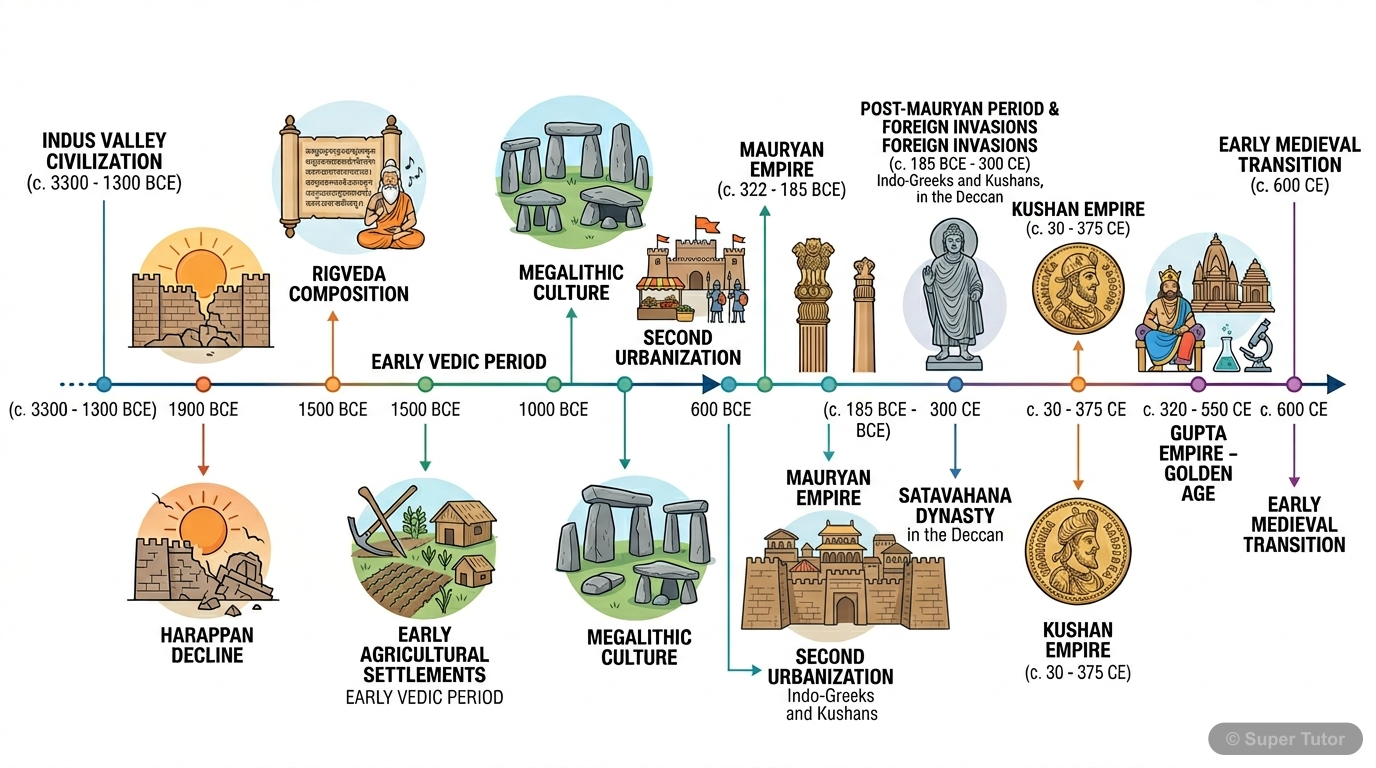
One of 18 illustrations for Kings, Farmers and Towns (Early States and Economies) (c.600 BCE-600 CE) in Super Tutor — alongside flashcards, concept maps and practice questions.
Study Plan
Learn the Theory
Read the textbook chapter carefully. Note down definitions, formulas and key ideas. Focus on: 1. Sources for Early Indian History, 2. Mahajanapadas and Early Political Forms, 3. The Mauryan Empire.
Practise
Solve the textbook exercises and extra practice questions. There are 51 questions available for this chapter.
Revise & Test
Revise key points without looking at your notes. Take a practice quiz and mark weak areas for another pass.
Spaced Revision
Come back to Kings, Farmers and Towns (Early States and Economies) (c.600 BCE-600 CE) after a week. Use flashcards for quick recall and try past exam questions on this chapter.
What to Focus On
- Epigraphy means the study of inscriptions.
- Numismatics means the study of coins.
- Inscriptions are permanent but selective sources.
- The sixth century BCE is linked to early states and urbanisation.
- Mahajanapadas were major states of early India.
- Ganas or sanghas were oligarchies, not monarchies.
- Magadha became the strongest mahajanapada.
- Agriculture, iron, elephants, and rivers supported its growth.
- Rulers and ministers also helped expand power.
Common Mistakes to Avoid
A chief and a king are basically the same because both are rulers.
Gana or sangha states were monarchies ruled by a single king.
Magadha became powerful only because of one ambitious king.
Memory Tips
James Prinsep and the decipherment of Brahmi
Piyadassi and Asoka in inscriptions
Sixteen mahajanapadas and the rise of Magadha
Ganas or sanghas as oligarchies
Want a personalised study plan?
Super Tutor builds a day-by-day plan for Madhya Pradesh Board Class 12 History that fits your exam date and pace.
Create My Study PlanFrequently Asked Questions
What are the important topics in Kings, Farmers and Towns (Early States and Economies) (c.600 BCE-600 CE) for Madhya Pradesh Board Class 12 History?
How should I revise Kings, Farmers and Towns (Early States and Economies) (c.600 BCE-600 CE) for the Madhya Pradesh Board Class 12 board exam?
Sources & Official References
Content is aligned to the official syllabus. Refer to the board website for the latest curriculum.
More resources for Kings, Farmers and Towns (Early States and Economies) (c.600 BCE-600 CE)
Practice Quiz
Test yourself with a quick quiz
Important Questions
Exam-style questions with answers
Revision Notes
Key points for last-minute revision
Chapter Summary
Understand the chapter at a glance
Concept Maps
See how topics connect
Flashcards
Quick-fire cards for active recall
Syllabus
What topics to cover
NCERT Solutions
Every textbook question solved step by step
For serious students
Get the full Kings, Farmers and Towns (Early States and Economies) (c.600 BCE-600 CE) chapter — start free.
Quizzes, flashcards, an AI doubt solver and a study plan for Madhya Pradesh Board Class 12 History. Free to start, no card needed.