India’s external relations — Important Questions
Madhya Pradesh Board · Class 12 · Political Science
46 important questions from India’s external relations for Madhya Pradesh Board Class 12 Political Science, with answers. Written for the board exams 2027.
Interactive on Super Tutor
Studying India’s external relations? Get the full interactive chapter.
Quizzes, flashcards, AI doubt-solver and a step-by-step study plan — built for important questions and more.
Free trial, no card needed.
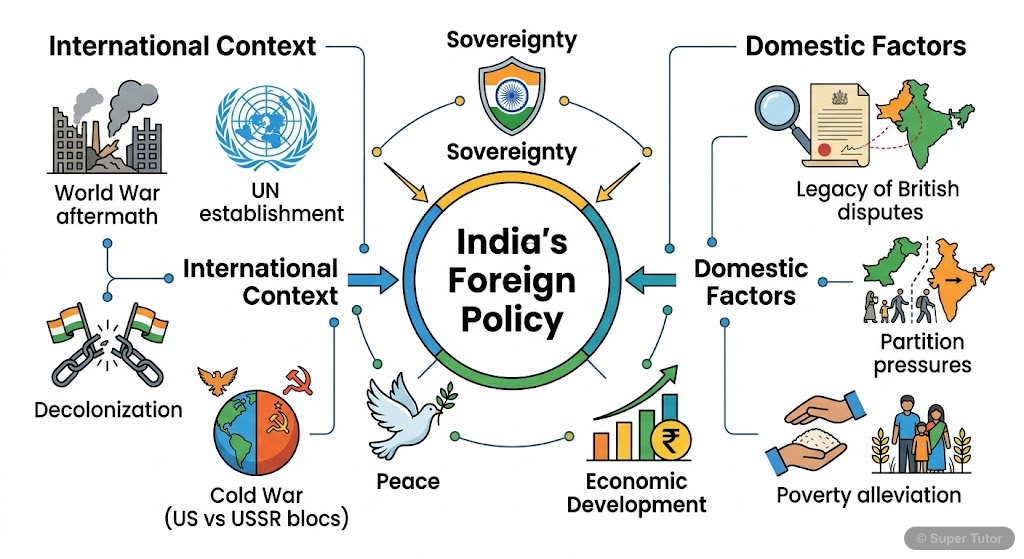
One of 9 illustrations for India’s external relations in Super Tutor — alongside flashcards, concept maps and practice questions.
Important Questions from India’s external relations
Which of the following are the three major objectives of Nehru's foreign policy? (Select all correct answers)
Show answer
Preserve hard-earned sovereignty, Protect territorial integrity, Promote rapid economic development
The three major objectives of Nehru's foreign policy were: (1) to preserve the hard-earned sovereignty, (2) protect territorial integrity, and (3) promote rapid economic development. Nehru aimed to achieve these objectives through the strategy of non-alignment, avoiding military alliances while focusing on India's core national interests.
In which year did the Sino-Indian War take place?
Show answer
1962
The Sino-Indian War took place in 1962 when China launched a swift and massive invasion in October on both disputed regions (Aksai Chin and NEFA/Arunachal Pradesh). The war occurred while the world's attention was focused on the Cuban Missile Crisis involving the superpowers.
Which territories were disputed between India and China during the 1962 conflict? (Select all correct answers)
Show answer
Aksai Chin in Ladakh region, NEFA (now Arunachal Pradesh)
The main border dispute between India and China was about two areas: Aksai Chin in the Ladakh region of Jammu and Kashmir, and NEFA (North Eastern Frontier Agency, now Arunachal Pradesh). China had occupied Aksai Chin and built a strategic road there between 1957-1959, and both these areas became focal points of the 1962 conflict.
The Dalai Lama sought asylum in India in which year?
Show answer
1959
The Dalai Lama crossed over into the Indian border and sought asylum in 1959, which was granted by India. This happened after an armed uprising in Tibet against China's occupation in 1958 was suppressed by Chinese forces. The Chinese government strongly protested against India's decision to grant asylum.
+42 more questions on India’s external relations (Madhya Pradesh Board Class 12 Political Science)
Practise AllFrequently Asked Questions
What are the important topics in India’s external relations for Madhya Pradesh Board Class 12 Political Science?
How many important questions are there in India’s external relations?
Sources & Official References
Content is aligned to the official syllabus. Refer to the board website for the latest curriculum.
More resources for India’s external relations
Practice Quiz
Test yourself with a quick quiz
Revision Notes
Key points for last-minute revision
Chapter Summary
Understand the chapter at a glance
Concept Maps
See how topics connect
Study Plan
Step-by-step plan for this chapter
Flashcards
Quick-fire cards for active recall
Syllabus
What topics to cover
NCERT Solutions
Every textbook question solved step by step
For serious students
Get the full India’s external relations chapter — start free.
Quizzes, flashcards, an AI doubt solver and a study plan for Madhya Pradesh Board Class 12 Political Science. Free to start, no card needed.