India’s external relations — Revision Notes
Madhya Pradesh Board · Class 12 · Political Science
India’s external relations revision notes for Madhya Pradesh Board Class 12 Political Science: 4 topics in quick points.
Interactive on Super Tutor
Studying India’s external relations? Get the full interactive chapter.
Quizzes, flashcards, AI doubt-solver and a step-by-step study plan — built for revision notes and more.
Free trial, no card needed.
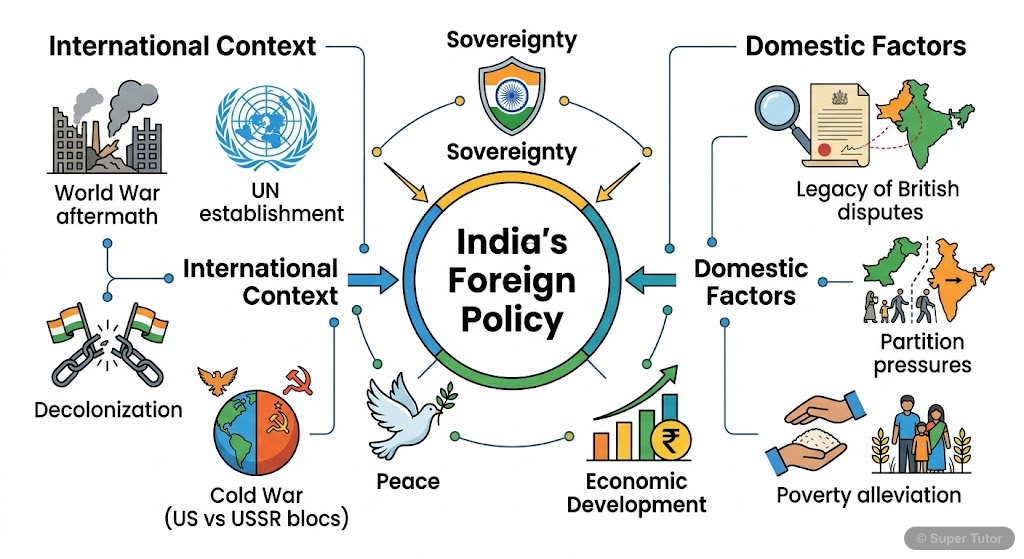
One of 9 illustrations for India’s external relations in Super Tutor — alongside flashcards, concept maps and practice questions.
Key Topics to Revise
International Context and Constitutional Basis
- India became independent in a difficult global setting: the Second World War had just ended, the world was facing reconstruction, decolonisation was creating new states, and Cold War blocs were dividi
- India’s foreign policy aimed to respect the sovereignty of all nations and to achieve security through peace.
- Article 51 of the Indian Constitution lays down the State’s duty to promote international peace and security.
Nehru and the Policy of Non-Alignment
- Jawaharlal Nehru was both Prime Minister and Foreign Minister, and he influenced foreign policy from 1946 to 1964.
- He was a co-founder of the Non-Aligned Movement.
- Nehru’s three major foreign policy objectives were sovereignty, territorial integrity, and rapid economic development.
Afro-Asian Unity and the Role of Bandung
- India’s national movement was linked with the wider struggle against colonialism and imperialism.
- Netaji Subhash Chandra Bose created the Indian National Army during the Second World War, showing links between India and overseas Indians.
- India convened the Asian Relations Conference in March 1947, before Independence.
India and China: Friendship, Tibet, and Conflict
- India and China began their relationship on a friendly note after the Chinese revolution of 1949.
- For a long time, the Chinese border was guarded by para-military forces, not the army.
- China took over control of Tibet in 1950.
Get complete notes with diagrams and examples
Full NotesKey Concepts
Frequently Asked Questions
What are the important topics in India’s external relations for Madhya Pradesh Board Class 12 Political Science?
How should I revise India’s external relations for the Madhya Pradesh Board Class 12 board exam?
Sources & Official References
Content is aligned to the official syllabus. Refer to the board website for the latest curriculum.
More resources for India’s external relations
Practice Quiz
Test yourself with a quick quiz
Important Questions
Exam-style questions with answers
Chapter Summary
Understand the chapter at a glance
Concept Maps
See how topics connect
Study Plan
Step-by-step plan for this chapter
Flashcards
Quick-fire cards for active recall
Syllabus
What topics to cover
NCERT Solutions
Every textbook question solved step by step
For serious students
Get the full India’s external relations chapter — start free.
Quizzes, flashcards, an AI doubt solver and a study plan for Madhya Pradesh Board Class 12 Political Science. Free to start, no card needed.