India’s external relations — Chapter Summary
Madhya Pradesh Board · Class 12 · Political Science
Summary of India’s external relations for Madhya Pradesh Board Class 12 Political Science. India’s external relations were shaped by the global situation.
Interactive on Super Tutor
Studying India’s external relations? Get the full interactive chapter.
Quizzes, flashcards, AI doubt-solver and a step-by-step study plan — built for chapter summary and more.
Free trial, no card needed.
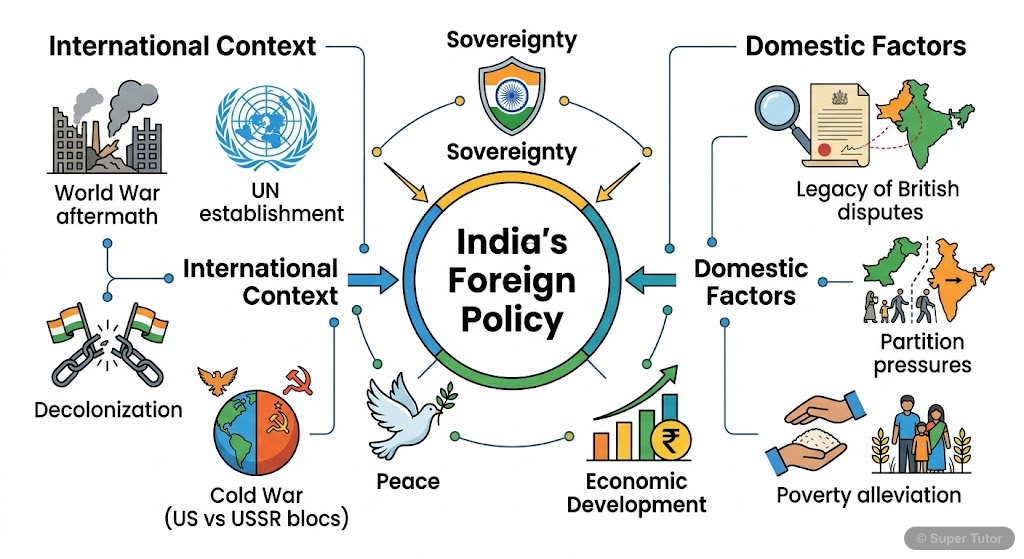
One of 9 illustrations for India’s external relations in Super Tutor — alongside flashcards, concept maps and practice questions.
Overview
India’s external relations were shaped by the global situation after the Second World War, the end of colonialism, the Cold War, and India’s own needs for sovereignty, territorial integrity, and rapid economic development. Jawaharlal Nehru gave foreign policy a strong direction by linking independen
Key Concepts
India became independent in a world
India became independent in a world recovering from war, facing decolonisation, the creation of new international institutions, and the start of the C
Article 51 of the Constitution directs
Article 51 of the Constitution directs the State to promote international peace and security, maintain just and honourable relations between nations,
Nehru was both Prime Minister
Nehru was both Prime Minister and Foreign Minister from 1946 to 1964. He aimed to preserve sovereignty, protect territorial integrity, and promote rap
Non
Non-alignment meant avoiding membership in the rival power blocs of the Cold War while keeping friendly relations with both sides. It was a way to pro
India supported Asian and African solidarity
India supported Asian and African solidarity, convened the Asian Relations Conference in March 1947, and played a major role in the Bandung Conference
Learning Objectives
- Understand the international context in which independent India shaped its foreign policy.
- Explain Nehru’s role in formulating India’s foreign policy and the idea of non-alignment.
- Describe India’s relations with the United States, the Soviet Union, China, and Pakistan.
- Trace major events in the China, Pakistan, and Bangladesh-related conflicts.
- Understand how wars influenced India’s economy, defence policy, and political life.
Frequently Asked Questions
What are the important topics in India’s external relations for Madhya Pradesh Board Class 12 Political Science?
How should I revise India’s external relations for the Madhya Pradesh Board Class 12 board exam?
Sources & Official References
Content is aligned to the official syllabus. Refer to the board website for the latest curriculum.
More resources for India’s external relations
Practice Quiz
Test yourself with a quick quiz
Important Questions
Exam-style questions with answers
Revision Notes
Key points for last-minute revision
Concept Maps
See how topics connect
Study Plan
Step-by-step plan for this chapter
Flashcards
Quick-fire cards for active recall
Syllabus
What topics to cover
NCERT Solutions
Every textbook question solved step by step
For serious students
Get the full India’s external relations chapter — start free.
Quizzes, flashcards, an AI doubt solver and a study plan for Madhya Pradesh Board Class 12 Political Science. Free to start, no card needed.