Contemporary South Asia — Study Plan
Madhya Pradesh Board · Class 12 · Political Science
A step-by-step study plan for Contemporary South Asia, Madhya Pradesh Board Class 12 Political Science: what to learn first, what to practise and when.
Interactive on Super Tutor
Studying Contemporary South Asia? Get the full interactive chapter.
Quizzes, flashcards, AI doubt-solver and a step-by-step study plan — built for study plan and more.
Free trial, no card needed.
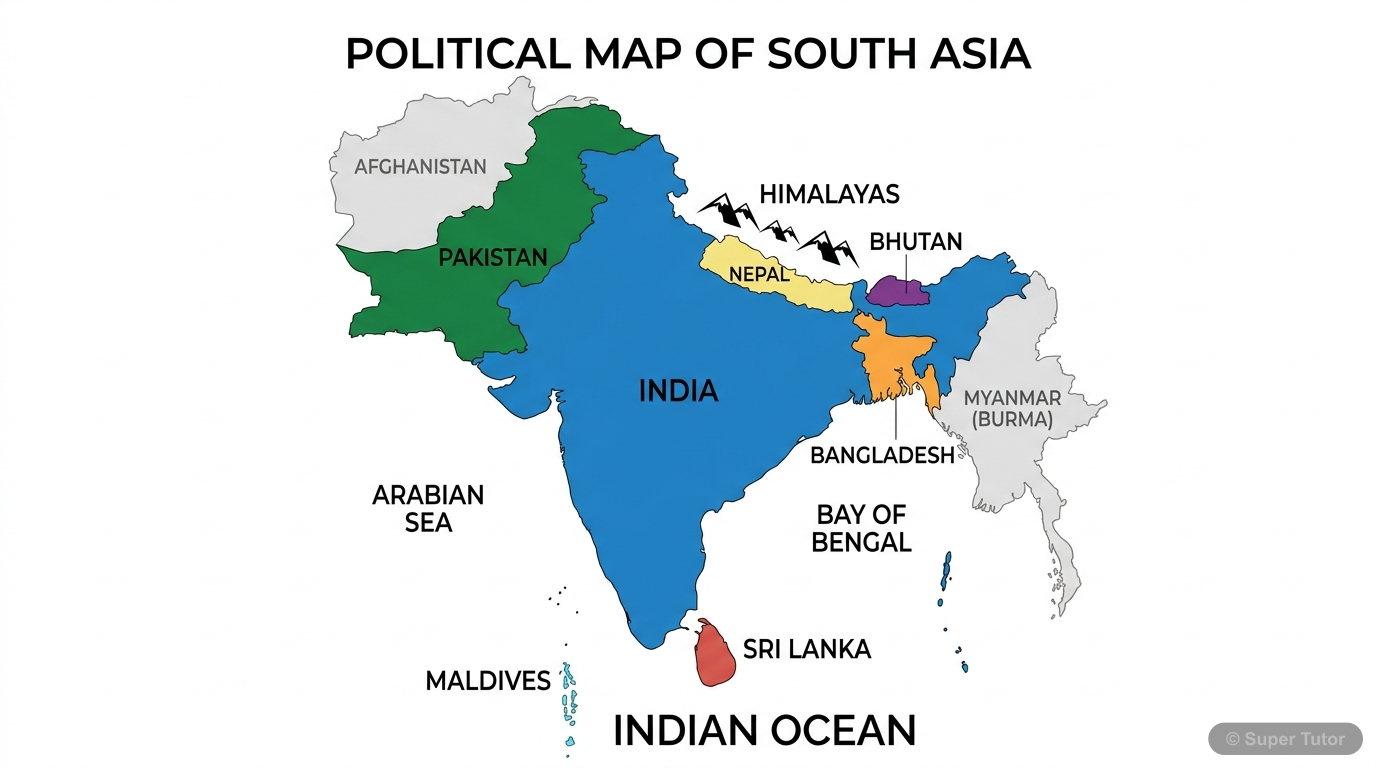
Learn better with visuals Super Tutor pairs illustrations like this with notes and quizzes for Contemporary South Asia.
Study Plan
Learn the Theory
Read the textbook chapter carefully. Note down definitions, formulas and key ideas. Focus on: 1. Meaning and Scope of South Asia, 2. Democracy in South Asia, 3. Pakistan: Military Rule and Democratic Struggle.
Practise
Solve the textbook exercises and extra practice questions. There are 38 questions available for this chapter.
Revise & Test
Revise key points without looking at your notes. Take a practice quiz and mark weak areas for another pass.
Spaced Revision
Come back to Contemporary South Asia after a week. Use flashcards for quick recall and try past exam questions on this chapter.
What to Focus On
- South Asia includes seven countries: Bangladesh, Bhutan, India, the Maldives, Nepal, Pakistan, and Sri Lanka.
- The Himalayas and surrounding seas create natural boundaries.
- Afghanistan and Myanmar are often discussed with the region, but they are not part of the seven-country definition.
- India and Sri Lanka have remained democracies since independence.
- Pakistan and Bangladesh have alternated between civilian and military rule.
- Nepal changed from monarchy to democratic republic.
- General Ayub Khan took over after Pakistan’s first constitution was framed.
- General Yahya Khan ruled during the Bangladesh crisis.
- Zulfikar Ali Bhutto led Pakistan from 1971 to 1977.
Common Mistakes to Avoid
China is part of South Asia.
South Asia includes Afghanistan and Myanmar as core countries of the region.
Sri Lanka became democratic because it overthrew military rule or monarchy.
Memory Tips
Seven countries in South Asia as defined here
China is not part of South Asia
India’s central location and neighbour relations
India and Sri Lanka have remained democracies since independence
Want a personalised study plan?
Super Tutor builds a day-by-day plan for Madhya Pradesh Board Class 12 Political Science that fits your exam date and pace.
Create My Study PlanFrequently Asked Questions
What are the important topics in Contemporary South Asia for Madhya Pradesh Board Class 12 Political Science?
How should I revise Contemporary South Asia for the Madhya Pradesh Board Class 12 board exam?
Sources & Official References
Content is aligned to the official syllabus. Refer to the board website for the latest curriculum.
More resources for Contemporary South Asia
Practice Quiz
Test yourself with a quick quiz
Important Questions
Exam-style questions with answers
Revision Notes
Key points for last-minute revision
Chapter Summary
Understand the chapter at a glance
Concept Maps
See how topics connect
Flashcards
Quick-fire cards for active recall
Syllabus
What topics to cover
NCERT Solutions
Every textbook question solved step by step
For serious students
Get the full Contemporary South Asia chapter — start free.
Quizzes, flashcards, an AI doubt solver and a study plan for Madhya Pradesh Board Class 12 Political Science. Free to start, no card needed.