Contemporary South Asia — NCERT Solutions
Madhya Pradesh Board · Class 12 · Political Science
NCERT Solutions for Contemporary South Asia, Madhya Pradesh Board Class 12 Political Science: 10 textbook questions solved step by step. Covers Exercises.
Interactive on Super Tutor
Studying Contemporary South Asia? Get the full interactive chapter.
Quizzes, flashcards, AI doubt-solver and a step-by-step study plan — built for NCERT solutions and more.
Free trial, no card needed.
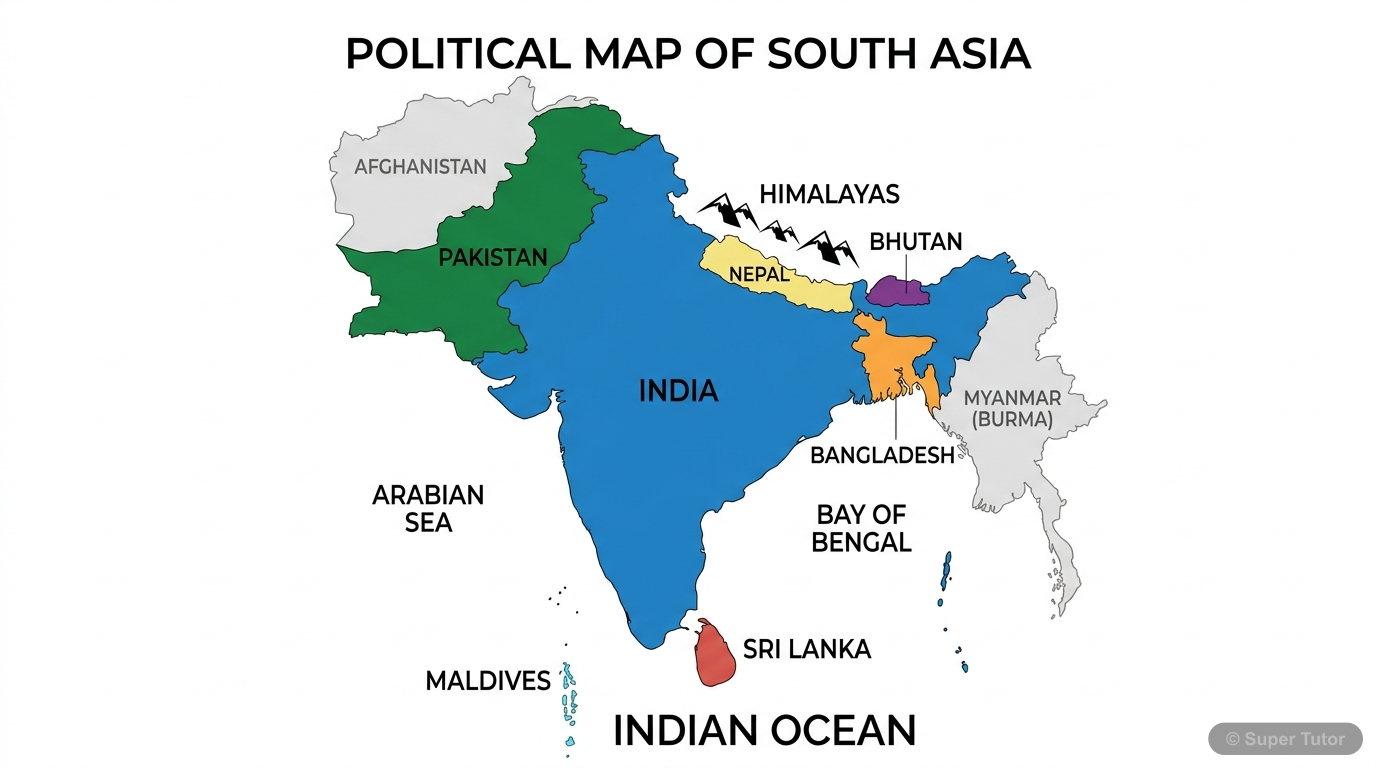
Learn better with visuals Super Tutor pairs illustrations like this with notes and quizzes for Contemporary South Asia.
The first 5 solutions are open to read. The other 5 are free with a Super Tutor account.
Exercises
1Identify the country:
a. The struggle among pro-monarchy, pro-democracy groups and extremists created an atmosphere of political instability.
b. A landlocked country with multi-party competition.
c. The first country to liberalise its economy in the South Asian region.
d. In the conflict between the military and pro-democracy groups, the military has prevailed over democracy.
e. Centrally located and shares borders with most of the South Asian countries.
f. Earlier the island had the Sultan as the head of state. Now, it's a republic.
g. Small savings and credit cooperatives in the rural areas have helped in reducing poverty.
h. A landlocked country with a monarchy.Show solution
Given: Descriptions of various South Asian countries based on their political and economic characteristics.
Answers:
(a) Nepal
Nepal witnessed a prolonged struggle among pro-monarchy forces, pro-democracy groups, and Maoist extremists, which created severe political instability. The monarchy was eventually abolished and Nepal became a federal democratic republic in 2008.
(b) Nepal (after 2008) / more precisely Bangladesh
Bangladesh is a landlocked country (surrounded by India on three sides and Myanmar) that has multi-party political competition between the Awami League and the Bangladesh Nationalist Party (BNP), among others.
> Note: Nepal is also landlocked with multi-party competition; however, in the context of this chapter, Bangladesh is the standard answer given for a landlocked country with multi-party competition, while Nepal fits (a) and (h). Many textbook answer keys identify this as Bangladesh.
(c) Sri Lanka
Sri Lanka was the first country in South Asia to liberalise its economy, doing so in 1977 — well before India's liberalisation in 1991.
(d) Pakistan
Pakistan has repeatedly seen military coups (e.g., General Ayub Khan, General Yahya Khan, General Zia-ul-Haq, General Pervez Musharraf). The military has consistently prevailed over pro-democracy groups.
(e) India
India is centrally located in South Asia and shares borders with most South Asian countries — Pakistan, Nepal, Bhutan, Bangladesh, Myanmar, and has a maritime boundary with Sri Lanka and Maldives.
(f) Maldives
Maldives was earlier ruled by a Sultan (sultanate). It became a republic in 1968. It is an island nation in the Indian Ocean.
(g) Bangladesh
Bangladesh, through organisations like the Grameen Bank, pioneered the concept of micro-credit — small savings and credit cooperatives in rural areas — which has significantly helped in reducing poverty.
(h) Bhutan
Bhutan is a landlocked country (surrounded by India and China) that was traditionally ruled by a monarchy. It transitioned to a constitutional monarchy with elections in 2008, but the King remains the head of state.
2Which among the following statements about South Asia is wrong?
a) All the countries in South Asia are democratic.
b) Bangladesh and India have signed an agreement on river-water sharing.
c) SAFTA was signed at the 12th SAARC Summit in Islamabad.
d) The US and China play an influential role in South Asian politics.Show solution
Correct Answer: (a) All the countries in South Asia are democratic.
Justification:
This statement is wrong because not all South Asian countries have been consistently democratic. Pakistan has experienced long periods of military rule (e.g., under General Musharraf). Myanmar (sometimes included in broader South Asia) is under military control. Even within the SAARC framework, countries like Bhutan were an absolute monarchy until 2008. Therefore, the claim that all countries in South Asia are democratic is incorrect.
Statements (b), (c), and (d) are correct:
- India and Bangladesh signed the Ganga Waters Treaty (river-water sharing agreement) in 1996.
- SAFTA (South Asian Free Trade Area) was indeed signed at the 12th SAARC Summit held in Islamabad in 2004.
- The US and China do play a significant and influential role in South Asian politics.
3What are some of the commonalities and differences between Bangladesh and Pakistan in their democratic experiences?Show solution
Given: A comparative question on the democratic experiences of Bangladesh and Pakistan.
Concept: Both Bangladesh and Pakistan were part of the same country (Pakistan) until 1971. Their post-independence political trajectories show both similarities and differences.
Commonalities between Bangladesh and Pakistan:
- Military Interventions: Both countries have experienced prolonged periods of military rule. In Pakistan, generals like Ayub Khan, Yahya Khan, Zia-ul-Haq, and Pervez Musharraf ruled for decades. In Bangladesh, General Ziaur Rahman and General H.M. Ershad also ruled through military coups.
- Weak Democratic Institutions: In both countries, democratic institutions such as the judiciary, legislature, and political parties have remained weak and have struggled to assert themselves against the military.
- Role of Islam: Both are Muslim-majority nations where religion has played a significant role in politics, sometimes being used to legitimise non-democratic rule.
- Civilian–Military Tension: Both countries have seen a persistent tension between elected civilian governments and the military establishment.
- Corruption and Political Instability: Both have faced allegations of widespread corruption among political leaders and frequent changes in government.
Differences between Bangladesh and Pakistan:
| Aspect | Bangladesh | Pakistan |
|---|---|---|
| Current Status | Has been functioning as a parliamentary democracy with regular elections since 1990. | Has had more prolonged and frequent military interventions. |
| Women in Leadership | Both major political parties (Awami League and BNP) have been led by women — Sheikh Hasina and Khaleda Zia. | Women's political leadership at the top level has been less prominent (though Benazir Bhutto was PM). |
| Nuclear Status | Non-nuclear state. | Nuclear-armed state, which adds a different dimension to civil-military relations. |
| Regional Conflicts | No major ongoing armed conflict with neighbours. | Ongoing tensions with India, especially over Kashmir, which strengthens the military's political role. |
Conclusion: Both countries share the challenge of establishing stable democracy against the backdrop of military interference, but Bangladesh has shown relatively more consistent democratic practice in recent decades compared to Pakistan.
4List three challenges to democracy in Nepal.Show solution
Given: Nepal's political history involves monarchy, Maoist insurgency, and a difficult transition to democracy.
Three major challenges to democracy in Nepal:
1. Role of the Monarchy:
For a long time, the monarchy posed the biggest challenge to democracy in Nepal. King Birendra accepted constitutional monarchy in 1990, but King Gyanendra dismissed the elected government in 2002 and again in 2005, assuming direct power. The struggle between pro-monarchy and pro-democracy forces created prolonged political instability. (The monarchy was finally abolished in 2008.)
2. Maoist Insurgency / Extremism:
The Maoist (Communist Party of Nepal – Maoist) insurgency, which began in 1996, challenged the democratic state through armed struggle. The Maoists sought to overthrow the parliamentary system and establish a communist state. This conflict caused thousands of deaths and severely disrupted normal democratic functioning. Integrating the Maoists into mainstream democratic politics remained a major challenge.
3. Weak Political Institutions and Instability:
Nepal has suffered from extreme political fragmentation, frequent changes of government, and weak political institutions. The inability of political parties to reach consensus, corruption, and the lack of a stable constitution for many years (a new constitution was finally adopted in 2015) made it difficult to consolidate democracy. Ethnic and regional demands for federalism also created tensions.
Additional challenges (if needed):
- Poverty and underdevelopment, which make it difficult for citizens to meaningfully participate in democracy.
- External interference from neighbouring countries (India and China).
5Name the principal players in the ethnic conflict in Sri Lanka. How do you assess the prospects of the resolution of this conflict?Show solution
Given: Sri Lanka has experienced a prolonged ethnic civil war.
Principal Players in the Ethnic Conflict in Sri Lanka:
- The Sri Lankan Government / Sinhalese-dominated State: Representing the majority Sinhalese Buddhist community. The government passed the 'Sinhala Only' Act in 1956, which made Sinhala the only official language, marginalising the Tamil community. The Sri Lankan Army fought against Tamil militant groups.
- Sri Lankan Tamils: The Tamil minority (both Sri Lankan Tamils and Indian-origin Tamils) demanded recognition of their language, culture, and political rights. They sought either a federal arrangement or a separate homeland called Eelam in the northern and eastern parts of Sri Lanka.
- LTTE (Liberation Tigers of Tamil Eelam): The most powerful Tamil militant organisation, led by V. Prabhakaran. The LTTE fought a prolonged armed insurgency for a separate Tamil homeland ('Tamil Eelam'). They were known for suicide bombings and guerrilla warfare.
- India: India played a significant role — initially providing some support to Tamil groups, then signing the Indo-Sri Lanka Accord (1987) and sending the Indian Peace Keeping Force (IPKF) to Sri Lanka, which was later withdrawn. India's Tamil Nadu state has strong ethnic ties with Sri Lankan Tamils.
Assessment of Prospects for Resolution:
- In May 2009, the Sri Lankan military decisively defeated the LTTE militarily, killing Prabhakaran. The armed conflict formally ended.
- However, military victory alone does not resolve the underlying ethnic grievances. The Tamil community still faces issues of political representation, land rights, rehabilitation of war victims, and cultural recognition.
- The 13th Amendment to the Sri Lankan Constitution (1987) promised devolution of power to provinces, but its full implementation remains incomplete.
- For lasting peace, Sri Lanka needs:
- Political reconciliation and genuine power-sharing with the Tamil community.
- Accountability for human rights violations committed during the war.
- Economic development of the war-affected northern and eastern regions.
- International pressure (from the UN, India, and Western countries) for accountability and reconciliation continues.
Conclusion: While the military phase of the conflict has ended, a durable political solution requires addressing Tamil aspirations through democratic means, constitutional reforms, and genuine reconciliation. The prospects depend on the political will of the Sri Lankan government.
Free with a Super Tutor account
Free with a Super Tutor account
Free with a Super Tutor account
Free with a Super Tutor account
Free with a Super Tutor account
5 more solved questions in Contemporary South Asia
They are free with a Super Tutor account, along with practice quizzes and flashcards for this chapter. Free to start, no card needed.
Frequently Asked Questions
What are the important topics in Contemporary South Asia for Madhya Pradesh Board Class 12 Political Science?
Are these NCERT Solutions for Contemporary South Asia free?
How should I revise Contemporary South Asia for the Madhya Pradesh Board Class 12 board exam?
Sources & Official References
Content is aligned to the official syllabus. Refer to the board website for the latest curriculum.
More resources for Contemporary South Asia
Practice Quiz
Test yourself with a quick quiz
Important Questions
Exam-style questions with answers
Revision Notes
Key points for last-minute revision
Chapter Summary
Understand the chapter at a glance
Concept Maps
See how topics connect
Study Plan
Step-by-step plan for this chapter
Flashcards
Quick-fire cards for active recall
Syllabus
What topics to cover
For serious students
Get the full Contemporary South Asia chapter — start free.
Quizzes, flashcards, an AI doubt solver and a study plan for Madhya Pradesh Board Class 12 Political Science. Free to start, no card needed.