The crisis of democratic order — Study Plan
Madhya Pradesh Board · Class 12 · Political Science
A step-by-step study plan for The crisis of democratic order, Madhya Pradesh Board Class 12 Political Science: what to learn first, what to practise.
Interactive on Super Tutor
Studying The crisis of democratic order? Get the full interactive chapter.
Quizzes, flashcards, AI doubt-solver and a step-by-step study plan — built for study plan and more.
Free trial, no card needed.
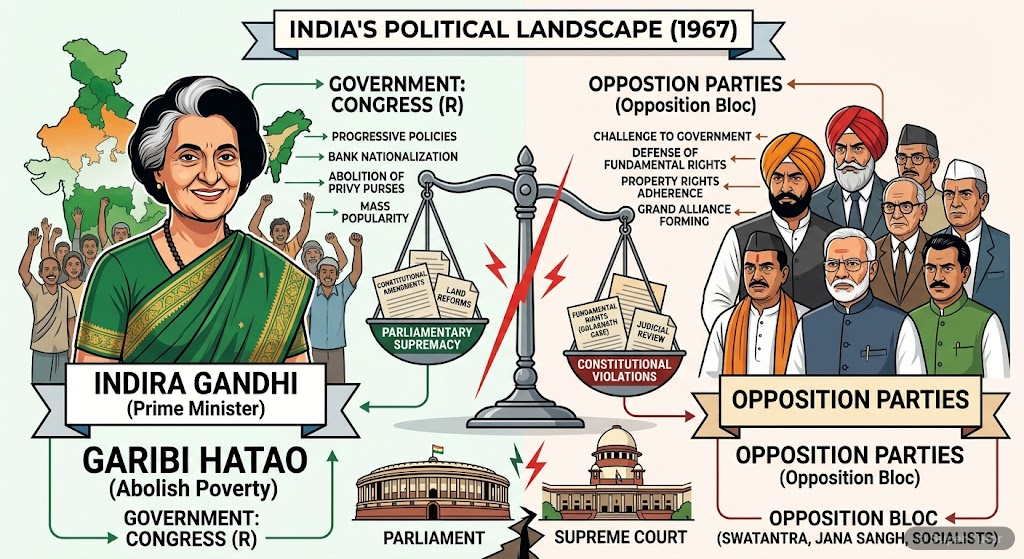
Learn better with visuals Super Tutor pairs illustrations like this with notes and quizzes for The crisis of democratic order.
Study Plan
Learn the Theory
Read the textbook chapter carefully. Note down definitions, formulas and key ideas. Focus on: Background to the Crisis, Economic Context and Public Discontent, Mass Movements in Gujarat and Bihar.
Practise
Solve the textbook exercises and extra practice questions. There are 53 questions available for this chapter.
Revise & Test
Revise key points without looking at your notes. Take a practice quiz and mark weak areas for another pass.
Spaced Revision
Come back to The crisis of democratic order after a week. Use flashcards for quick recall and try past exam questions on this chapter.
What to Focus On
- Politics became more polarised after 1967.
- Indira Gandhi became a towering popular leader.
- Conflict grew between Parliament, the government, and the judiciary.
- The Bangladesh crisis strained the economy.
- Inflation rose sharply in 1973 and 1974.
- Unemployment remained high, especially in rural areas.
- Student unrest became more active and widespread.
- Naxalite groups rejected parliamentary politics and used armed methods.
- The Gujarat movement led to President’s rule and later Congress defeat.
Common Mistakes to Avoid
The Emergency was declared because of an external war threat.
The Allahabad High Court judgment removed Indira Gandhi from office immediately and finally.
Jayaprakash Narayan was a Marxist-Leninist leader like the Naxalites.
Memory Tips
Background causes of the crisis: political tension, judiciary conflict, and personalised politics
Inflation and economic hardship in 1973-1974
Bangladesh crisis and pressure on India
Naxalites as Marxist-Leninist groups using armed methods
Want a personalised study plan?
Super Tutor builds a day-by-day plan for Madhya Pradesh Board Class 12 Political Science that fits your exam date and pace.
Create My Study PlanFrequently Asked Questions
What are the important topics in The crisis of democratic order for Madhya Pradesh Board Class 12 Political Science?
How should I revise The crisis of democratic order for the Madhya Pradesh Board Class 12 board exam?
Sources & Official References
Content is aligned to the official syllabus. Refer to the board website for the latest curriculum.
More resources for The crisis of democratic order
Practice Quiz
Test yourself with a quick quiz
Important Questions
Exam-style questions with answers
Revision Notes
Key points for last-minute revision
Chapter Summary
Understand the chapter at a glance
Concept Maps
See how topics connect
Flashcards
Quick-fire cards for active recall
Syllabus
What topics to cover
NCERT Solutions
Every textbook question solved step by step
For serious students
Get the full The crisis of democratic order chapter — start free.
Quizzes, flashcards, an AI doubt solver and a study plan for Madhya Pradesh Board Class 12 Political Science. Free to start, no card needed.