Introducing Indian Society — Concept Maps
Madhya Pradesh Board · Class 12 · Sociology
4 concept maps of Introducing Indian Society for Madhya Pradesh Board Class 12 Sociology, each also written out as a text outline.
Interactive on Super Tutor
Studying Introducing Indian Society? Get the full interactive chapter.
Quizzes, flashcards, AI doubt-solver and a step-by-step study plan — built for concept maps and more.
Free trial, no card needed.
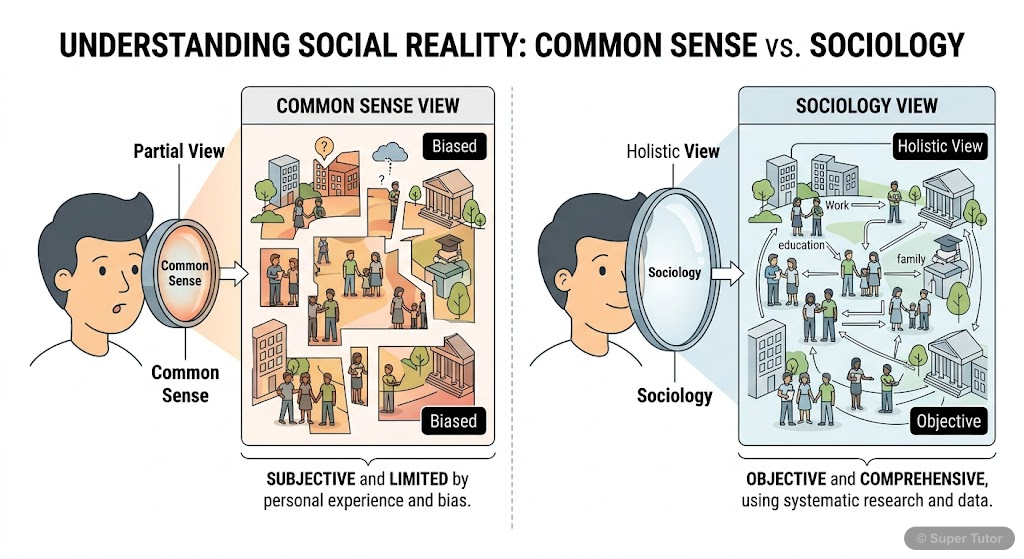
One of 5 illustrations for Introducing Indian Society in Super Tutor — alongside flashcards, concept maps and practice questions.
Common Sense vs Sociological Knowledge — Key Differences
The map in words
- Knowledge About Society
- How Was It Acquired?
- Through growing up and socialisation: Common Sense Knowledge
- Partial Knowledge
- Incomplete — sees only part of social reality
- Problem — Misleads in Exams
- Biased — tilted towards own social group
- Incomplete — sees only part of social reality
- Partial Knowledge
- Through systematic study: Sociological Knowledge
- Critical and Reflexive
- Examines all social groups fairly
- Correct Sociological Thinking
- Goes beyond personal viewpoint
- Examines all social groups fairly
- Critical and Reflexive
- Through growing up and socialisation: Common Sense Knowledge
- How Was It Acquired?
Chapter 1 Concept Map: Introducing Indian Society
The map in words
- Introducing Indian Society
- Sociology as Discipline
- Prior Knowledge
- Unlearning
- Reflexivity
- Common Sense vs Sociology
- Social Map
- Age Group
- Caste or Tribe
- Class
- Religion
- Language Region
- C Wright Mills
- Personal Troubles
- Social Issues
- Sociological Imagination
- Indian Society Textbook
- Demography Chapter 2
- Caste Tribe Family Chapter 3
- Markets Chapter 4
- Inequality Exclusion Chapter 5
- Diversity Chapter 6
- Fieldwork Chapter 7
- Sociology as Discipline
Chapter 1 — Core Concepts Overview
The map in words
- Introducing Indian Society
- Sociology as Discipline
- Unique Subject
- Prior Knowledge Exists
- Advantage and Disadvantage
- Common Sense Knowledge
- Naturally Acquired
- Partial
- Incomplete
- Biased
- Must Unlearn It
- Key Concepts
- Reflexivity
- Critical Self Inspection
- Social Map
- Age Group
- Caste and Religion
- Economic Class
- Region and Language
- Personal Troubles
- Social Issues
- C Wright Mills
- Reflexivity
- Indian Society Structure
- Chapter 2 Population
- Chapter 3 Caste Tribe Family
- Chapter 4 Market
- Chapter 5 Inequality
- Chapter 6 Diversity
- Sociology as Discipline
Indian Society studied through Sociology
The map in words
- Indian Society studied through Sociology
- Sociology
- Common sense knowledge
- Self-reflexivity
- Social mapping
- Personal troubles
- Social issues
- Basic structure of Indian society
- Demographic structure
Explore these maps interactively
Explore DiagramsFrequently Asked Questions
What are the important topics in Introducing Indian Society for Madhya Pradesh Board Class 12 Sociology?
What do the concept maps for Introducing Indian Society show?
How should I revise Introducing Indian Society for the Madhya Pradesh Board Class 12 board exam?
Sources & Official References
Content is aligned to the official syllabus. Refer to the board website for the latest curriculum.
More resources for Introducing Indian Society
Practice Quiz
Test yourself with a quick quiz
Important Questions
Exam-style questions with answers
Revision Notes
Key points for last-minute revision
Chapter Summary
Understand the chapter at a glance
Study Plan
Step-by-step plan for this chapter
Flashcards
Quick-fire cards for active recall
Syllabus
What topics to cover
For serious students
Get the full Introducing Indian Society chapter — start free.
Quizzes, flashcards, an AI doubt solver and a study plan for Madhya Pradesh Board Class 12 Sociology. Free to start, no card needed.