Social Institutions: Continuity and Change — Concept Maps
Madhya Pradesh Board · Class 12 · Sociology
4 concept maps of Social Institutions: Continuity and Change for Madhya Pradesh Board Class 12 Sociology, each also written out as a text outline.
Interactive on Super Tutor
Studying Social Institutions: Continuity and Change? Get the full interactive chapter.
Quizzes, flashcards, AI doubt-solver and a step-by-step study plan — built for concept maps and more.
Free trial, no card needed.
Learn better with visuals Super Tutor pairs illustrations like this with notes and quizzes for Social Institutions: Continuity and Change.
Chapter Concept Map — Social Institutions: Continuity and Change
The map in words
- root((Social Institutions
- Continuity and Change))
- Caste System
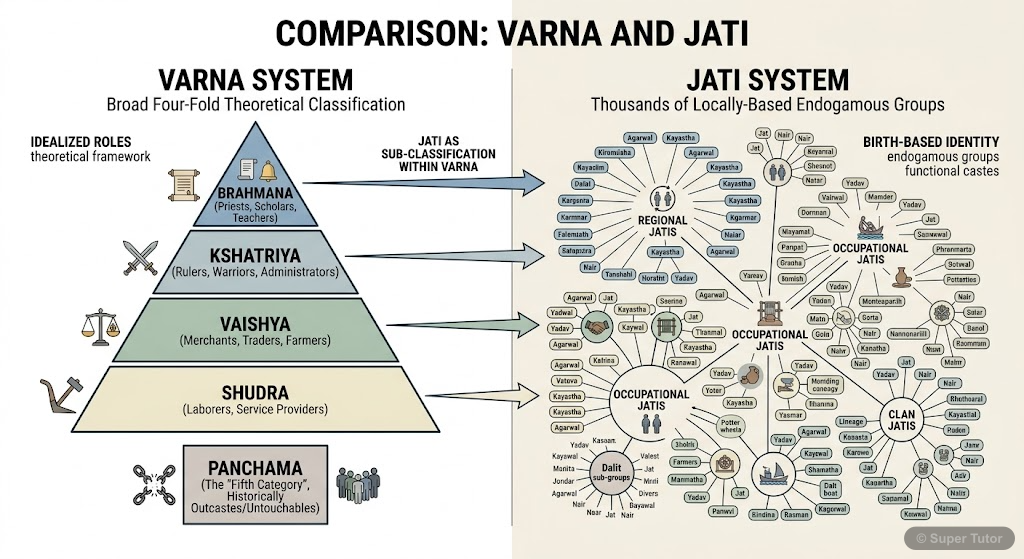
- Varna and Jati
- Varna — 4 fold division
- Jati — local sub-classification
- Defining Features
- Birth determined
- Endogamy
- Food Rules
- Hierarchy
- Occupational Link
- Segmental Organisation
- Purity and Pollution
- Ritual Purity — High Status
- Ritual Pollution — Low Status
- Colonialism and Caste
- Census 1881 — Risley
- Rigidification of Caste
- Govt of India Act 1935
- Scheduled Castes and Tribes
- Post-Independence Caste
- Constitutional Abolition
- Reservations
- Electoral Politics
- Sanskritisation — Srinivas
- Dominant Caste
- Invisible for Upper Class
- Varna and Jati
- Tribal Communities
- Classification
- Permanent Traits
- Region and Habitat
- Language — Austric, Tibeto-Burman
- Physical Characteristics
- Acquired Traits
- Mode of Livelihood
- Assimilation into Hindu Society
- Permanent Traits
- Major Tribes
- Gonds, Bhils, Santhals
- Oraons, Minas, Bodos, Mundas
- Tribal Issues
- Displacement — Dams and Mines
- Forest Loss
- In-migration of Non-tribals
- Land Dispossession
- Tribal Identity Today
- Resistance Movements
- Educated Middle Class
- Statehood — Jharkhand, Chattisgarh
- Cultural Assertion
- Classification
- Family and Kinship
- Types by Structure
- Nuclear Family
- Extended — Joint Family
- Rules of Residence
- Patrilocal
- Matrilocal
- Rules of Descent
- Patrilineal
- Matrilineal
- Authority Structure
- Patriarchal
- Matriarchy — theoretical only
- Family Change
- Migration and Work
- Urbanisation
- Love and Choice Marriages
- Types by Structure
- Social Reformers
- Jotirao Phule — Satyashodhak Samaj
- Savitri Bai Phule — Girls Education
- Ayyankali — Dalit Rights Kerala
- Periyar — Rationalism South India
- Sri Narayana Guru — One Caste One God
- B.R. Ambedkar — Anti-untouchability
- Caste System
Common Misconceptions About Caste — Correct vs Incorrect Understanding
The map in words
- Caste - Key Concepts
- Terminology
- Wrong - Varna equals Caste
- Right - Varna is pan-India framework
- Right - Jati is local specific grouping
- Right - Caste from Portuguese casta
- Historical Evolution
- Wrong - Always rigid from birth
- Right - Vedic period - not birth-based
- Right - Post-Vedic - became rigid
- Right - System changed over time
- Colonialism Impact
- Wrong - British had no role
- Right - Census hardened caste identity
- Right - 1935 Act created SC and ST
- Right - Some scholars - modern caste is colonial product
- Contemporary Relevance
- Wrong - Caste is now irrelevant
- Right - Endogamy persists
- Right - Caste central to elections
- Right - Invisible for privileged only
- Spread of Caste
- Wrong - Only Hindu communities
- Right - Also Muslims Christians Sikhs
- Terminology
Chapter 3 Overview: Social Institutions
The map in words
- root((Social Institutions
- Continuity and Change))
- Caste System
- Varna
- Four categories
- All India scope
- 3000 years old
- Jati
- Local regional
- Hundreds of castes
- Most used term
- Six Features
- Birth determined
- Endogamy
- Food rules
- Hierarchy
- Segmental
- Hereditary occupation
- Colonial Changes
- Risley Census 1901
- GoI Act 1935
- SC and ST lists
- Post Independence
- Constitution abolishes caste
- Reservations
- Dominant Caste
- Sanskritisation
- Varna
- Tribal Communities
- 85 percent Middle India
- 8.6 percent population 2011
- Classification
- Permanent traits
- Acquired traits
- Key Issues
- Land and forest loss
- Development displacement
- Ethnic identity
- North East pressure
- Family and Kinship
- Nuclear family
- Extended joint family
- Descent rules
- Matrilineal
- Patrilineal
- Residence rules
- Matrilocal
- Patrilocal
- Authority
- Patriarchy real
- Matriarchy only theoretical
- Caste System
Social institutions in India change over time while also showing continuity in caste, tribe, family, and kinship
The map in words
- Social institutions in India change over time while also showing continuity in caste, tribe, family, and kinship
- Caste system
- Tribal communities
- Family and kinship
- Social change
Explore these maps interactively
Explore DiagramsFrequently Asked Questions
What are the important topics in Social Institutions: Continuity and Change for Madhya Pradesh Board Class 12 Sociology?
What do the concept maps for Social Institutions: Continuity and Change show?
How should I revise Social Institutions: Continuity and Change for the Madhya Pradesh Board Class 12 board exam?
Sources & Official References
Content is aligned to the official syllabus. Refer to the board website for the latest curriculum.
More resources for Social Institutions: Continuity and Change
Practice Quiz
Test yourself with a quick quiz
Important Questions
Exam-style questions with answers
Revision Notes
Key points for last-minute revision
Chapter Summary
Understand the chapter at a glance
Study Plan
Step-by-step plan for this chapter
Flashcards
Quick-fire cards for active recall
Syllabus
What topics to cover
NCERT Solutions
Every textbook question solved step by step
For serious students
Get the full Social Institutions: Continuity and Change chapter — start free.
Quizzes, flashcards, an AI doubt solver and a study plan for Madhya Pradesh Board Class 12 Sociology. Free to start, no card needed.