Introducing Indian Society — Chapter Summary
Madhya Pradesh Board · Class 12 · Sociology
Summary of Introducing Indian Society for Madhya Pradesh Board Class 12 Sociology. Part of the Madhya Pradesh Board Class 12 Sociology syllabus.
Interactive on Super Tutor
Studying Introducing Indian Society? Get the full interactive chapter.
Quizzes, flashcards, AI doubt-solver and a step-by-step study plan — built for chapter summary and more.
Free trial, no card needed.
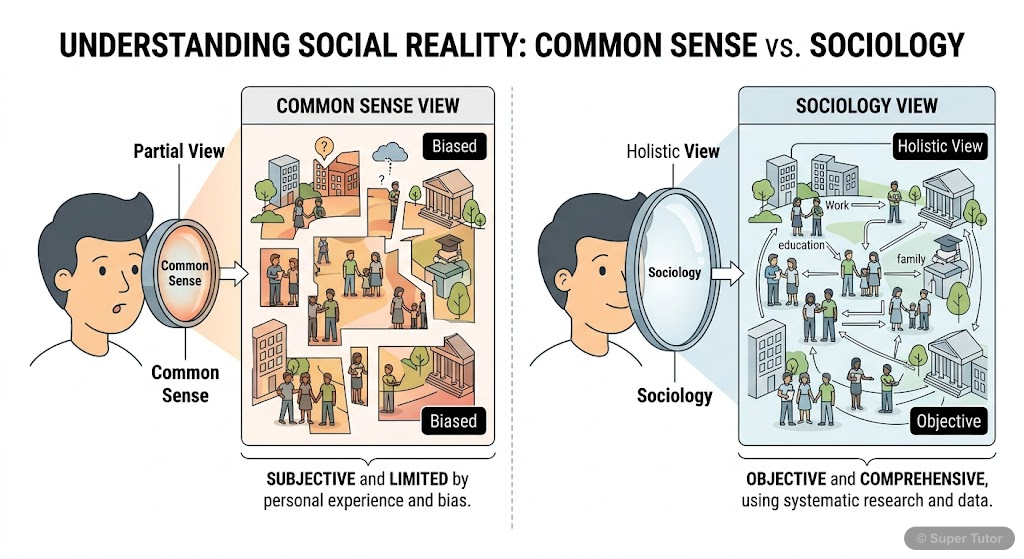
One of 5 illustrations for Introducing Indian Society in Super Tutor — alongside flashcards, concept maps and practice questions.
Overview
Sociology studies society, and it begins from a different starting point than most other subjects because prior knowledge about society already exists. Common-sense ideas about society are learned through family, social groups, and daily life, but this knowledge is often partial in two ways: it is i
Key Concepts
Sociology is the discipline that studies
Sociology is the discipline that studies society. It is unusual because no one starts from zero; everyone already knows something about social life.
Common sense knowledge about society
Common sense knowledge about society is learned without formal teaching and comes from the social group and environment into which a person is sociali
Learning sociology requires unlearning common
Learning sociology requires unlearning common-sense ideas about society before building a more careful and critical understanding.
Common
Common-sense knowledge is partial in two senses: it is incomplete and it is biased.
Self
Self-reflexivity, also called reflexivity, is the ability to reflect on oneself and to turn one’s gaze back on oneself critically.
Learning Objectives
- Understand why sociology is different from other subjects because it starts with prior knowledge of society.
- Recognise how common-sense knowledge is both useful and limited.
- Explain the meaning of self-reflexivity and its critical nature.
- Understand how social location is shaped by age, region, language, class, religion, caste, and tribe.
- Distinguish between personal troubles and social issues using C. Wright Mills’ idea.
Frequently Asked Questions
What are the important topics in Introducing Indian Society for Madhya Pradesh Board Class 12 Sociology?
How should I revise Introducing Indian Society for the Madhya Pradesh Board Class 12 board exam?
Sources & Official References
Content is aligned to the official syllabus. Refer to the board website for the latest curriculum.
More resources for Introducing Indian Society
For serious students
Get the full Introducing Indian Society chapter — start free.
Quizzes, flashcards, an AI doubt solver and a study plan for Madhya Pradesh Board Class 12 Sociology. Free to start, no card needed.