Patterns of Social Inequality and Exclusion — Practice Quiz
Madhya Pradesh Board · Class 12 · Sociology
Try a 4-question quiz on Patterns of Social Inequality and Exclusion for Madhya Pradesh Board Class 12 Sociology: tap an answer to check it and see why.
Interactive on Super Tutor
Studying Patterns of Social Inequality and Exclusion? Get the full interactive chapter.
Quizzes, flashcards, AI doubt-solver and a step-by-step study plan — built for practice quiz and more.
Free trial, no card needed.
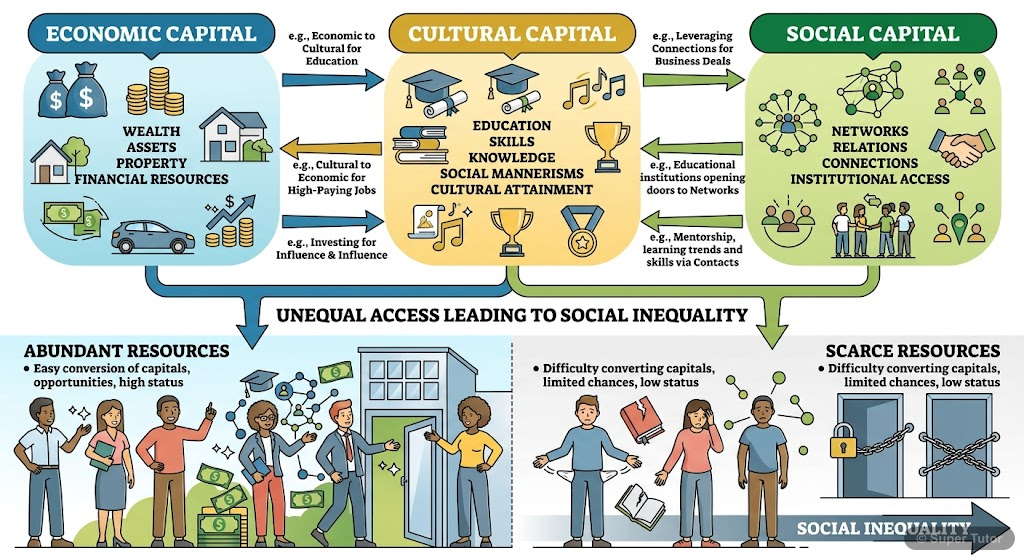
Learn better with visuals Super Tutor pairs illustrations like this with notes and quizzes for Patterns of Social Inequality and Exclusion.
Quick Quiz: Patterns of Social Inequality and Exclusion
0/4Tap an answer to check it instantly. No sign-up needed for these 4.
What does the term 'Dalit' literally mean in Indian languages?
Who popularized the term 'Harijan' in the 1930s?
The term 'Adivasi' literally means:
The Second Backward Classes Commission was headed by:
Sample Questions
Which of the following are forms of social capital according to the chapter?
Show answer
Networks of contacts, Social associations, Influential relatives and friends
Social capital refers to networks of contacts, social associations, and connections like influential relatives and friends. Educational qualifications are cultural capital, while material assets are economic capital.
Untouchability involves which of the following dimensions?
Show answer
Exclusion, Humiliation-subordination, Exploitation
The three main dimensions of untouchability are exclusion (being prohibited from sharing water sources, religious worship), humiliation-subordination (being treated as inferior), and exploitation (forced unpaid labor, property confiscation).
Which book was written by Tarabai Shinde in 1882?
Show answer
Stree Purush Tulana
Stree Purush Tulana (Comparison of Men and Women) was written by Tarabai Shinde in 1882 as a protest against the double standards of a male-dominated society. It created quite a stir when published.
Which of the following are characteristics of social stratification?
Show answer
It is a characteristic of society, not individual differences, It persists over generations, It is supported by patterns of belief or ideology
Social stratification has three key principles: it's a society-wide system (not individual), it persists across generations through inheritance, and it's supported by ideologies that make it seem fair or inevitable.
+46 more questions on Patterns of Social Inequality and Exclusion (Madhya Pradesh Board Class 12 Sociology)
Practise AllFrequently Asked Questions
What are the important topics in Patterns of Social Inequality and Exclusion for Madhya Pradesh Board Class 12 Sociology?
How many practice questions are there for Patterns of Social Inequality and Exclusion?
Sources & Official References
Content is aligned to the official syllabus. Refer to the board website for the latest curriculum.
More resources for Patterns of Social Inequality and Exclusion
Important Questions
Exam-style questions with answers
Revision Notes
Key points for last-minute revision
Chapter Summary
Understand the chapter at a glance
Concept Maps
See how topics connect
Study Plan
Step-by-step plan for this chapter
Flashcards
Quick-fire cards for active recall
Syllabus
What topics to cover
NCERT Solutions
Every textbook question solved step by step
For serious students
Get the full Patterns of Social Inequality and Exclusion chapter — start free.
Quizzes, flashcards, an AI doubt solver and a study plan for Madhya Pradesh Board Class 12 Sociology. Free to start, no card needed.