Patterns of Social Inequality and Exclusion — NCERT Solutions
Madhya Pradesh Board · Class 12 · Sociology
NCERT Solutions for Patterns of Social Inequality and Exclusion, Madhya Pradesh Board Class 12 Sociology: 22 textbook questions solved step by step.
Interactive on Super Tutor
Studying Patterns of Social Inequality and Exclusion? Get the full interactive chapter.
Quizzes, flashcards, AI doubt-solver and a step-by-step study plan — built for NCERT solutions and more.
Free trial, no card needed.
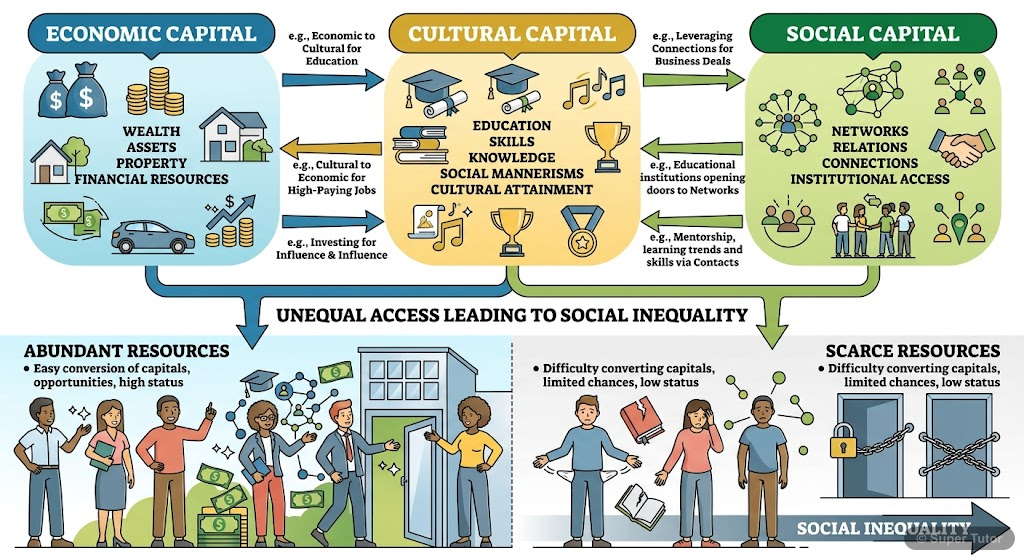
Learn better with visuals Super Tutor pairs illustrations like this with notes and quizzes for Patterns of Social Inequality and Exclusion.
The first 11 solutions are open to read. The other 11 are free with a Super Tutor account.
Activity 5.1
1Why is the person ‘unemployed’? Has he/she been looking for work? How is he/she supporting herself/himself? In what ways are they affected by the fact of not having any work? Is their lifestyle any different from when they were working?Show solution
The chapter suggests asking first why the person is unemployed: whether they have been unable to find work, are between jobs, or have been excluded from work opportunities. It then asks you to check whether the person has been looking for work and how they are surviving without a job — for example, through help from family, savings, or some informal work. You should also note how unemployment affects their life: it may reduce income, create stress, and change daily routine and social status. Their lifestyle may be very different from when they were working, with less spending, more dependence on others, and fewer opportunities.
Activity 5.2
1Can you distinguish between instances of prejudice that were intentional – i.e., the film maker or writer wanted to show it as prejudiced – and unintentional or unconscious prejudice?Show solution
Yes. Intentional prejudice is when the writer or filmmaker clearly means to show a biased view as biased, so the audience can criticise it. Unintentional or unconscious prejudice is when stereotypes slip into the portrayal without the creator fully realising it. The chapter says prejudice can appear in films or novels through the way a social group is depicted, and asks us to judge whether the portrayal is deliberately prejudiced or reflects hidden assumptions.
Exercise for Tables 1 and 2
1What is the percentage of the Indian population that was living below the poverty line in (a) Rural India and (b) Urban India?Show solution
From Table 1, the percentage of the population living below the poverty line is given in the ALL GROUPS row. It is 25.4% for rural India and 13.7% for urban India.
3Approximately how many times higher than the national average is the poverty percentage for each of the lower castes (ST, SC, OBC)? Is there a significant rural-urban difference?Show solution
The national average poverty rate is 25.4% in rural India and 13.7% in urban India.
- Scheduled Tribes (ST): rural 45.3%, which is about 1.8 times the national average (); urban 24.1%, about 1.8 times the urban average ().
- Scheduled Castes (SC): rural 31.5%, about 1.2 times the rural average; urban 21.7%, about 1.6 times the urban average.
- OBCs: rural 22.7%, slightly below the rural average (); urban 15.4%, slightly above the urban average ().
So, there is a rural-urban difference, but it is not huge for ST and SC. ST and SC remain much poorer than the national average in both rural and urban areas.
6What do these tables tell you about the relative position of the OBCs? Is there a significant rural-urban difference?Show solution
The tables show that the OBCs occupy an intermediate position. They are better off than Scheduled Castes and Scheduled Tribes, but worse off than the upper castes and some other better-off groups. Their poverty rate is around the national average or slightly below it in rural India and slightly above it in urban India. In affluence too, they are below the national average. So the OBC category is diverse, with some groups closer to upper castes and others close to Dalits in socio-economic position. There is a rural-urban difference: upper OBCs are stronger in rural areas, while urban OBCs are closer to SC/ST conditions.
Activity 5.4
1Can you see any of the ideas they fought for existing today in our everyday lives or in our constitutional provisions?Show solution
Yes. Many of the ideas fought for by reformers are reflected today in everyday life and in constitutional provisions. For example, the Constitution guarantees equality before law, prohibits discrimination on grounds of religion, caste, creed or sex, gives women the right to vote and hold public office, and supports equality in public employment and opportunity. Social reforms such as opposition to sati, support for widow remarriage, and the demand for women’s education also influenced later social practice and legal reform.
Activity 5.5
1Make a list of professions in which women are involved today.Show solution
The chapter asks students to make a list of professions in which women are involved today. A suitable answer is that women work in a wide range of fields, including education, health, law, government service, business, agriculture, science, media, and other jobs. The chapter’s point is that women are no longer confined to a single role, even though inequality remains.
2Can you think of any educational field where women are barred today? Perhaps the discussion on women in the Indian armed forces may throw some light on this.Show solution
The chapter says that once education for women was accepted, it became impossible to confine women to only some kinds of education. So today it is difficult to say that women are completely barred from any educational field. However, in practice, some fields have traditionally had very low female participation, and the chapter mentions that the discussion on women in the armed forces may throw light on such barriers. So the answer is that there may still be informal or social barriers, even if there is no clear legal ban in most educational fields.
Activity 5.8
1Make a list of examples that show positive achievements of the disabled in different fields like music, art, etc.Show solution
The chapter asks for examples of positive achievements of the disabled in different fields like music, art, and so on. Suitable examples would include musicians, painters, writers, athletes, teachers, and public figures with disabilities who have achieved success. The chapter itself mentions the film Iqbal as an example of a disabled person excelling in cricket, showing that disability does not prevent achievement when society provides opportunity.
Activity 5.9
1Have you seen the film, Iqbal? If you have not, do try and see it. It is an exemplary story of the grit and determination of a young boy who cannot hear and speak but has a passion for cricket, and finally, excels as a bowler. The film brings alive not just *Iqbal*'s struggles but also the many possible concrete meanings of the phrase 'differently abled'.Show solution
The film Iqbal shows that a disabled person can have talent, determination, and success. The chapter uses it to illustrate the meaning of “differently abled”. Iqbal cannot hear or speak, but he works hard, follows his passion for cricket, and finally succeeds as a bowler. So the film challenges the idea that disability means inability.
Activity 5.10
1Read the quote above and discuss the different ways in which the problems of the disabled are socially constituted.Show solution
The problems of the disabled are socially constituted because disability is not only a matter of bodily impairment. The chapter says people are disabled by buildings not designed for them, by segregated schooling, by lack of access to employment, education, and public facilities. It also points out that poverty, malnutrition, poor healthcare, and unsafe living conditions increase disability. So society creates or deepens disability through its structures and attitudes.
Exercise Questions
Free with a Super Tutor account
Free with a Super Tutor account
Free with a Super Tutor account
Free with a Super Tutor account
Free with a Super Tutor account
Free with a Super Tutor account
Free with a Super Tutor account
Free with a Super Tutor account
Free with a Super Tutor account
Free with a Super Tutor account
Free with a Super Tutor account
11 more solved questions in Patterns of Social Inequality and Exclusion
They are free with a Super Tutor account, along with practice quizzes and flashcards for this chapter. Free to start, no card needed.
Frequently Asked Questions
What are the important topics in Patterns of Social Inequality and Exclusion for Madhya Pradesh Board Class 12 Sociology?
Are these NCERT Solutions for Patterns of Social Inequality and Exclusion free?
How should I revise Patterns of Social Inequality and Exclusion for the Madhya Pradesh Board Class 12 board exam?
Sources & Official References
Content is aligned to the official syllabus. Refer to the board website for the latest curriculum.
More resources for Patterns of Social Inequality and Exclusion
Practice Quiz
Test yourself with a quick quiz
Important Questions
Exam-style questions with answers
Revision Notes
Key points for last-minute revision
Chapter Summary
Understand the chapter at a glance
Concept Maps
See how topics connect
Study Plan
Step-by-step plan for this chapter
Flashcards
Quick-fire cards for active recall
Syllabus
What topics to cover
For serious students
Get the full Patterns of Social Inequality and Exclusion chapter — start free.
Quizzes, flashcards, an AI doubt solver and a study plan for Madhya Pradesh Board Class 12 Sociology. Free to start, no card needed.