Structure of the Atom — Chapter Summary
Madhya Pradesh Board · Class 9 · Science
Summary of Structure of the Atom for Madhya Pradesh Board Class 9 Science. Part of the Madhya Pradesh Board Class 9 Science syllabus.
Interactive on Super Tutor
Studying Structure of the Atom? Get the full interactive chapter.
Quizzes, flashcards, AI doubt-solver and a step-by-step study plan — built for chapter summary and more.
Free trial, no card needed.
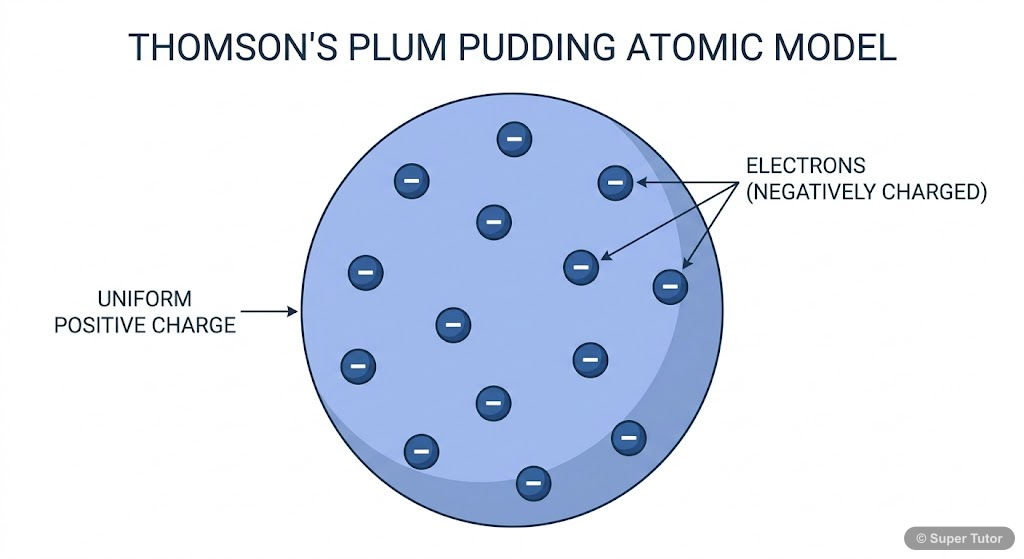
Learn better with visuals Super Tutor pairs illustrations like this with notes and quizzes for Structure of the Atom.
Overview
This chapter explores the fundamental structure of atoms, revealing that they are not indivisible as once believed by Dalton, but contain smaller subatomic particles. We learn about the discovery of electrons, protons, and neutrons, and how scientists developed different models to explain the arrang
Key Concepts
Atoms contain three fundamental particles
Atoms contain three fundamental particles: electrons (negatively charged, negligible mass), protons (positively charged, mass = 1 unit), and neutrons
Proposed that atoms are like Christmas
Proposed that atoms are like Christmas pudding with electrons embedded in a sphere of positive charge, like currants in pudding or seeds in watermelon
Based on alpha
Based on alpha-particle scattering experiment, proposed that atoms have a tiny, dense, positively charged nucleus with electrons revolving around it.
Electrons revolve in fixed orbits (K
Electrons revolve in fixed orbits (K, L, M, N shells) with specific energy levels. Electrons don't radiate energy while in these orbits, explaining at
Electrons fill shells following rules
Electrons fill shells following rules: K shell (max 2), L shell (max 8), M shell (max 18), N shell (max 32). Outermost shell can hold maximum 8 electr
Learning Objectives
- Understand that atoms contain subatomic particles (electrons, protons, neutrons)
- Learn about the historical development of atomic models from Thomson to Bohr
- Explain the arrangement of electrons in different shells around the nucleus
- Calculate valency based on electron configuration
- Distinguish between atomic number and mass number
Frequently Asked Questions
What are the important topics in Structure of the Atom for Madhya Pradesh Board Class 9 Science?
How should I revise Structure of the Atom for Class 9 exams?
Sources & Official References
Content is aligned to the official syllabus. Refer to the board website for the latest curriculum.
More resources for Structure of the Atom
Practice Quiz
Test yourself with a quick quiz
Important Questions
Exam-style questions with answers
Revision Notes
Key points for last-minute revision
Formula Sheet
The chapter's formulas in one place
Flashcards
Quick-fire cards for active recall
Syllabus
What topics to cover
NCERT Solutions
Every textbook question solved step by step
For serious students
Get the full Structure of the Atom chapter — start free.
Quizzes, flashcards, an AI doubt solver and a study plan for Madhya Pradesh Board Class 9 Science. Free to start, no card needed.