Tissues — Chapter Summary
Madhya Pradesh Board · Class 9 · Science
Summary of Tissues for Madhya Pradesh Board Class 9 Science. Key concepts: A tissue is a group, These are actively dividing and Tissues made of one type.
Interactive on Super Tutor
Studying Tissues? Get the full interactive chapter.
Quizzes, flashcards, AI doubt-solver and a step-by-step study plan — built for chapter summary and more.
Free trial, no card needed.
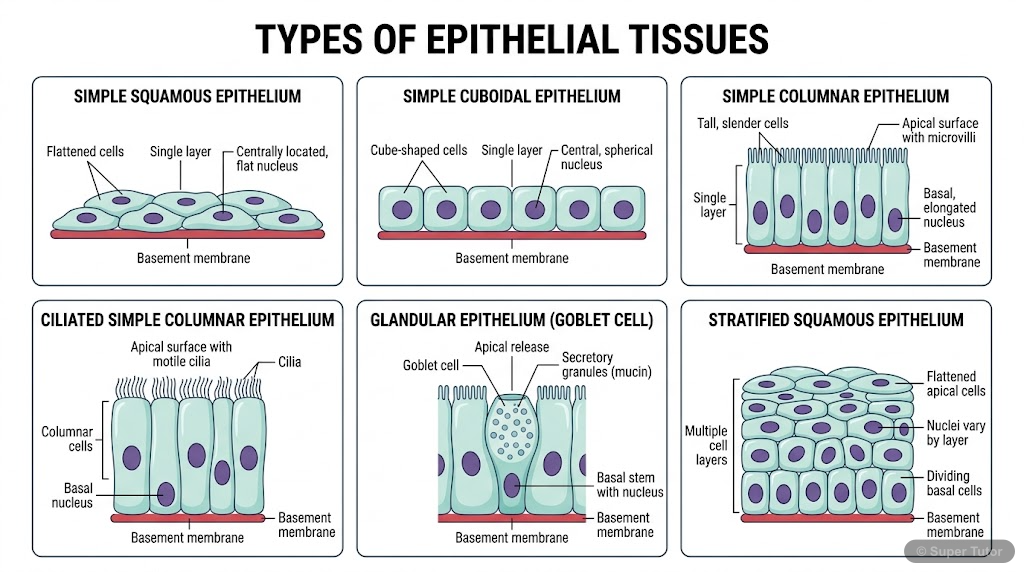
One of 6 illustrations for Tissues in Super Tutor — alongside flashcards, concept maps and practice questions.
Overview
Tissues are groups of cells that work together to perform specific functions in living organisms. While unicellular organisms like Amoeba perform all functions with a single cell, multicellular organisms show division of labour where different groups of cells specialize in different functions. This
Key Concepts
A tissue is a group
A tissue is a group of cells that are similar in structure and work together to achieve a particular function. Examples include blood, muscle, and phl
These are actively dividing plant tissues
These are actively dividing plant tissues found in growing regions. They have dense cytoplasm, thin cell walls, prominent nuclei, and lack vacuoles. T
Tissues made of one type
Tissues made of one type of cell that have lost the ability to divide. Include: Parenchyma (storage, living cells with intercellular spaces), Collench
Tissues made of multiple cell types
Tissues made of multiple cell types working together. Xylem (water and mineral transport) consists of tracheids, vessels, xylem parenchyma, and fibers
Protective covering tissue in animals
Protective covering tissue in animals with tightly packed cells and minimal intercellular spaces. Types include squamous (flat), cuboidal (cube-shaped
Learning Objectives
- Understand the concept of tissues and their importance in multicellular organisms
- Differentiate between plant and animal tissues based on their structure and functions
- Learn about different types of plant tissues - meristematic and permanent tissues
- Study the classification and functions of simple and complex permanent tissues in plants
- Explore the four main types of animal tissues and their characteristics
Frequently Asked Questions
What are the important topics in Tissues for Madhya Pradesh Board Class 9 Science?
How should I revise Tissues for Class 9 exams?
Sources & Official References
Content is aligned to the official syllabus. Refer to the board website for the latest curriculum.
More resources for Tissues
Practice Quiz
Test yourself with a quick quiz
Important Questions
Exam-style questions with answers
Revision Notes
Key points for last-minute revision
Concept Maps
See how topics connect
Study Plan
Step-by-step plan for this chapter
Flashcards
Quick-fire cards for active recall
Syllabus
What topics to cover
NCERT Solutions
Every textbook question solved step by step
For serious students
Get the full Tissues chapter — start free.
Quizzes, flashcards, an AI doubt solver and a study plan for Madhya Pradesh Board Class 9 Science. Free to start, no card needed.