Structure of the Atom — NCERT Solutions
Madhya Pradesh Board · Class 9 · Science
NCERT Solutions for Structure of the Atom, Madhya Pradesh Board Class 9 Science: 19 textbook questions solved step by step. Covers Exercises.
Interactive on Super Tutor
Studying Structure of the Atom? Get the full interactive chapter.
Quizzes, flashcards, AI doubt-solver and a step-by-step study plan — built for NCERT solutions and more.
Free trial, no card needed.
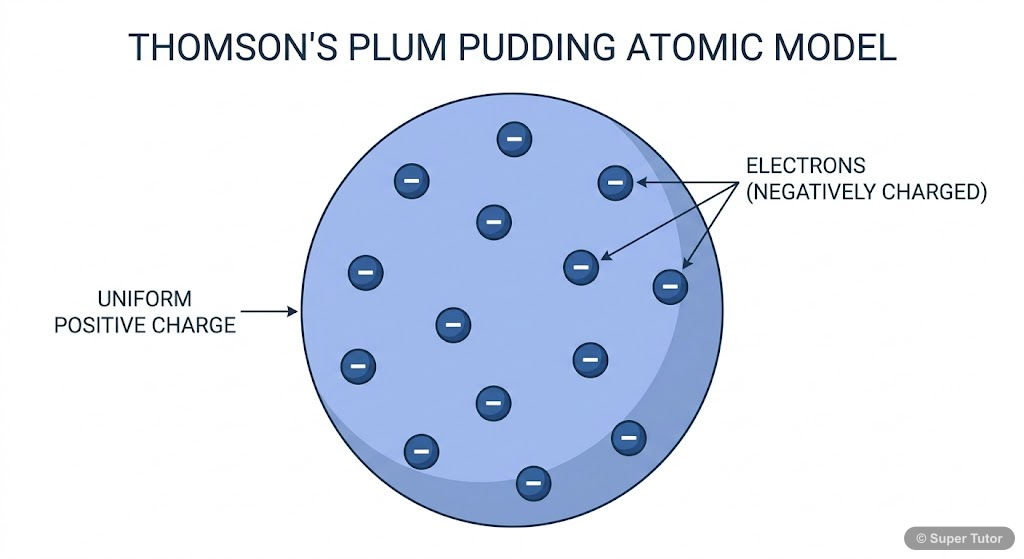
Learn better with visuals Super Tutor pairs illustrations like this with notes and quizzes for Structure of the Atom.
The first 10 solutions are open to read. The other 9 are free with a Super Tutor account.
Exercises
1Compare the properties of electrons, protons and neutrons.Show solution
The properties of the three sub-atomic particles are compared below:
| Property | Electron | Proton | Neutron |
|---|---|---|---|
| Discovery | J.J. Thomson (1897) | E. Goldstein (1886) | J. Chadwick (1932) |
| Symbol | |||
| Charge | (negative) | (positive) | (neutral) |
| Absolute charge | C | C | Zero |
| Mass | kg ( u) | kg ( u) | kg ( u) |
| Location in atom | Outside nucleus (in shells) | Inside nucleus | Inside nucleus |
Key points:
- Electrons are negatively charged and revolve around the nucleus in fixed shells.
- Protons are positively charged and are present in the nucleus.
- Neutrons are neutral (no charge) and are also present in the nucleus.
- The mass of an electron is negligible compared to protons and neutrons.
2What are the limitations of J.J. Thomson's model of the atom?Show solution
J.J. Thomson's Model (Plum Pudding Model): Thomson proposed that an atom is a sphere of positive charge with electrons embedded in it like plums in a pudding.
Limitations:
- Thomson's model could not explain the results of Rutherford's alpha-particle scattering experiment. If the positive charge were spread uniformly throughout the atom, the alpha particles should have passed through with very little deflection. However, Rutherford observed that some alpha particles were deflected at large angles and some even bounced back, which Thomson's model could not account for.
- The model did not mention the existence of a nucleus — a dense, positively charged centre of the atom.
- It could not explain the stability of the atom in terms of arrangement of electrons.
Conclusion: Thomson's model was an early attempt but was soon replaced by Rutherford's nuclear model.
3What are the limitations of Rutherford's model of the atom?Show solution
Rutherford's Nuclear Model: Rutherford proposed that the atom has a tiny, dense, positively charged nucleus at the centre, and electrons revolve around it in circular orbits.
Limitations:
- Instability of the atom: According to classical electromagnetic theory, a charged particle (electron) moving in a circular orbit continuously loses energy by emitting radiation. As it loses energy, it should spiral inward and eventually fall into the nucleus. This would make the atom unstable and collapse within seconds. But atoms are known to be stable — this contradiction could not be explained by Rutherford's model.
- Could not explain the atomic spectrum: If electrons lose energy continuously, they should emit a continuous spectrum of radiation. However, atoms emit a line spectrum (discrete lines), which Rutherford's model failed to explain.
- No information about electronic arrangement: The model did not say anything about how electrons are arranged or distributed around the nucleus.
Conclusion: Rutherford's model was an improvement over Thomson's model but had serious drawbacks that were later addressed by Bohr's model.
4Describe Bohr's model of the atom.Show solution
Bohr's Model of the Atom (1913):
Neils Bohr proposed an improved model of the atom to overcome the limitations of Rutherford's model. The main postulates are:
- Nucleus: The atom has a small, dense, positively charged nucleus at its centre (retained from Rutherford's model).
- Fixed orbits (shells): Electrons revolve around the nucleus in fixed circular paths called orbits or shells. These shells are designated as K, L, M, N, ... (or numbered 1, 2, 3, 4, ...).
- Discrete energy levels: Each orbit has a fixed amount of energy associated with it. As long as an electron remains in a particular orbit, it does not radiate energy. Hence the atom is stable.
- Energy change during transition: When an electron jumps from a lower energy orbit to a higher energy orbit, it absorbs energy. When it falls from a higher to a lower orbit, it emits energy in the form of radiation. This explains the line spectrum of atoms.
Diagram (description): The nucleus is at the centre; K shell is closest (lowest energy), followed by L, M, N shells at increasing distances and energies.
Significance: Bohr's model successfully explained the stability of the atom and the line spectrum of hydrogen.
5Compare all the proposed models of an atom given in this chapter.Show solution
The three atomic models discussed in the chapter are compared below:
| Feature | Thomson's Model | Rutherford's Model | Bohr's Model |
|---|---|---|---|
| Year | 1898 | 1911 | 1913 |
| Shape of atom | Sphere of uniform positive charge | Mostly empty space with a nucleus | Mostly empty space with a nucleus |
| Nucleus | Not proposed | Tiny, dense, positively charged nucleus | Tiny, dense, positively charged nucleus |
| Electrons | Embedded in positive sphere (like plums in pudding) | Revolve around nucleus in circular orbits | Revolve in fixed shells (K, L, M, N...) with discrete energies |
| Energy of electrons | Not specified | Continuous — electrons lose energy and spiral in | Discrete — electrons in fixed energy levels, stable orbits |
| Stability of atom | Could not explain | Could not explain (electrons should collapse) | Explained — electrons in fixed orbits do not radiate energy |
| Atomic spectrum | Could not explain | Could not explain | Explained (line spectrum due to electron transitions) |
| Limitation | No nucleus; disproved by Rutherford's experiment | Atom should collapse; no line spectrum explanation | Does not explain multi-electron atoms fully |
Conclusion: Each model was an improvement over the previous one. Bohr's model was the most successful among the three in explaining atomic stability and hydrogen spectrum.
6Summarise the rules for writing of distribution of electrons in various shells for the first eighteen elements.Show solution
Rules for Distribution of Electrons in Shells (Bohr-Bury Rules):
- Maximum electrons in a shell: The maximum number of electrons that can be accommodated in a shell is given by the formula , where is the shell number.
- K shell (): electrons
- L shell (): electrons
- M shell (): electrons (but for first 18 elements, max 8 are filled)
- Outermost shell rule: The outermost shell cannot have more than 8 electrons, even if the formula allows more.
- Penultimate shell rule: The second last (penultimate) shell cannot have more than 18 electrons.
- Sequential filling: Shells are filled in order — a new shell is started only when the inner shell is completely filled.
- Valence shell: The last shell (outermost) is called the valence shell and the electrons in it are called valence electrons.
Example — Electronic configurations of first 18 elements:
| Element | Atomic No. | K | L | M |
|---|---|---|---|---|
| H | 1 | 1 | — | — |
| He | 2 | 2 | — | — |
| Li | 3 | 2 | 1 | — |
| Be | 4 | 2 | 2 | — |
| B | 5 | 2 | 3 | — |
| C | 6 | 2 | 4 | — |
| N | 7 | 2 | 5 | — |
| O | 8 | 2 | 6 | — |
| F | 9 | 2 | 7 | — |
| Ne | 10 | 2 | 8 | — |
| Na | 11 | 2 | 8 | 1 |
| Mg | 12 | 2 | 8 | 2 |
| Al | 13 | 2 | 8 | 3 |
| Si | 14 | 2 | 8 | 4 |
| P | 15 | 2 | 8 | 5 |
| S | 16 | 2 | 8 | 6 |
| Cl | 17 | 2 | 8 | 7 |
| Ar | 18 | 2 | 8 | 8 |
7Define valency by taking examples of silicon and oxygen.Show solution
Definition of Valency:
Valency is the combining capacity of an atom of an element. It is determined by the number of electrons in the outermost shell (valence electrons) of an atom.
- If the number of valence electrons is 4 or less, the valency = number of valence electrons.
- If the number of valence electrons is more than 4, the valency = (number of valence electrons).
Example 1 — Silicon (Si):
- Atomic number of Si = 14
- Electronic configuration: K = 2, L = 8, M = 4
- Valence electrons = 4
- Since valence electrons , Valency of Si = 4
- Silicon can form 4 bonds (e.g., ).
Example 2 — Oxygen (O):
- Atomic number of O = 8
- Electronic configuration: K = 2, L = 6
- Valence electrons = 6
- Since valence electrons , Valency of O = 2
- Oxygen can form 2 bonds (e.g., ).
Conclusion: Valency tells us how many bonds an atom can form with other atoms.
8Explain with examples (i) Atomic number, (ii) Mass number, (iii) Isotopes and (iv) Isobars. Give any two uses of isotopes.Show solution
(i) Atomic Number (Z):
The atomic number of an element is defined as the number of protons present in the nucleus of its atom. Since an atom is electrically neutral, the number of protons equals the number of electrons.
Example: Carbon (C) has 6 protons, so its atomic number .
(ii) Mass Number (A):
The mass number of an atom is defined as the total number of protons and neutrons (nucleons) present in the nucleus.
Example: Carbon has 6 protons and 6 neutrons, so its mass number . It is written as .
(iii) Isotopes:
Isotopes are atoms of the same element that have the same atomic number but different mass numbers (i.e., same number of protons but different number of neutrons).
Example: Hydrogen has three isotopes:
- Protium: (1 proton, 0 neutrons)
- Deuterium: (1 proton, 1 neutron)
- Tritium: (1 proton, 2 neutrons)
All have the same atomic number (1) but different mass numbers.
(iv) Isobars:
Isobars are atoms of different elements that have the same mass number but different atomic numbers.
Example: Calcium () and Argon () are isobars — both have mass number 40 but different atomic numbers (20 and 18 respectively).
Two Uses of Isotopes:
- An isotope of uranium () is used as fuel in nuclear reactors to generate electricity.
- An isotope of iodine () is used in the treatment of thyroid cancer (goitre).
- (Bonus) An isotope of cobalt () is used in the treatment of cancer (radiotherapy).
9Na⁺ has completely filled K and L shells. Explain.Show solution
Given: ion has completely filled K and L shells.
Step 1: Electronic configuration of Na atom
- Atomic number of Na = 11
- Number of electrons in Na = 11
- Electronic configuration: K = 2, L = 8, M = 1
Step 2: Formation of Na⁺ ion
- is formed when a sodium atom loses 1 electron from its outermost shell (M shell).
- Number of electrons in =
Step 3: Electronic configuration of Na⁺
- 10 electrons are distributed as: K = 2, L = 8
- K shell capacity = 2 (completely filled ✓)
- L shell capacity = 8 (completely filled ✓)
- M shell has 0 electrons.
Conclusion: Since has only 10 electrons, they completely fill the K shell (2 electrons) and L shell (8 electrons), with no electrons in the M shell. Hence, has completely filled K and L shells.
10If bromine atom is available in the form of, say, two isotopes Br (49.7%) and Br (50.3%), calculate the average atomic mass of bromine atom.Show solution
Given:
- Isotope 1: , abundance = 49.7%
- Isotope 2: , abundance = 50.3%
Formula:
Calculation:
Free with a Super Tutor account
Free with a Super Tutor account
X: Protons = 6, Neutrons = 6
Y: Protons = 6, Neutrons = 8
Give the mass numbers of X and Y. What is the relation between the two species?
Free with a Super Tutor account
(a) J.J. Thomson proposed that the nucleus of an atom contains only nucleons.
(b) A neutron is formed by an electron and a proton combining together. Therefore, it is neutral.
(c) The mass of an electron is about 1/2000 times that of proton.
(d) An isotope of iodine is used for making tincture iodine, which is used as a medicine.
Free with a Super Tutor account
(a) Atomic Nucleus
(b) Electron
(c) Proton
(d) Neutron
Free with a Super Tutor account
(a) the same physical properties
(b) different chemical properties
(c) different number of neutrons
(d) different atomic numbers.
Free with a Super Tutor account
(a) 16
(b) 8
(c) 17
(d) 18
Free with a Super Tutor account
(a) 2,8
(b) 8,2,1
(c) 2,1,8
(d) 2,8,1
Free with a Super Tutor account
| Atomic Number | Mass Number | Number of Neutrons | Number of Protons | Number of Electrons | Name of the Atomic Species |
|---|---|---|---|---|---|
| 9 | - | 10 | - | - | - |
| 16 | 32 | - | - | - | Sulphur |
| - | 24 | - | 12 | - | - |
| - | 2 | - | 1 | - | - |
| - | 1 | 0 | 1 | 0 | - |
Free with a Super Tutor account
9 more solved questions in Structure of the Atom
They are free with a Super Tutor account, along with practice quizzes and flashcards for this chapter. Free to start, no card needed.
Frequently Asked Questions
What are the important topics in Structure of the Atom for Madhya Pradesh Board Class 9 Science?
Are these NCERT Solutions for Structure of the Atom free?
How should I revise Structure of the Atom for Class 9 exams?
Sources & Official References
Content is aligned to the official syllabus. Refer to the board website for the latest curriculum.
More resources for Structure of the Atom
Practice Quiz
Test yourself with a quick quiz
Important Questions
Exam-style questions with answers
Revision Notes
Key points for last-minute revision
Formula Sheet
The chapter's formulas in one place
Chapter Summary
Understand the chapter at a glance
Flashcards
Quick-fire cards for active recall
Syllabus
What topics to cover
For serious students
Get the full Structure of the Atom chapter — start free.
Quizzes, flashcards, an AI doubt solver and a study plan for Madhya Pradesh Board Class 9 Science. Free to start, no card needed.