The Fundamental Unit of Life — Chapter Summary
Madhya Pradesh Board · Class 9 · Science
Summary of The Fundamental Unit of Life for Madhya Pradesh Board Class 9 Science. Part of the Madhya Pradesh Board Class 9 Science syllabus.
Interactive on Super Tutor
Studying The Fundamental Unit of Life? Get the full interactive chapter.
Quizzes, flashcards, AI doubt-solver and a step-by-step study plan — built for chapter summary and more.
Free trial, no card needed.
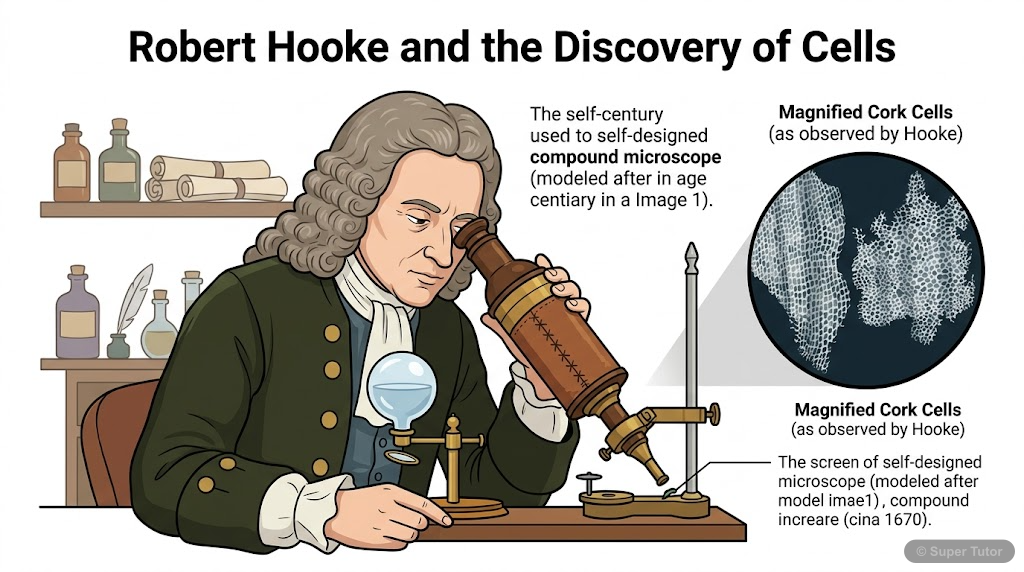
Learn better with visuals Super Tutor pairs illustrations like this with notes and quizzes for The Fundamental Unit of Life.
Overview
In 1665, Robert Hooke observed cork under a microscope and saw compartments resembling a honeycomb. He called these structures 'cells' - a term derived from the Latin word meaning 'a little room'. This discovery marked the beginning of cell biology. All living organisms, from tiny bacteria to comple
Key Concepts
The cell theory states
The cell theory states that: (1) All living organisms are made up of cells, (2) The cell is the basic unit of life, and (3) All cells arise from pre-e
The outermost covering of the cell
The outermost covering of the cell made of lipids and proteins. It is selectively permeable, allowing some substances to pass through while blocking o
The control center of the cell
The control center of the cell enclosed by a double-layered nuclear membrane with pores. It contains chromosomes made of DNA and proteins, which carry
The fluid content inside the plasma
The fluid content inside the plasma membrane containing specialized structures called organelles. Each organelle has specific functions: ER for transp
Prokaryotic cells (like bacteria) lack
Prokaryotic cells (like bacteria) lack a defined nucleus and membrane-bound organelles. Eukaryotic cells (like plant and animal cells) have a well-def
Learning Objectives
- Understand what living organisms are made up of and identify cells as the basic unit of life
- Learn about the discovery of cells and the cell theory
- Explore the structural organization of cells including plasma membrane, nucleus, and cytoplasm
- Differentiate between prokaryotic and eukaryotic cells
- Study various cell organelles and their specific functions
Frequently Asked Questions
What are the important topics in The Fundamental Unit of Life for Madhya Pradesh Board Class 9 Science?
How should I revise The Fundamental Unit of Life for Class 9 exams?
Sources & Official References
Content is aligned to the official syllabus. Refer to the board website for the latest curriculum.
More resources for The Fundamental Unit of Life
Practice Quiz
Test yourself with a quick quiz
Important Questions
Exam-style questions with answers
Revision Notes
Key points for last-minute revision
Concept Maps
See how topics connect
Study Plan
Step-by-step plan for this chapter
Flashcards
Quick-fire cards for active recall
Syllabus
What topics to cover
NCERT Solutions
Every textbook question solved step by step
For serious students
Get the full The Fundamental Unit of Life chapter — start free.
Quizzes, flashcards, an AI doubt solver and a study plan for Madhya Pradesh Board Class 9 Science. Free to start, no card needed.