Atoms and Molecules — Practice Quiz
Madhya Pradesh Board · Class 9 · Science
Try a 4-question quiz on Atoms and Molecules for Madhya Pradesh Board Class 9 Science: tap an answer to check it and see why.
Interactive on Super Tutor
Studying Atoms and Molecules? Get the full interactive chapter.
Quizzes, flashcards, AI doubt-solver and a step-by-step study plan — built for practice quiz and more.
Free trial, no card needed.
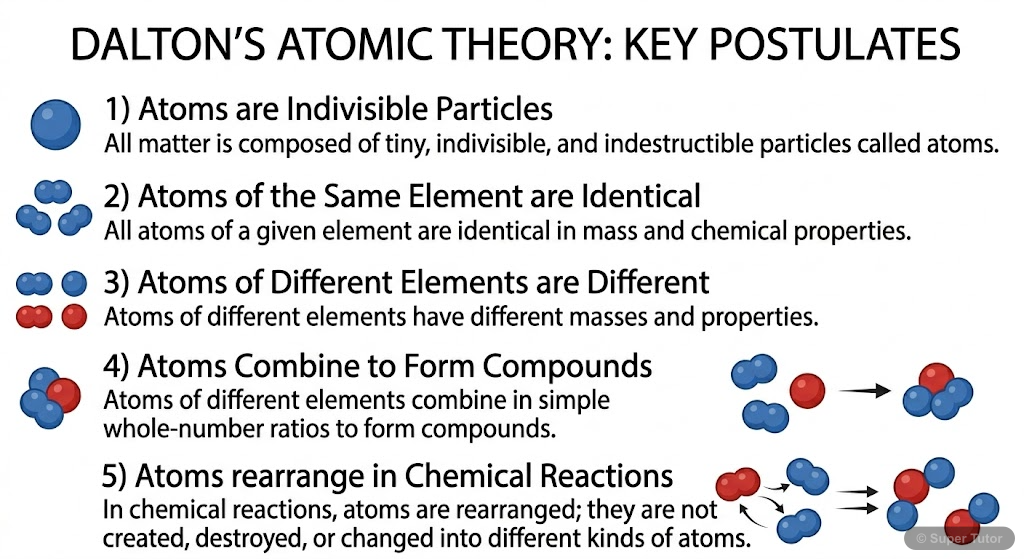
An illustration from Super Tutor's Atoms and Molecules chapter — alongside flashcards, concept maps and practice questions.
Quick Quiz: Atoms and Molecules
0/4Tap an answer to check it instantly. No sign-up needed for these 4.
Who was the Indian philosopher who first proposed the idea of indivisible particles called 'Parmanu'?
According to the Law of Conservation of Mass, what happens to mass during a chemical reaction?
What is the current standard reference for measuring atomic masses?
The symbol for sodium is Na. This is derived from which language?
Sample Questions
Which of the following are postulates of Dalton's Atomic Theory?
Show answer
All matter is made of tiny particles called atoms, Atoms are indivisible and cannot be created or destroyed, Atoms of the same element are identical in mass, Atoms combine in simple whole number ratios
Dalton's atomic theory has several postulates including that all matter is made of atoms, atoms are indivisible, atoms of the same element are identical, and they combine in simple ratios. However, most atoms cannot exist independently in nature.
Which of the following molecules are diatomic?
Show answer
Oxygen (O₂), Hydrogen (H₂), Nitrogen (N₂)
Diatomic molecules contain exactly two atoms. O₂, H₂, and N₂ are diatomic. Argon is monoatomic (single atom) and ozone is triatomic (three atoms).
What is the atomicity of phosphorus (P₄)?
Show answer
4
Atomicity is the number of atoms in a molecule. Phosphorus exists as P₄ molecules, so its atomicity is 4. This is also called tetra-atomic.
In water (H₂O), the ratio of hydrogen to oxygen by mass is:
Show answer
1:8
In water, the mass ratio of hydrogen to oxygen is always 1:8. This demonstrates the Law of Constant Proportions - elements in a compound are always present in definite proportions by mass.
+25 more questions on Atoms and Molecules (Madhya Pradesh Board Class 9 Science)
Practise AllFrequently Asked Questions
What are the important topics in Atoms and Molecules for Madhya Pradesh Board Class 9 Science?
How many practice questions are there for Atoms and Molecules?
Sources & Official References
Content is aligned to the official syllabus. Refer to the board website for the latest curriculum.
More resources for Atoms and Molecules
For serious students
Get the full Atoms and Molecules chapter — start free.
Quizzes, flashcards, an AI doubt solver and a study plan for Madhya Pradesh Board Class 9 Science. Free to start, no card needed.