Force and Laws of Motion — Practice Quiz
Madhya Pradesh Board · Class 9 · Science
Try a 4-question quiz on Force and Laws of Motion for Madhya Pradesh Board Class 9 Science: tap an answer to check it and see why.
Interactive on Super Tutor
Studying Force and Laws of Motion? Get the full interactive chapter.
Quizzes, flashcards, AI doubt-solver and a step-by-step study plan — built for practice quiz and more.
Free trial, no card needed.
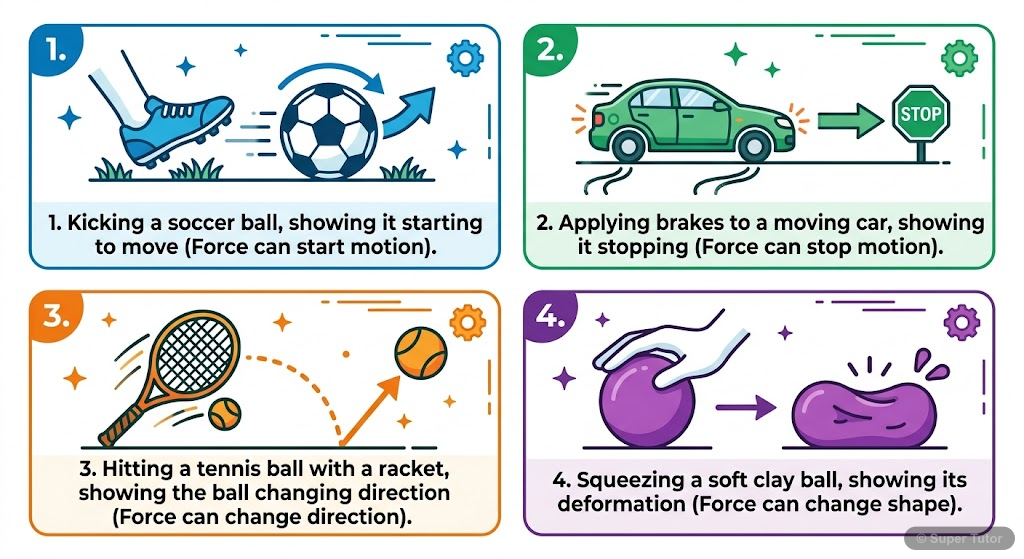
Learn better with visuals Super Tutor pairs illustrations like this with notes and quizzes for Force and Laws of Motion.
Quick Quiz: Force and Laws of Motion
0/4Tap an answer to check it instantly. No sign-up needed for these 4.
What is the SI unit of force?
According to Newton's First Law of Motion, an object at rest will:
What is inertia?
What determines the inertia of an object?
Sample Questions
Which of the following are examples of inertia? (Select all correct answers)
Show answer
Passengers jerking forward when a bus suddenly stops, A coin falling into a glass when a card is flicked away, Feeling thrown to one side when a car takes a sharp turn
All three correct answers demonstrate inertia: passengers continue moving forward when the bus stops (inertia of motion), the coin stays at rest when the card is removed (inertia of rest), and passengers continue in straight-line motion when the car turns (inertia of motion). Rolling and sliding involve forces acting on objects.
Newton's Second Law of Motion can be expressed as:
Show answer
F = ma
Newton's Second Law states that the force acting on an object is equal to the mass of the object multiplied by its acceleration (F = ma). This law shows the relationship between force, mass, and acceleration.
What is momentum?
Show answer
The product of mass and velocity
Momentum (p) is defined as the product of an object's mass (m) and its velocity (v), expressed as p = mv. Momentum has both magnitude and direction, and its SI unit is kg⋅m⋅s⁻¹.
Which of the following factors affect momentum? (Select all correct answers)
Show answer
Mass of the object, Velocity of the object
Momentum depends only on mass and velocity (p = mv). The color, shape, and temperature of an object do not directly affect its momentum, although shape might indirectly affect motion through air resistance.
+41 more questions on Force and Laws of Motion (Madhya Pradesh Board Class 9 Science)
Practise AllFrequently Asked Questions
What are the important topics in Force and Laws of Motion for Madhya Pradesh Board Class 9 Science?
How many practice questions are there for Force and Laws of Motion?
Sources & Official References
Content is aligned to the official syllabus. Refer to the board website for the latest curriculum.
More resources for Force and Laws of Motion
Important Questions
Exam-style questions with answers
Revision Notes
Key points for last-minute revision
Formula Sheet
The chapter's formulas in one place
Chapter Summary
Understand the chapter at a glance
Concept Maps
See how topics connect
Study Plan
Step-by-step plan for this chapter
Flashcards
Quick-fire cards for active recall
Syllabus
What topics to cover
NCERT Solutions
Every textbook question solved step by step
For serious students
Get the full Force and Laws of Motion chapter — start free.
Quizzes, flashcards, an AI doubt solver and a study plan for Madhya Pradesh Board Class 9 Science. Free to start, no card needed.