The Fundamental Unit of Life — Practice Quiz
Madhya Pradesh Board · Class 9 · Science
Try a 4-question quiz on The Fundamental Unit of Life for Madhya Pradesh Board Class 9 Science: tap an answer to check it and see why.
Interactive on Super Tutor
Studying The Fundamental Unit of Life? Get the full interactive chapter.
Quizzes, flashcards, AI doubt-solver and a step-by-step study plan — built for practice quiz and more.
Free trial, no card needed.
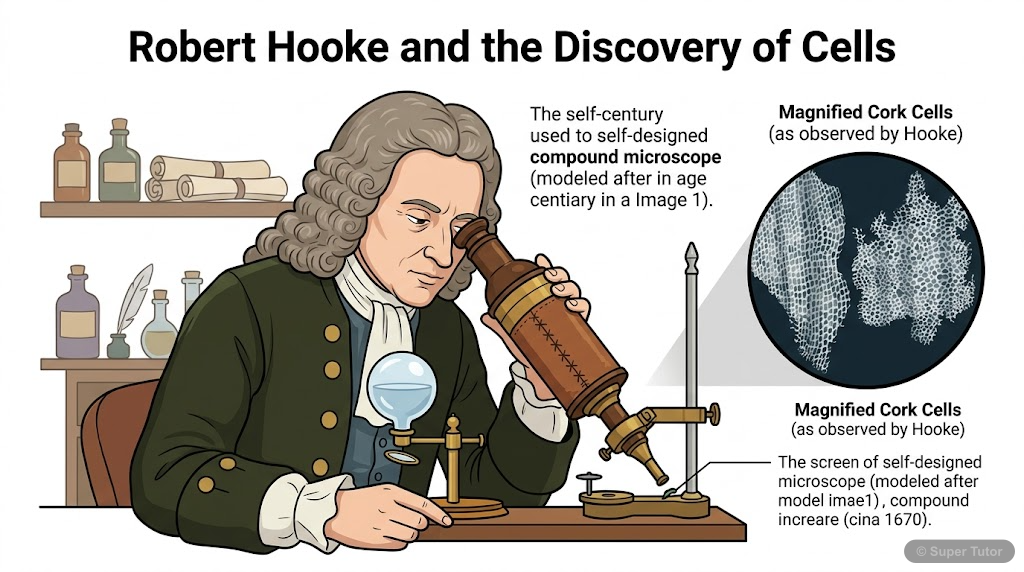
Learn better with visuals Super Tutor pairs illustrations like this with notes and quizzes for The Fundamental Unit of Life.
Quick Quiz: The Fundamental Unit of Life
0/4Tap an answer to check it instantly. No sign-up needed for these 4.
Who first discovered cells and in which year?
What is the outermost covering of a cell called?
The movement of water across a selectively permeable membrane is called:
Which organelle is known as the 'powerhouse of the cell'?
Sample Questions
Which of the following are characteristics of prokaryotic cells?
Show answer
Absence of nuclear membrane, Presence of nucleoid, Lack of membrane-bound organelles, Found in bacteria
Prokaryotic cells are primitive cells without a nuclear membrane. They have a nucleoid (undefined nuclear region), lack membrane-bound organelles, and are found in bacteria. The genetic material is freely present in the cytoplasm.
Which of the following organelles are found only in plant cells?
Show answer
Cell wall, Chloroplasts, Large central vacuole
Plant cells have unique structures: cell wall (made of cellulose for support), chloroplasts (for photosynthesis), and large central vacuoles (for storage and maintaining cell shape). Mitochondria and nucleus are found in both plant and animal cells.
What happens to a cell when placed in a hypotonic solution?
Show answer
Cell swells up
In a hypotonic solution, the external solution has higher water concentration than the cell. Water enters the cell through osmosis, causing the cell to swell up. This is because water moves from high concentration to low concentration.
The nucleus contains which of the following structures?
Show answer
Chromosomes, DNA, Genes, Chromatin material
The nucleus contains chromosomes (made of DNA and proteins), DNA molecules, genes (functional segments of DNA), and chromatin material (thread-like structures containing DNA). Ribosomes are found in the cytoplasm, not inside the nucleus.
+24 more questions on The Fundamental Unit of Life (Madhya Pradesh Board Class 9 Science)
Practise AllFrequently Asked Questions
What are the important topics in The Fundamental Unit of Life for Madhya Pradesh Board Class 9 Science?
How many practice questions are there for The Fundamental Unit of Life?
Sources & Official References
Content is aligned to the official syllabus. Refer to the board website for the latest curriculum.
More resources for The Fundamental Unit of Life
Important Questions
Exam-style questions with answers
Revision Notes
Key points for last-minute revision
Chapter Summary
Understand the chapter at a glance
Concept Maps
See how topics connect
Study Plan
Step-by-step plan for this chapter
Flashcards
Quick-fire cards for active recall
Syllabus
What topics to cover
NCERT Solutions
Every textbook question solved step by step
For serious students
Get the full The Fundamental Unit of Life chapter — start free.
Quizzes, flashcards, an AI doubt solver and a study plan for Madhya Pradesh Board Class 9 Science. Free to start, no card needed.