Atoms and Molecules — NCERT Solutions
Madhya Pradesh Board · Class 9 · Science
NCERT Solutions for Atoms and Molecules, Madhya Pradesh Board Class 9 Science: 6 textbook questions solved step by step. Covers Exercises.
Interactive on Super Tutor
Studying Atoms and Molecules? Get the full interactive chapter.
Quizzes, flashcards, AI doubt-solver and a step-by-step study plan — built for NCERT solutions and more.
Free trial, no card needed.
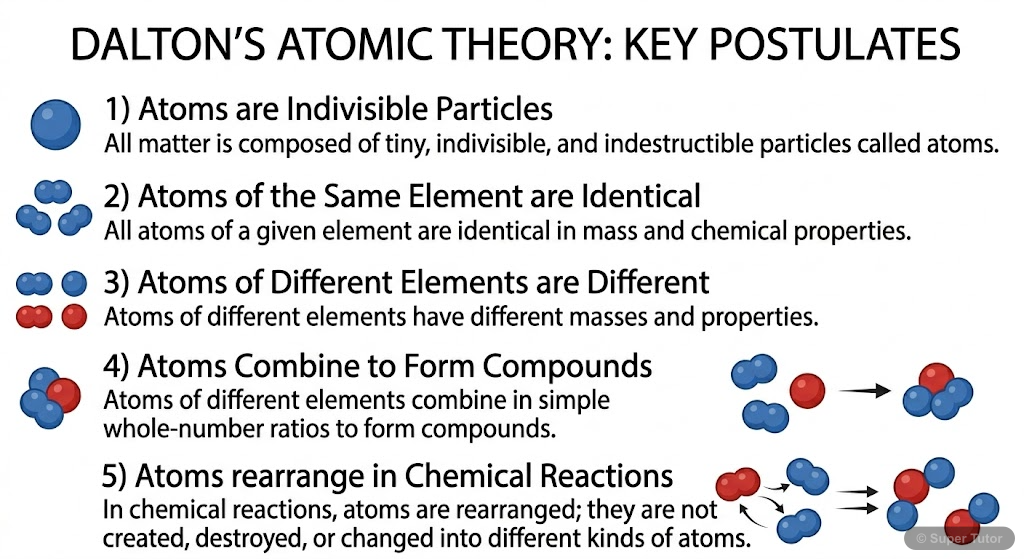
An illustration from Super Tutor's Atoms and Molecules chapter — alongside flashcards, concept maps and practice questions.
The first 3 solutions are open to read. The other 3 are free with a Super Tutor account.
Exercises
1A 0.24 g sample of compound of oxygen and boron was found by analysis to contain 0.096 g of boron and 0.144 g of oxygen. Calculate the percentage composition of the compound by weight.Show solution
Given:
- Total mass of compound = 0.24 g
- Mass of boron = 0.096 g
- Mass of oxygen = 0.144 g
Formula used:
Step 1: Percentage of Boron
Step 2: Percentage of Oxygen
Verification: ✓
Answer: The compound contains 40% Boron and 60% Oxygen by weight.
2When 3.0 g of carbon is burnt in 8.00 g oxygen, 11.00 g of carbon dioxide is produced. What mass of carbon dioxide will be formed when 3.00 g of carbon is burnt in 50.00 g of oxygen? Which law of chemical combination will govern your answer?Show solution
Given (first case):
- Mass of carbon = 3.0 g
- Mass of oxygen = 8.00 g
- Mass of CO₂ produced = 11.00 g
Observation from first case:
Carbon and oxygen combine in the ratio:
This means 3 g of carbon requires exactly 8 g of oxygen to produce 11 g of CO₂.
Second case:
- Mass of carbon = 3.00 g
- Mass of oxygen available = 50.00 g
Step 1: Find oxygen required to burn 3.00 g of carbon completely.
From the fixed ratio, oxygen required g.
Step 2: Since 50.00 g of oxygen is available but only 8.00 g is needed, oxygen is in excess. Carbon is the limiting reactant.
Step 3: Mass of CO₂ formed
Answer: 11.00 g of carbon dioxide will be formed.
Law governing this: This is governed by the Law of Constant Proportions (Law of Definite Proportions), which states that in a chemical compound, elements are always present in definite proportions by mass, regardless of the source or method of preparation.
3What are polyatomic ions? Give examples.Show solution
Definition:
A polyatomic ion is a group of atoms carrying a net electric charge (positive or negative). These atoms are covalently bonded together and the group as a whole acts as a single ion.
Examples:
| Ion | Formula | Charge |
|---|---|---|
| Ammonium ion | ||
| Hydroxide ion | ||
| Carbonate ion | ||
| Sulphate ion | ||
| Nitrate ion | ||
| Phosphate ion |
These ions participate in ionic bonding just like monoatomic ions.
(a) Magnesium chloride
(b) Calcium oxide
(c) Copper nitrate
(d) Aluminium chloride
(e) Calcium carbonate
Free with a Super Tutor account
(a) Quick lime
(b) Hydrogen bromide
(c) Baking powder
(d) Potassium sulphate
Free with a Super Tutor account
(a) Ethyne, C₂H₂
(b) Sulphur molecule, S₈
(c) Phosphorus molecule, P₄ (Atomic mass of phosphorus = 31)
(d) Hydrochloric acid, HCl
(e) Nitric acid, HNO₃
Free with a Super Tutor account
3 more solved questions in Atoms and Molecules
They are free with a Super Tutor account, along with practice quizzes and flashcards for this chapter. Free to start, no card needed.
Frequently Asked Questions
What are the important topics in Atoms and Molecules for Madhya Pradesh Board Class 9 Science?
Are these NCERT Solutions for Atoms and Molecules free?
How should I revise Atoms and Molecules for Class 9 exams?
Sources & Official References
Content is aligned to the official syllabus. Refer to the board website for the latest curriculum.
More resources for Atoms and Molecules
For serious students
Get the full Atoms and Molecules chapter — start free.
Quizzes, flashcards, an AI doubt solver and a study plan for Madhya Pradesh Board Class 9 Science. Free to start, no card needed.