Force and Laws of Motion — NCERT Solutions
Madhya Pradesh Board · Class 9 · Science
NCERT Solutions for Force and Laws of Motion, Madhya Pradesh Board Class 9 Science: 21 textbook questions solved step by step.
Interactive on Super Tutor
Studying Force and Laws of Motion? Get the full interactive chapter.
Quizzes, flashcards, AI doubt-solver and a step-by-step study plan — built for NCERT solutions and more.
Free trial, no card needed.
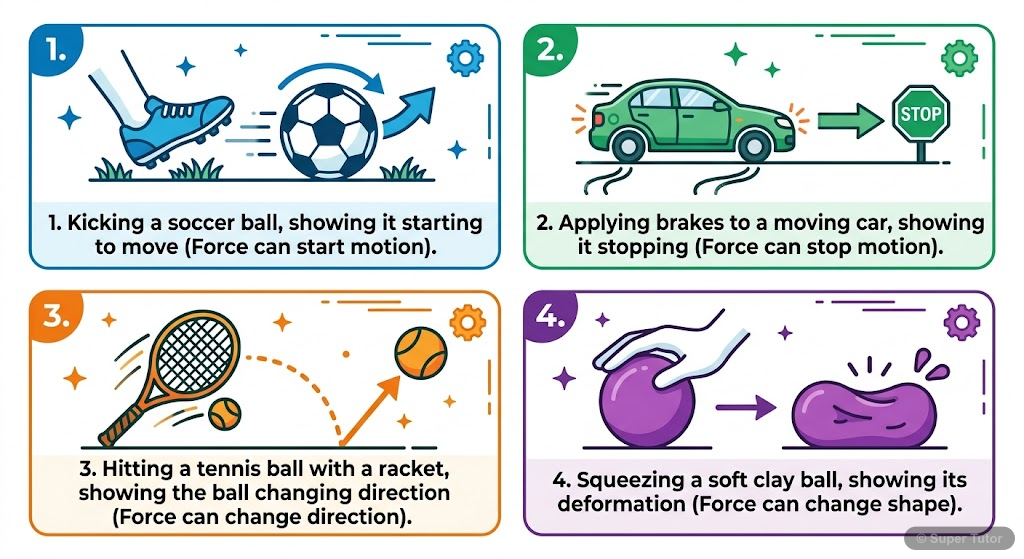
Learn better with visuals Super Tutor pairs illustrations like this with notes and quizzes for Force and Laws of Motion.
The first 11 solutions are open to read. The other 10 are free with a Super Tutor account.
Exercises
1An object experiences a net zero external unbalanced force. Is it possible for the object to be travelling with a non-zero velocity? If yes, state the conditions that must be placed on the magnitude and direction of the velocity.Show solution
Given/Concept: Net external unbalanced force = 0. By Newton's First Law of Motion, an object continues in its state of rest or of uniform motion in a straight line unless acted upon by an unbalanced external force.
Answer: Yes, it is absolutely possible for the object to be travelling with a non-zero velocity even when the net external unbalanced force is zero.
Conditions:
- The object must be moving with a constant (uniform) velocity — i.e., no change in speed.
- The direction of motion must remain unchanged (straight line).
- There should be no acceleration (since , if then ).
For example, a hockey puck sliding on a frictionless ice surface moves with constant velocity because no net unbalanced force acts on it.
2When a carpet is beaten with a stick, dust comes out of it. Explain.Show solution
Concept Used: Newton's First Law of Motion (Law of Inertia).
Explanation:
- When a carpet is beaten with a stick, the carpet is suddenly set into motion.
- The dust particles on the carpet, due to their inertia of rest, tend to remain in their original position (at rest).
- Since the carpet moves forward but the dust particles stay behind (due to inertia), the dust gets separated from the carpet and falls off.
This is a direct application of the property of inertia — every object resists a change in its state of rest or motion.
3Why is it advised to tie any luggage kept on the roof of a bus with a rope?Show solution
Concept Used: Newton's First Law of Motion (Inertia of motion and inertia of rest).
Explanation:
- When the bus suddenly accelerates (starts moving), the luggage on the roof tends to remain at rest due to inertia of rest, and may fall backward.
- When the bus suddenly brakes (stops), the luggage tends to continue moving forward due to inertia of motion, and may fall forward.
- When the bus takes a sharp turn, the luggage tends to continue in a straight line due to inertia and may slide off sideways.
Therefore, it is advised to tie the luggage with a rope so that it moves along with the bus and does not fall off due to inertia.
4A batsman hits a cricket ball which then rolls on a level ground. After covering a short distance, the ball comes to rest. The ball slows to a stop because:
(a) the batsman did not hit the ball hard enough.
(b) velocity is proportional to the force exerted on the ball.
(c) there is a force on the ball opposing the motion.
(d) there is no unbalanced force on the ball, so the ball would want to come to rest.Show solution
Correct Option: (c) there is a force on the ball opposing the motion.
Justification: After the ball leaves the bat, the only horizontal force acting on it is the force of friction between the ball and the ground, which opposes the motion of the ball. This unbalanced frictional force decelerates the ball and eventually brings it to rest. Options (a), (b), and (d) are incorrect because the ball's stopping has nothing to do with how hard it was hit, velocity is not proportional to force (acceleration is), and there IS an unbalanced force (friction) acting on the ball.
5A truck starts from rest and rolls down a hill with a constant acceleration. It travels a distance of 400 m in 20 s. Find its acceleration. Find the force acting on it if its mass is 7 tonnes (Hint: 1 tonne = 1000 kg).Show solution
Given:
- Initial velocity, (starts from rest)
- Distance, m
- Time, s
- Mass, tonnes kg
Step 1: Find acceleration using the equation of motion
Step 2: Find force using Newton's Second Law
Answer: Acceleration and Force .
6A stone of 1 kg is thrown with a velocity of 20 m s⁻¹ across the frozen surface of a lake and comes to rest after travelling a distance of 50 m. What is the force of friction between the stone and the ice?Show solution
Given:
- Mass of stone, kg
- Initial velocity, m s
- Final velocity, (comes to rest)
- Distance, m
Step 1: Find acceleration using
(Negative sign indicates deceleration/retardation)
Step 2: Find force of friction using
The negative sign indicates the force opposes the motion.
Answer: The force of friction between the stone and the ice is N (opposing the motion).
7A 8000 kg engine pulls a train of 5 wagons, each of 2000 kg, along a horizontal track. If the engine exerts a force of 40000 N and the track offers a friction force of 5000 N, then calculate: (a) the net accelerating force and (b) the acceleration of the train.Show solution
Given:
- Mass of engine, kg
- Number of wagons , each of mass kg
- Total mass of wagons kg
- Total mass of train (engine + wagons), kg
- Force exerted by engine N
- Friction force N
(a) Net accelerating force:
(b) Acceleration of the train:
Using Newton's Second Law:
Answer: (a) Net accelerating force N; (b) Acceleration m s.
8An automobile vehicle has a mass of 1500 kg. What must be the force between the vehicle and road if the vehicle is to be stopped with a negative acceleration of 1.7 m s⁻²?Show solution
Given:
- Mass of vehicle, kg
- Acceleration (retardation), m s
Using Newton's Second Law:
The negative sign indicates that the force acts opposite to the direction of motion (i.e., it is a braking/retarding force).
Answer: The force between the vehicle and the road must be N (acting opposite to the direction of motion).
9What is the momentum of an object of mass , moving with a velocity ?
(a)
(b)
(c)
(d) Show solution
Correct Option: (d)
Justification: By definition, momentum () is the product of the mass of an object and its velocity:
It is a vector quantity with the same direction as the velocity. Its SI unit is kg m s. Options (a), (b), and (c) represent other physical quantities (related to kinetic energy, etc.) and are not momentum.
10Using a horizontal force of 200 N, we intend to move a wooden cabinet across a floor at a constant velocity. What is the friction force that will be exerted on the cabinet?Show solution
Given:
- Applied horizontal force N
- The cabinet moves at constant velocity (i.e., zero acceleration)
Concept: Since the cabinet moves at constant velocity, the net force on it is zero (Newton's First Law).
Answer: The friction force exerted on the cabinet is N, acting in the direction opposite to the motion.
11According to the third law of motion when we push on an object, the object pushes back on us with an equal and opposite force. If the object is a massive truck parked along the roadside, it will probably not move. A student justifies this by answering that the two opposite and equal forces cancel each other. Comment on this logic and explain why the truck does not move.Show solution
Comment on the student's logic: The student's logic is incorrect. The action and reaction forces in Newton's Third Law always act on two different bodies — they never act on the same body. Therefore, they cannot cancel each other.
Correct Explanation:
- When we push the truck (action force on the truck), the truck pushes back on us (reaction force on us). These two forces act on different bodies (truck and person), so they do NOT cancel each other.
- The truck does not move because the force we apply on the truck is not large enough to overcome the static friction between the truck's tyres and the road.
- The net force on the truck = Applied force − Static friction force. Since static friction is large enough to balance our push, the net force on the truck is zero, and it does not accelerate.
Conclusion: The truck remains stationary not because action and reaction cancel, but because the applied force is insufficient to overcome static friction acting on the truck.
Free with a Super Tutor account
Free with a Super Tutor account
Free with a Super Tutor account
Free with a Super Tutor account
Free with a Super Tutor account
Free with a Super Tutor account
Additional Exercises
| Time (s) | Distance (m) |
|---|---|
| 0 | 0 |
| 1 | 1 |
| 2 | 8 |
| 3 | 27 |
| 4 | 64 |
| 5 | 125 |
| 6 | 216 |
| 7 | 343 |
(a) What conclusion can you draw about the acceleration? Is it constant, increasing, decreasing, or zero?
(b) What do you infer about the forces acting on the object?
Free with a Super Tutor account
Free with a Super Tutor account
Free with a Super Tutor account
Free with a Super Tutor account
10 more solved questions in Force and Laws of Motion
They are free with a Super Tutor account, along with practice quizzes and flashcards for this chapter. Free to start, no card needed.
Frequently Asked Questions
What are the important topics in Force and Laws of Motion for Madhya Pradesh Board Class 9 Science?
Are these NCERT Solutions for Force and Laws of Motion free?
How should I revise Force and Laws of Motion for Class 9 exams?
Sources & Official References
Content is aligned to the official syllabus. Refer to the board website for the latest curriculum.
More resources for Force and Laws of Motion
Practice Quiz
Test yourself with a quick quiz
Important Questions
Exam-style questions with answers
Revision Notes
Key points for last-minute revision
Formula Sheet
The chapter's formulas in one place
Chapter Summary
Understand the chapter at a glance
Concept Maps
See how topics connect
Study Plan
Step-by-step plan for this chapter
Flashcards
Quick-fire cards for active recall
Syllabus
What topics to cover
For serious students
Get the full Force and Laws of Motion chapter — start free.
Quizzes, flashcards, an AI doubt solver and a study plan for Madhya Pradesh Board Class 9 Science. Free to start, no card needed.