Matter in Our Surroundings — Syllabus
Madhya Pradesh Board · Class 9 · Science
What Matter in Our Surroundings covers in Madhya Pradesh Board Class 9 Science: 4 topics, for the 2026-27 session.
Interactive on Super Tutor
Studying Matter in Our Surroundings? Get the full interactive chapter.
Quizzes, flashcards, AI doubt-solver and a step-by-step study plan — built for syllabus and more.
Free trial, no card needed.
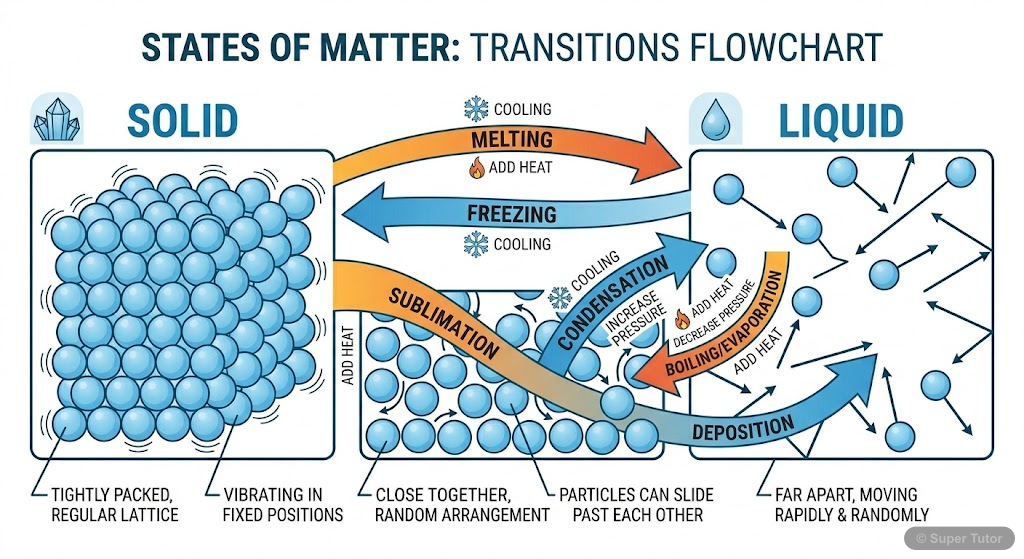
Learn better with visuals Super Tutor pairs illustrations like this with notes and quizzes for Matter in Our Surroundings.
Topics in Matter in Our Surroundings
Physical Nature of Matter
- Matter is made up of tiny particles - this was proven through dissolution experiments with salt/sugar in water
- Particles of matter are extremely small - demonstrated by potassium permanganate dilution experiment where few crystals can color 1000L of water
- Ancient Indian philosophers classified matter as 'Panch Tatva' - air, earth, fire, sky, and water
Characteristics of Particles of Matter
- Particles have space between them - shown by sugar/salt dissolving in water without increasing water level
- Particles are in continuous motion (kinetic energy) - increases with temperature
- Particles attract each other with varying force strength - strongest in solids, weakest in gases
States of Matter
- Three states: Solid, Liquid, Gas - differ in particle arrangement and movement
- SOLIDS: Fixed shape, fixed volume, negligible compressibility, particles closely packed with strong attraction
- LIQUIDS: No fixed shape, fixed volume, particles can move freely but still attracted to each other
Change of State
- States can change by altering temperature or pressure
- MELTING: Solid to liquid at melting point (273 K for ice)
- BOILING: Liquid to gas at boiling point (373 K for water)
Key Concepts
Work through every topic in Matter in Our Surroundings with notes and quizzes
Start This ChapterFrequently Asked Questions
What are the important topics in Matter in Our Surroundings for Madhya Pradesh Board Class 9 Science?
How should I revise Matter in Our Surroundings for Class 9 exams?
Sources & Official References
Content is aligned to the official syllabus. Refer to the board website for the latest curriculum.
More resources for Matter in Our Surroundings
For serious students
Get the full Matter in Our Surroundings chapter — start free.
Quizzes, flashcards, an AI doubt solver and a study plan for Madhya Pradesh Board Class 9 Science. Free to start, no card needed.