Matter in Our Surroundings — NCERT Solutions
Madhya Pradesh Board · Class 9 · Science
NCERT Solutions for Matter in Our Surroundings, Madhya Pradesh Board Class 9 Science: 9 textbook questions solved step by step.
Interactive on Super Tutor
Studying Matter in Our Surroundings? Get the full interactive chapter.
Quizzes, flashcards, AI doubt-solver and a step-by-step study plan — built for NCERT solutions and more.
Free trial, no card needed.
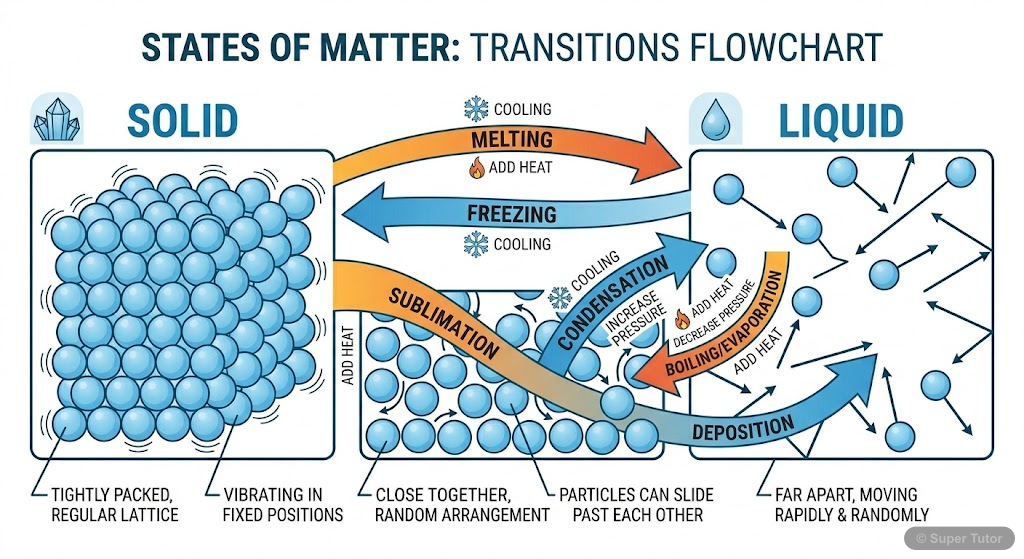
Learn better with visuals Super Tutor pairs illustrations like this with notes and quizzes for Matter in Our Surroundings.
The first 5 solutions are open to read. The other 4 are free with a Super Tutor account.
Exercises — Matter in Our Surroundings
1Convert the following temperatures to the celsius scale.
(a) 293 K
(b) 470 KShow solution
Formula used:
(a) 293 K to Celsius:
(b) 470 K to Celsius:
2Convert the following temperatures to the kelvin scale.
(a) 25°C
(b) 373°CShow solution
Formula used:
(a) 25°C to Kelvin:
(b) 373°C to Kelvin:
3Give reason for the following observations.
(a) Naphthalene balls disappear with time without leaving any solid.
(b) We can get the smell of perfume sitting several metres away.Show solution
(a) Naphthalene balls disappear with time without leaving any solid:
Naphthalene undergoes sublimation — it directly converts from the solid state to the gaseous (vapour) state without passing through the liquid state. The naphthalene vapours mix with the surrounding air and disperse, which is why no solid residue is left behind.
(b) We can get the smell of perfume sitting several metres away:
Perfume contains volatile liquid substances. These substances evaporate and their particles (molecules) mix with air. Due to the property of diffusion, the particles of perfume spread and intermix with the particles of air and reach our nostrils even from several metres away. Gases diffuse very rapidly because their particles have high kinetic energy and large intermolecular spaces.
4Arrange the following substances in increasing order of forces of attraction between the particles — water, sugar, oxygen.Show solution
Concept: Forces of attraction between particles are weakest in gases, intermediate in liquids, and strongest in solids.
- Oxygen is a gas → weakest intermolecular forces.
- Water is a liquid → intermediate intermolecular forces.
- Sugar is a solid → strongest intermolecular forces.
Increasing order of forces of attraction:
5What is the physical state of water at—
(a) 25°C
(b) 0°C
(c) 100°C?Show solution
Known facts: Water melts at (273 K) and boils at (373 K) at standard atmospheric pressure.
(a) At 25°C: 25°C is between 0°C and 100°C, so water exists as a liquid.
(b) At 0°C: This is the melting/freezing point of water. At this temperature, water can exist in both solid (ice) and liquid states simultaneously (it is a transition point). Generally, it is considered to be in the solid state (ice) or at the boundary of solid and liquid.
(c) At 100°C: This is the boiling point of water. At this temperature, water can exist in both liquid and gaseous (steam) states simultaneously. It is at the boundary of liquid and gas, generally considered as liquid converting to gas (steam).
(a) water at room temperature is a liquid.
(b) an iron almirah is a solid at room temperature.
Free with a Super Tutor account
Free with a Super Tutor account
Free with a Super Tutor account
Free with a Super Tutor account
4 more solved questions in Matter in Our Surroundings
They are free with a Super Tutor account, along with practice quizzes and flashcards for this chapter. Free to start, no card needed.
Frequently Asked Questions
What are the important topics in Matter in Our Surroundings for Madhya Pradesh Board Class 9 Science?
Are these NCERT Solutions for Matter in Our Surroundings free?
How should I revise Matter in Our Surroundings for Class 9 exams?
Sources & Official References
Content is aligned to the official syllabus. Refer to the board website for the latest curriculum.
More resources for Matter in Our Surroundings
For serious students
Get the full Matter in Our Surroundings chapter — start free.
Quizzes, flashcards, an AI doubt solver and a study plan for Madhya Pradesh Board Class 9 Science. Free to start, no card needed.