Chapter 5 of 9
Concept Maps
Root System — Concept Maps
NIOS · Class 12 · Biology
3 concept maps of Root System for NIOS Class 12 Biology, each also written out as a text outline. Part of the NIOS Class 12 Biology syllabus.
45 questions26 flashcards5 concepts
Interactive on Super Tutor
Studying Root System? Get the full interactive chapter.
Quizzes, flashcards, AI doubt-solver and a step-by-step study plan — built for concept maps and more.
Free trial, no card needed.
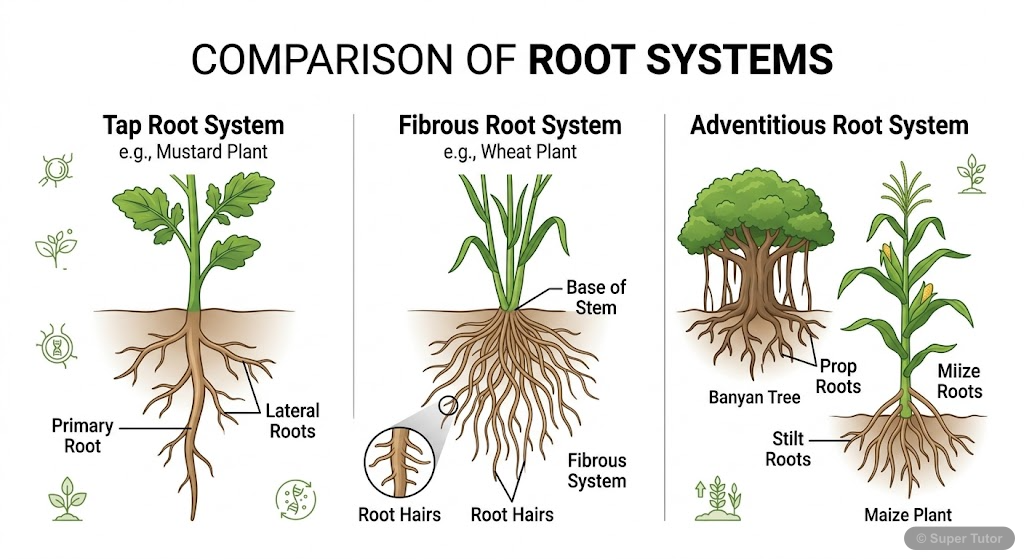
Super Tutor
One of 5 illustrations for Root System in Super Tutor — alongside flashcards, concept maps and practice questions.
3 Concept Maps
Root System – Complete Chapter Overview
The map in words
- Root System
- Characteristics
- Non-green
- No nodes or internodes
- No leaves or buds
- Positively Geotropic
- Positively Hydrotropic
- Negatively Phototropic
- Types of Root Systems
- Tap Root System
- Found in Dicots
- Develops from Radicle
- Deep Anchorage
- Examples Gram Neem Carrot
- Fibrous Root System
- Found in Monocots
- Primary root short-lived
- Shallow Horizontal
- Examples Wheat Maize Grass
- Tap Root System
- Regions of Root Tip
- Root Cap
- Protects Apical Meristem
- Aquatic plants have Root Pocket
- Meristematic Zone
- Dermatogen to Epiblema
- Periblem to Cortex
- Plerome to Stele
- Calyptrogen in Monocots
- Elongation Zone
- Root grows in length
- Maturation Zone
- Root Hair Zone
- Permanent Region
- Root Cap
- Modifications
- Tap Root
- Conical Carrot
- Fusiform Radish
- Napiform Turnip
- Tuberous 4 O clock plant
- Adventitious Root
- Storage Sweet Potato Dahlia
- Photosynthesis Tinospora
- Velamen Vanda Orchid
- Pneumatophores Rhizophora
- Haustoria Cuscuta
- Prop Roots Banyan
- Stilt Roots Sugarcane
- Floating Roots Jussiaea
- Tap Root
- Anatomy
- Dicot Root
- Exarch Xylem
- Radial Vascular Bundle
- 2 to 6 xylem bundles
- Pith small or absent
- Secondary growth present
- Monocot Root
- Exarch Xylem
- Polyarch many bundles
- Large Pith
- No secondary growth
- Dicot Root
- Secondary Growth
- Only in Dicots
- Vascular Cambium
- Cork Cambium Phellogen
- Periderm formed
- Outer tissues shed
- Characteristics
Root System - Comprehensive Overview
The map in words
- Root System
- Structure
- Types
- Tap Root
- Dicots
- Develops from radicle
- Fibrous Root
- Monocots
- Short-lived primary
- Tap Root
- Regions of Root Apex
- Root Cap
- Protection
- Meristematic Region
- Cell division
- Dermatogen
- Periblem
- Plerome
- Region of Elongation
- Cell enlargement
- Region of Maturation
- Root hairs
- Permanent tissue
- Root Cap
- Types
- Modifications
- Tap Root Modifications
- Conical
- Fusiform
- Napiform
- Tuberous
- Adventitious Modifications
- Storage
- Tuberous
- Fasciculated
- Nodulose
- Photosynthesis
- Assimilatory roots
- Respiration
- Pneumatophores
- Support
- Prop roots
- Stilt roots
- Climbing roots
- Parasitic
- Haustoria
- Aquatic
- Floating roots
- Storage
- Tap Root Modifications
- Anatomy
- Dicot Root
- Epiblema
- Cortex
- Endodermis
- Pericycle
- Vascular Bundle
- Pith
- Monocot Root
- Similar to dicot
- Larger pith
- Polyarch bundles
- No cambium
- Dicot Root
- Growth
- Primary Growth
- Apical meristem
- Length increase
- Secondary Growth
- Vascular cambium
- Cork cambium
- Dicots only
- Girth increase
- Primary Growth
- Functions
- Anchorage
- Absorption
- Storage
- Support
- Respiration
- Photosynthesis
- Structure
Root System – Complete Concept Overview
The map in words
- ROOT SYSTEM
- Characteristics
- Non-green
- No nodes or internodes
- No leaves or buds
- Positively geotropic
- Positively hydrotropic
- Negatively phototropic
- Types of Root Systems
- Tap Root System
- Dicots
- Develops from radicle
- Deep strong anchorage
- Examples gram neem carrot
- Fibrous Root System
- Monocots
- Primary root short lived
- Shallow horizontal spread
- Examples maize wheat grass
- Tap Root System
- Types of Roots
- Tap Root
- From radicle
- Main primary root
- Adventitious Root
- From any part except radicle
- Nodes stem branches
- Tap Root
- Regions of Root Apex
- Root Cap
- Thimble shaped
- Protects meristem
- Meristematic Zone
- Dermatogen
- Periblem
- Plerome
- Quiescent Centre
- Elongation Zone
- Cells enlarge
- Root length increases
- Maturation Zone
- Root hair zone
- Permanent region
- Root Cap
- Modifications
- Tap Root Modifications
- Conical carrot
- Fusiform radish
- Napiform turnip
- Tuberous 4 oclock
- Adventitious Modifications
- Food storage
- Photosynthesis
- Moisture absorption
- Gaseous exchange
- Parasitic nutrition
- Mechanical support
- Buoyancy
- Tap Root Modifications
- Primary Structure
- Dicot Root
- Diarch to hexarch
- Small or absent pith
- Secondary growth present
- Monocot Root
- Polyarch
- Large pith
- No secondary growth
- Dicot Root
- Secondary Growth
- Dicot roots only
- Vascular cambium
- Cork cambium
- Periderm formation
- Characteristics
Explore these maps interactively
Explore DiagramsFrequently Asked Questions
What are the important topics in Root System for NIOS Class 12 Biology?
Key topics in Root System include 1 Characteristics of Roots, 2 Types of Root Systems, 3 Regions of Root (Root Apex), 4 Modifications of Roots. Study these first, then practise questions on each for the NIOS Class 12 board exam.
What do the concept maps for Root System show?
The 3 maps show how the ideas in Root System connect: Root System – Complete Chapter Overview; Root System - Comprehensive Overview. Each map is also written out as an outline on this page.
How should I revise Root System for the NIOS Class 12 board exam?
Learn the core ideas first, then work through the 45 practice questions on Root System. Revise definitions regularly and use flashcards for quick recall before the exam.
Sources & Official References
Content is aligned to the official syllabus. Refer to the board website for the latest curriculum.
More resources for Root System
For serious students
Get the full Root System chapter — start free.
Quizzes, flashcards, an AI doubt solver and a study plan for NIOS Class 12 Biology. Free to start, no card needed.