Chapter 5 of 9
Revision Notes
Root System — Revision Notes
NIOS · Class 12 · Biology
Root System revision notes for NIOS Class 12 Biology: 4 topics in quick points. Part of the NIOS Class 12 Biology syllabus.
45 questions26 flashcards5 concepts
Interactive on Super Tutor
Studying Root System? Get the full interactive chapter.
Quizzes, flashcards, AI doubt-solver and a step-by-step study plan — built for revision notes and more.
Free trial, no card needed.
Super Tutor
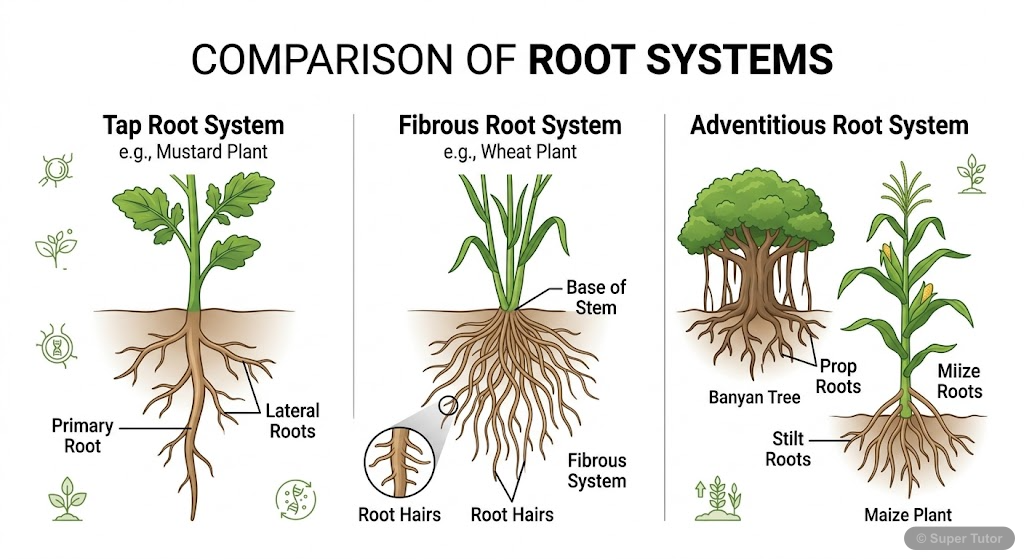
One of 5 illustrations for Root System in Super Tutor — alongside flashcards, concept maps and practice questions.
Key Topics to Revise
1
6.1 Characteristics of Roots
- Roots are non-green because they lack chlorophyll – they grow underground away from light.
- Roots do NOT have nodes and internodes (unlike stems).
- Roots do NOT bear leaves or buds.
2
6.2 Types of Root Systems
- There are TWO main types of root systems: (1) Tap Root System and (2) Fibrous Root System.
- TAP ROOT SYSTEM: Develops from the radicle. The primary (tap) root persists and gives off secondary and tertiary lateral roots. Found in DICOTS (e.g., gram, chinarose, neem, sunflower, mustard, carrot
- FIBROUS ROOT SYSTEM: Primary root is short-lived. A cluster of slender, fibre-like roots arises from the base of the stem. Found in MONOCOTS (e.g., maize, grasses, wheat).
3
6.3 Regions of Root (Root Apex)
- The apical (tip) region of any root shows FOUR distinct zones, from tip to base.
- ZONE 1 – ROOT CAP REGION: A thimble-shaped structure. Protects the delicate apical meristem (growing tip) from harsh soil particles. Constantly renewed as it wears out. In aquatic plants (Pistia, wate
- ZONE 2 – REGION OF MERISTEMATIC CELLS (APICAL MERISTEM): Actively dividing cells. Consists of three layers: (a) Dermatogen – outermost; matures into epiblema and root cap; (b) Periblem – middle layer;
4
6.4 Modifications of Roots
- Roots undergo modifications to perform special functions beyond simple anchorage and absorption.
- TAP ROOT MODIFICATIONS (for food storage – all become fleshy): (1) CONICAL – broad at base, tapers gradually to apex, e.g. Carrot; (2) FUSIFORM – swollen in middle, tapers at both ends, e.g. Radish; (
- ADVENTITIOUS ROOT MODIFICATIONS FOR FOOD STORAGE: (1) Tuberous – from nodes of prostrate stem, e.g. Sweet Potato; (2) Fasciculated – cluster from stem base, e.g. Dahlia; (3) Nodulose – only apices swo
Get complete notes with diagrams and examples
Full NotesKey Concepts
Roots possess unique identifying featuresRoot systems are categorized into twoRoots are classified as tap rootsThe apical region of every rootTap roots undergo modifications to store
Frequently Asked Questions
What are the important topics in Root System for NIOS Class 12 Biology?
Key topics in Root System include 1 Characteristics of Roots, 2 Types of Root Systems, 3 Regions of Root (Root Apex), 4 Modifications of Roots. Study these first, then practise questions on each for the NIOS Class 12 board exam.
How should I revise Root System for the NIOS Class 12 board exam?
Learn the core ideas first, then work through the 45 practice questions on Root System. Revise definitions regularly and use flashcards for quick recall before the exam.
Sources & Official References
Content is aligned to the official syllabus. Refer to the board website for the latest curriculum.
More resources for Root System
For serious students
Get the full Root System chapter — start free.
Quizzes, flashcards, an AI doubt solver and a study plan for NIOS Class 12 Biology. Free to start, no card needed.