Root System — Flashcards
NIOS · Class 12 · Biology
26 flashcards for Root System (NIOS Class 12 Biology) to test yourself on key terms and facts. Sample: "What is a root and what is the first organ"
Interactive on Super Tutor
Studying Root System? Get the full interactive chapter.
Quizzes, flashcards, AI doubt-solver and a step-by-step study plan — built for flashcards and more.
Free trial, no card needed.
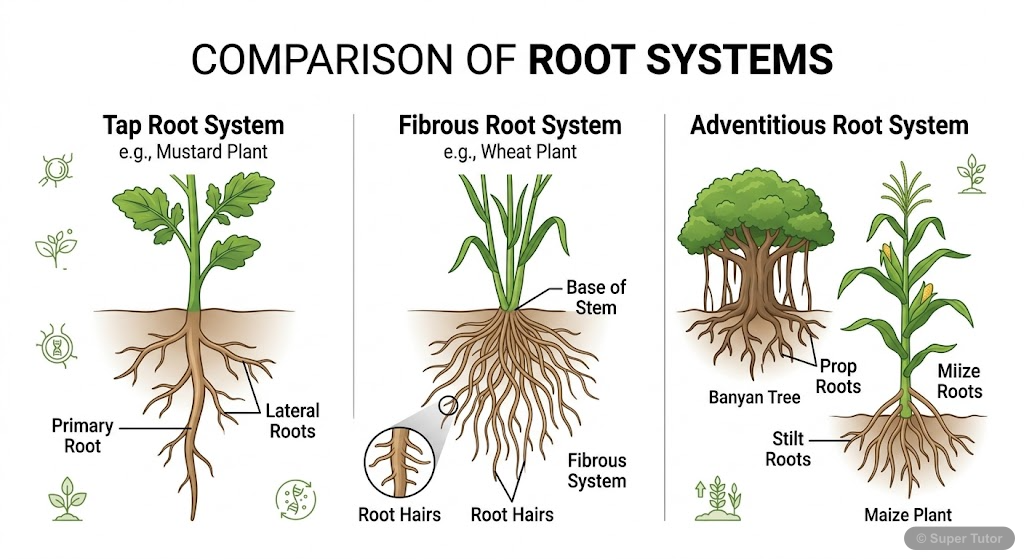
One of 5 illustrations for Root System in Super Tutor — alongside flashcards, concept maps and practice questions.
What is a root and what is the first organ to emerge when a seed germinates?
Answer
A root is the downward-growing portion of the plant axis that develops from the radicle. When a seed germinates, the radicle is the first organ to emerge. It elongates to form the primary or tap root,…
List and explain the five main characteristics by which roots can be recognized.
Answer
Roots have these distinguishing characteristics: (1) Non-green due to absence of chlorophyll - roots don't photosynthesize; (2) Not divided into nodes and internodes - unlike stems; (3) Absence of lea…
Compare tap root system and fibrous root system. Which type is found in dicots and monocots?
Answer
Tap Root System: Develops from the radicle and continues as the primary root (tap root) which gives off lateral roots. Provides very strong anchorage as roots reach deep into soil. Found in DICOTS (e.
What is the root cap and what is its function?
Answer
The root cap is a thimble-like structure produced by the meristematic zone at the tip of a root. Its functions are: (1) Protects the tender apical meristem from harsh soil particles and friction as th…
Describe the region of meristematic cells in the root apex and name the three layers that comprise it.
Answer
The region of meristematic cells (apical meristem) is a small zone of actively dividing cells located just below the root cap. It consists of three layers: (1) Dermatogen - outermost layer, whose cell…
What happens in the region of elongation and region of maturation of a root?
Answer
Region of Elongation: Located next to the meristematic region, cells here elongate and enlarge significantly, causing the root to increase in length. This is where the growth force that pushes the roo…
What is the Quiescent Centre and what is its significance?
Answer
The Quiescent Centre is a cup-like reservoir of inactive (quiescent) cells discovered by Clowes in 1958, located between the root cap and the active meristematic region in the maize root tip. Signific…
Are carrot, radish, and turnip actually roots? Justify your answer and explain why they are fleshy.
Answer
Yes, carrot, radish, and turnip are true roots - specifically modified tap roots. Justification: They have the characteristic features of roots: non-green, lack nodes and internodes, lack leaves and b…
+18 more flashcards
Practise AllFrequently Asked Questions
What are the important topics in Root System for NIOS Class 12 Biology?
How many flashcards are available for Root System?
How should I revise Root System for the NIOS Class 12 board exam?
Sources & Official References
Content is aligned to the official syllabus. Refer to the board website for the latest curriculum.
More resources for Root System
For serious students
Get the full Root System chapter — start free.
Quizzes, flashcards, an AI doubt solver and a study plan for NIOS Class 12 Biology. Free to start, no card needed.